
Five hundred shepherds, a thousand-year-old sheep breed, and a seasonal migration across three ecosystems that the Soviet Union couldn’t kill. Georgia’s Tusheti transhumance wasn’t designed for spectacle. It was designed for survival.
Somewhere on the road between Alvani and the Abano Pass towards Tusheti, a shepherd will pour you a glass of chacha, Georgia’s potent homemade grape spirit, and raise a toast to “the shepherds without payment.” He means the horses and the dogs.
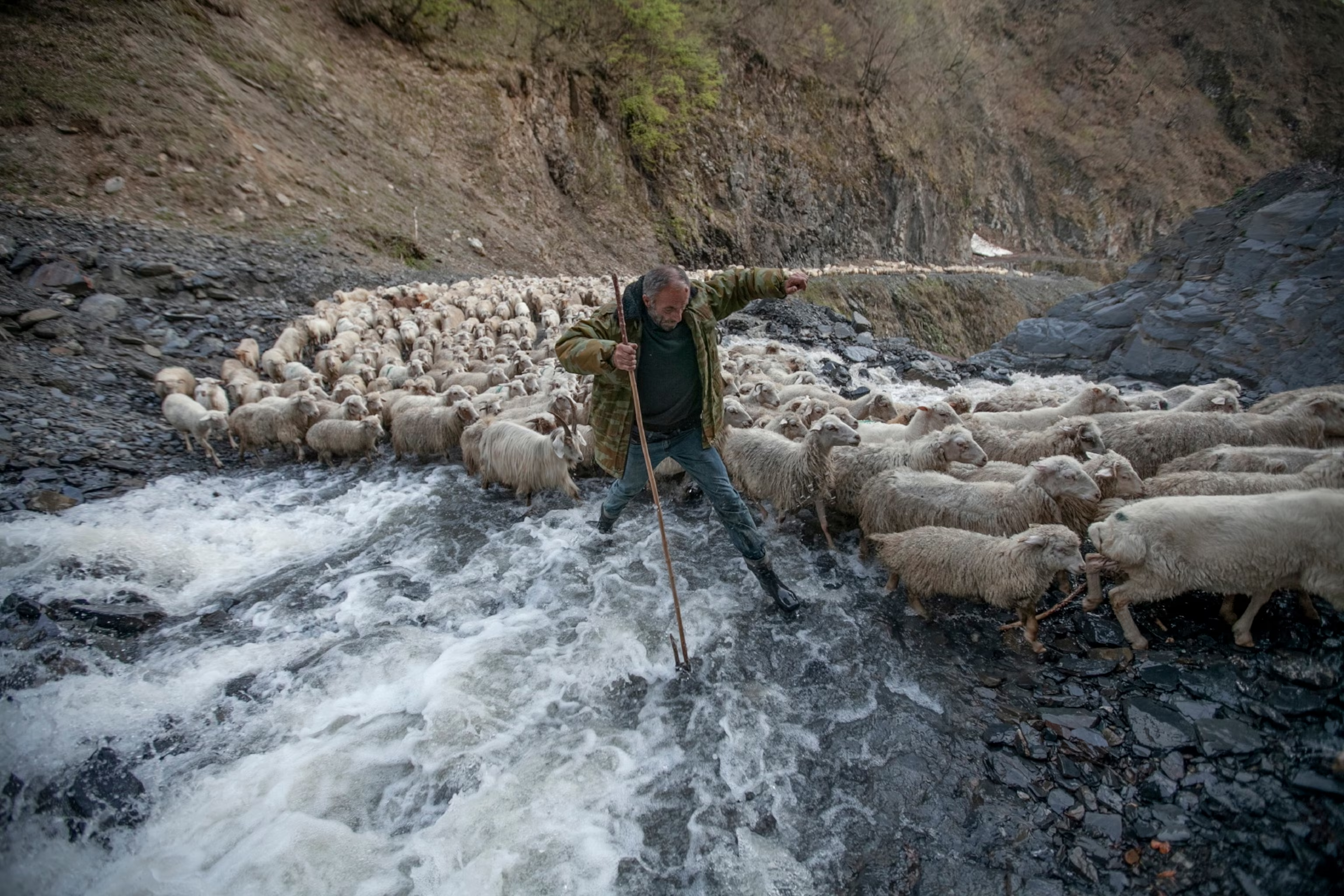
Twice a year, roughly 500 Tushetian shepherds walk their giant flocks of sheep about 300 kilometers, a practice called transhumance, between lowland winter pastures near Azerbaijan and the alpine highlands of Tusheti, a region in Georgia’s Greater Caucasus so remote that the only road in climbs over a 2,926-meter pass the BBC has called one of the deadliest on Earth. The Tushetians have been making this journey, in some form, since at least the 16th century.
A Civilization Built Around Sheep
Tusheti is a remote highland region in northeastern Georgia, tucked against the borders of Chechnya and Dagestan, accessible by a single road, the Abano Pass, that’s only open five months a year. The Tush people have been here a long time. Ptolemy mentioned them in the 2nd century AD. But the transhumance as a formalized system dates to the Kakhetian kings, who granted Tushetians lowland grazing rights in exchange for military service. The Tush were renowned mountain warriors, so fierce that Georgian kings hand-picked them as royal bodyguards. When Tushetian fighters helped overthrow a Persian garrison at the Battle of Bakhtrioni in 1659, they earned permanent access to winter pastures on the Shiraki Plain in lowland Kakheti near modern day Azerbaijan. Legend says they were granted as much land as one horse could gallop before collapsing.
By the 1860s, Tusheti was a thriving world: 50 villages, over 5,100 people, roughly 100,000 sheep. The Tush had their own architecture, defensive stone towers you can still see in Dartlo and many of the ancient villages, and a religious life genuinely unlike anything else in Europe. They’re Orthodox Christian, technically, but the older pagan system never went away. Villages maintain stone shrines decorated with sheep horns, dedicated to a mix of pagan heroes and Christian saints. Sacred beer brewed from mountain barley is part of every ceremony. And everything revolves around sheep, specifically the Tushuri breed, a tough mountain animal whose high-fat milk produces Tusheti’s famous guda cheese, aged in sheepskin sacks.

The transhumance was the engine that made all of this possible. Tusheti’s alpine pastures are rich in summer but buried under snow for half the year, and the lowland steppe is warm enough for winter grazing but scorched and overgrazed by summer. Neither works alone. The seasonal migration between the two is what kept the sheep fed, the cheese production running, and the economy alive. Without the walk, there is no Tusheti.
This long-standing tradition and economic lifeline for the Tusheti region was put under threat after the Red Army invaded Georgia in 1921. Georgia, and Tusheti with it, was absorbed into the Soviet Union, and over the following decades Moscow reshaped nearly every aspect of Tushetian life. Collectivization in the 1930s capped family herds at 10 sheep, gutting the flocks that made the migration worthwhile. Authorities destroyed towers, shut down schools, and banned grain cultivation. In the 1950s, Soviet planners classified Tusheti’s mountain villages as “without prospects,” a designation that meant the state considered them too remote and unproductive to maintain. Services were cut, residents were pressured or forced to relocate to lowland towns, and an entire way of life was systematically dismantled. By the 1989 census, the entire permanent population of Tusheti had fallen to 101 people. With almost no one left in the highlands, the transhumance had lost its destination.
When the Soviet Union collapsed in 1991, things did not immediately change for the better either. The army had been the primary sheep wool buyer, so that market vanished overnight. Newly created international borders cut off winter grazing in Azerbaijan and Dagestan. The Tushuri sheep population dropped from over 900,000 to less than half, and the number of shepherds making the migration shrank with it.

Today, fewer than 40 people live in Tusheti year-round. But the story isn’t only decline. Since 2003, when the Georgian government established Tusheti’s Protected Areas, the region has slowly started pulling itself back. Tourism has been the biggest driver: visitor numbers jumped from fewer than 1,000 in 2008 to over 16,000 by 2019, and the number of guesthouses in the region grew from one to roughly 70. Each summer, 2,000 to 2,500 Tushetians now return to the highlands, reopening family homes and running guesthouses, and the villages feel alive again for a few months. Critically, the transhumance itself has survived. Roughly 500 shepherds still make the journey each year, and international support has helped stabilize what remains. The tradition is diminished, but it is not gone.
Explore our Georgia Tours
Wild & Green Georgia
A 12-Day Journey through Wine Valleys, Ancient Fortresses, Caucasus Peaks, and Black Sea Coast
Tbilisi to the Black Sea by Rail
8 days by rail through Georgia's wine country, mountain villages, and Black Sea coast
Over the Pass
The transhumance happens twice a year. In spring, the shepherds drive their flocks north from the lowlands up into the Tusheti highlands, where the sheep spend the summer grazing on alpine meadows that produce the high-fat milk needed for guda cheese. In autumn, as temperatures drop and snow threatens, they reverse the journey and bring the flocks back down to the warmer lowland steppe for winter. The reason is simple: Tusheti’s highlands can’t sustain the sheep year-round, and neither can the lowlands. The migration is what makes both pastures work.
The full route covers roughly 300 kilometers each way, and the journey takes about two weeks. From the lowlands, the flocks walk north through grain fields and Kakhetian vineyards to the foothill town of Alvani, where they rest for vaccinations and sheep sales. Then comes the hard part: the climb over the 2,926-meter Abano Pass, 67 kilometers of unpaved road with no guardrails, waterfalls across the surface, and drops steep enough that 10 to 12 people die on it every year.
Each flock of 500 to 1,200 sheep travels with 8 to 10 Georgian Mountain Dogs. These are enormous animals (males can hit 90 kilograms) bred specifically to match the coloring of the sheep, so that wolves charging the flock can’t tell which white shape is a 40-kilogram ewe and which is a 90-kilogram dog that will break their jaw. The Tushetian horse, meanwhile, averages about 1.35 meters tall but carries 120 kilograms of cargo on terrain where larger breeds have literally died. Stories about English and Arabian horses perishing on the Abano Pass persist for a reason.
The Annual Cycle
Nov to Mar: Flocks graze on the Shiraki Plain and Vashlovani lowlands, semi-arid steppe near Azerbaijan.
Mar to May: Spring migration north to Alvani. Sheep rest for vaccinations before the mountain ascent.
May to Sep: Flocks graze in the Tusheti highlands at 2,000 to 3,300m. Cheese production happens here.
Oct to Nov: Autumn descent back over the Abano Pass and south to winter pastures.

Getting There
Tusheti is only accessible by road from late May to mid-October, when the Abano Pass is clear. From Tbilisi, you drive five to six hours to Pshaveli, then another three to four hours in a 4×4 over the pass to Omalo, the heart of Tusheti. The pass crossing alone is an experience. Accommodation is all guesthouses: basic facilities, home-cooked khinkali and guda, and legendary Tusheti hospitality. The protected area covers 113,660 hectares of East Caucasian tur, bezoar goat, brown bear, and wolf habitat.
The autumn descent in early October is the most accessible time to witness the transhumance, since the pass is reliably open and the weather is stable. The spring migration in late May is harder to catch because the pass often doesn’t open until early June, depending on snowfall, and the timing shifts year to year. The Tushetoba festival (horse races, cheese-making, khinkali competitions) runs in late July or early August and is worth the trip on its own.
EcoVoyager runs trips with vetted local operators who handle the 4×4 logistics, accommodation, guides, and translation. The remoteness is real, and having someone who knows the terrain and the people makes the difference between watching the transhumance and actually understanding what you’re seeing.
Planning Your Visit
When: Late May to mid-October. Autumn transhumance (early Oct) is most accessible. Tushetoba festival late July/early August.
Access: 5 to 6 hrs Tbilisi to Pshaveli, then 3 to 4 hrs over Abano Pass. 4×4 and experienced driver required.
Accommodation: Guesthouses only. Home-cooked meals, shared facilities, minimal cell signal.
Visas: 98 countries visa-free for one year.