
On the morning of July 11, 2025, in a stadium in Ulaanbaatar built to seat 11,000, a cavalry honor guard escorts nine white banners made from the tail hairs of a thousand stallions across a field of performers in silk robes. Throat singers sustain two notes at once. The president speaks. And then 512 men in open-chested vests and tiny leather boots walk onto the grass, spread their arms like eagles, and begin to wrestle.
This is Naadam. Mongolia’s most important cultural event, its national holiday, and the living thread connecting three million modern Mongolians to the mounted warriors who built the largest contiguous land empire in human history. The word means “three games of men”: wrestling, horse racing, and archery. It runs July 11–13 every year, and UNESCO inscribed it on the Representative List of the Intangible Cultural Heritage of Humanity in 2010, calling it “inseparably connected to the nomadic civilization of the Mongols.”

Eight Centuries of Warrior Games
The games are far older than the empire they helped build. Bronze plates from the Xiongnu period, dating back over 2,000 years, depict wrestling, and cave paintings in Bayankhongor Province show two figures grappling before a crowd similar to what could have been seen last summer. But the formalized festival as Mongolia knows it today traces to 1206, when Genghis Khan united the Mongol tribes at a great quriltai assembly and gathered athletes to compete in the skills that kept warriors sharp between military campaigns. The Secret History of the Mongols, the foundational chronicle of Mongolian civilization written around 1240, records specific wrestling matches and archery feats from this period, and Mongolia celebrated the 800th anniversary of the festival in 2006, tying its official origin directly to the founding of the empire.
For centuries after that, Naadam was inseparable from religious life. Under the Qing Dynasty it evolved into an annual festival tied to Buddhist ceremonies and administrative gatherings, where lords from across Mongolia traveled to present livestock and precious metals, and a thousand wrestlers competed for silk and horses. That world ended abruptly in 1921, when a Soviet-backed revolution overthrew the old order and Mongolia became the world’s second communist state. The new government had no use for Buddhist rituals, but it recognized the games’ hold on the population. Revolutionary leader Sükhbaatar ordered a Naadam on July 11, 1922, to celebrate the revolution’s first anniversary, and that date became permanent. The spiritual elements were stripped away. Military parades replaced Buddhist ceremonies. But the wrestling, the racing, and the archery survived intact.
When Mongolia’s own democratic revolution swept through in 1990, the cultural and spiritual traditions came flooding back almost overnight. Shamanic mountain worship returned. Buddhist ceremonies reappeared. The Procession of the Nine White Banners—Genghis Khan’s peacetime emblem, nine flag poles decorated with white horse-tail hairs from a thousand stallions—was revived after decades of suppression. The festival had survived empire, theocracy, communism, and revolution. It had changed shape every time. It had never stopped.

The Three Games
Mongolian wrestling, Bökh, is the emotional core of Naadam and unlike any combat sport in the West. There are no weight classes, no time limits, no ring, and no age restrictions. Two men meet on open ground, and the moment any body part other than feet or palms touches the ground, it’s over. Before and after every bout, wrestlers perform the Eagle Dance, a ritualized movement imitating the mythical Garuda bird taking flight. Titles are earned based on rounds won and held for life: Falcon after five wins, Elephant after seven, Lion for the ninth-round winner, and Avarga (Titan) for the champion.
Only 20 wrestlers have achieved Avarga rank in the modern era. The most successful, Badmaanyambuugiin Bat-Erdene, won 11 national championships and later served as Mongolia’s Minister of Defense. In Mongolia, a shepherd with no academy training can walk into the arena and, through technique alone, become a national hero whose title outlives him.

Horse racing at Naadam bears no resemblance to the Western version. These are cross-country endurance races of 10 to 27 kilometers across open steppe, designed to test the horse’s stamina rather than the rider’s skill. Jockeys are children aged five to thirteen, both boys and girls, chosen because their light weight ensures the competition measures the horse’s pure ability. Before each race they sing the traditional Giingoo song to bond with their horses, invoking Khayankhyarvaa, the god of horses. The winning horse is garlanded and sprinkled with fermented mare’s milk while crowds rush forward to touch the winner’s sweat, believed to bring luck. In a touching tradition, the last-place horse in the two-year-old race receives a special song wishing it victory the following year.
Explore our Mongolia Tours
Ultimate Mongolia: Naadam Festival & Gobi Desert Tour
A 12-day expedition through the Gobi Desert and Naadam Festival, from the Flaming Cliffs and ancient Karakorum to Hustai’s wild horses
Wild Mongolia: Among Eagle Hunters & Ancient Empires
A 14-day Mongolia tour from the Kazakh eagle hunters of Bayan-Ölgii to Naadam Festival, ancient Karakorum & Hustai’s wild horses

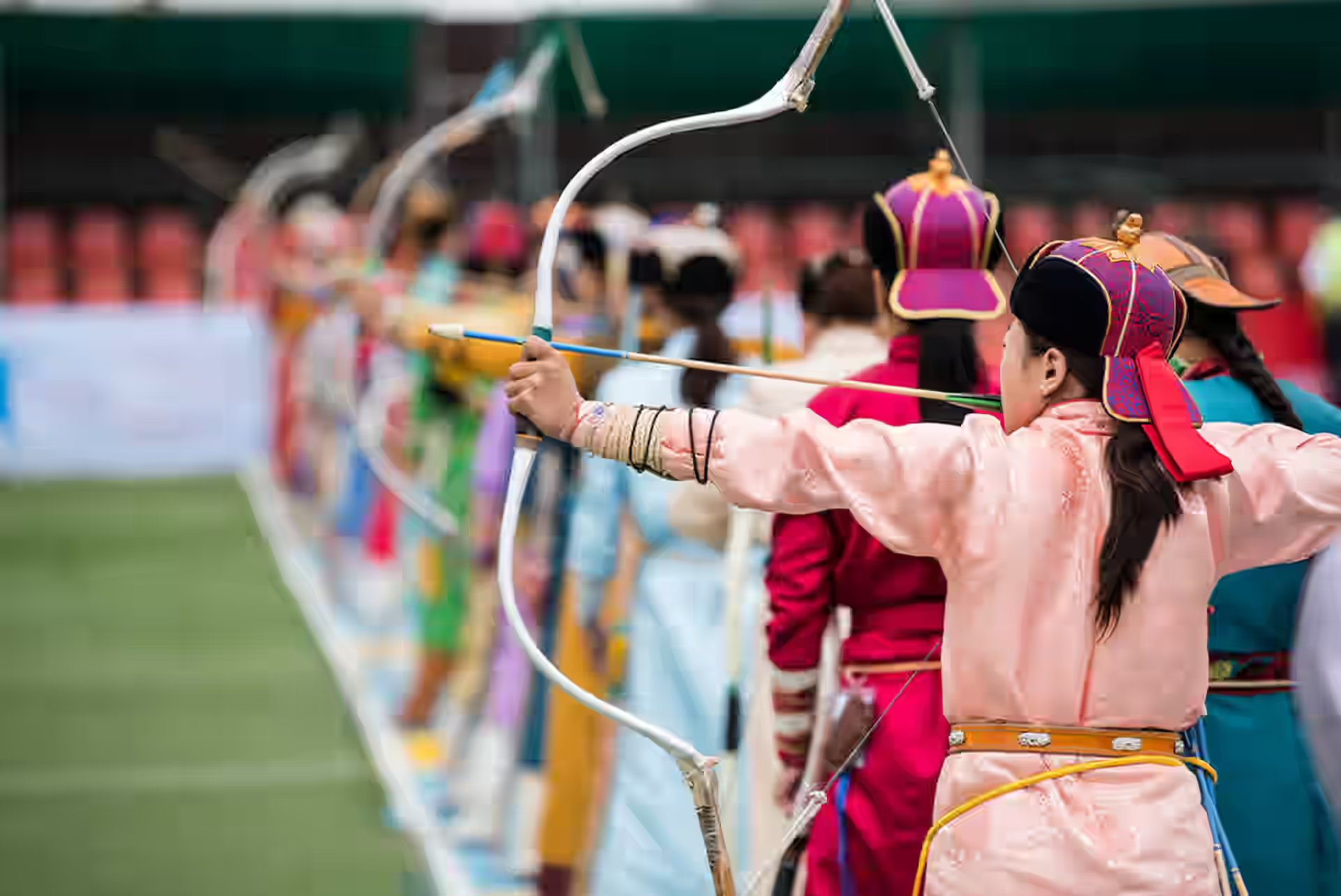
Archery showcases the bow-craft that built the empire. Three distinct ethnic styles compete—Khalkha, Buryat, and Uriankhai—each representing different regional traditions. Men fire 40 arrows at 75 meters, women 20 at 60, aiming at small leather cylinders called surs stacked in a low wall. The traditional Mongolian composite bow, built from birch, sinew, and water buffalo horn, took up to a year to construct and had draw weights averaging 166 pounds—more than double a medieval English longbow. When an archer hits the target, judges raise their hands and sing uukhai!, transforming the competition into a call-and-response performance that ripples across the field.
The Capital or the Countryside
For travelers, the most important question about Naadam isn’t whether to go. It’s where.
The National Naadam in Ulaanbaatar provides the spectacle: the opening ceremony with the Nine White Banners, cavalry parades, throat singing, and 512 wrestlers on the stadium floor. But tickets are extremely limited—roughly 2,500 are allocated to international tourists—events are split between the stadium and a horse racing ground 30 to 40 kilometers away, and the sheer scale of the crowds makes the experience impressive but exhausting.
The countryside alternative is where the real magic lives. Each of Mongolia’s 21 provinces and 333 soums holds its own Naadam in the days surrounding the national event, and these smaller festivals are a fundamentally different experience. Free entry, unrestricted photography, up-close access to athletes, all events in one location, and the ability to celebrate alongside competitors and their families in a communal atmosphere that is impossible to replicate in a stadium.

EcoVoyager’s curated Mongolia expeditions build Naadam into immersive itineraries with vetted local operators who handle the logistics, accommodation, and festival timing. The countryside Naadams remain uncommercial, intimate, and extraordinary. The window to experience them that way will not stay open forever.
Planning Your Visit
When: July 11–13 annually. Countryside Naadams run late June through mid-July. Book 9–12 months in advance.
Access: Fly into Chinggis Khaan International Airport (UBN). Direct routes from Seoul, Tokyo, Istanbul, Moscow, Beijing. 90-day visa-free for US, Canada, most EU.
UB Naadam: Opening ceremony at National Sports Stadium (11,000 seats). Horse racing 30–40 km west. Tickets limited; ~2,500 for international visitors.
Countryside: Free entry, all events in one place, unrestricted access. Top locations: Kharkhorin, Khatgal, Arkhangai Province. Requires 4×4 and local knowledge.