
On a September morning in 1992, a transport plane from the Netherlands touched down at Ulaanbaatar’s airport carrying sixteen stocky, dun-colored horses with stiff upright manes and dark zebra-striped legs. Hundreds of Mongolians had come to the tarmac to watch. Some wept. These were Takhi, “spirit horses” and Mongolia’s national symbol, known to Western science as Przewalski’s horse. They hadn’t stood on Mongolian soil in over two decades. The last confirmed wild sighting had been in 1969: a lone stallion, crossing the desert of western Mongolia. After that, nothing. A species that had survived the ice ages, outrun wolves across the Central Asian grasslands for tens of thousands of years had simply vanished from the wild.
What happened between that lone stallion and that airport tarmac is one of the most improbable conservation recoveries ever attempted. It spans four continents, two world wars, a genetic bottleneck so narrow it should have guaranteed extinction, and a stubborn network of zookeepers, geneticists, and Mongolian herders who refused to let the last truly wild horse disappear.

An Animal That Was Never Tamed
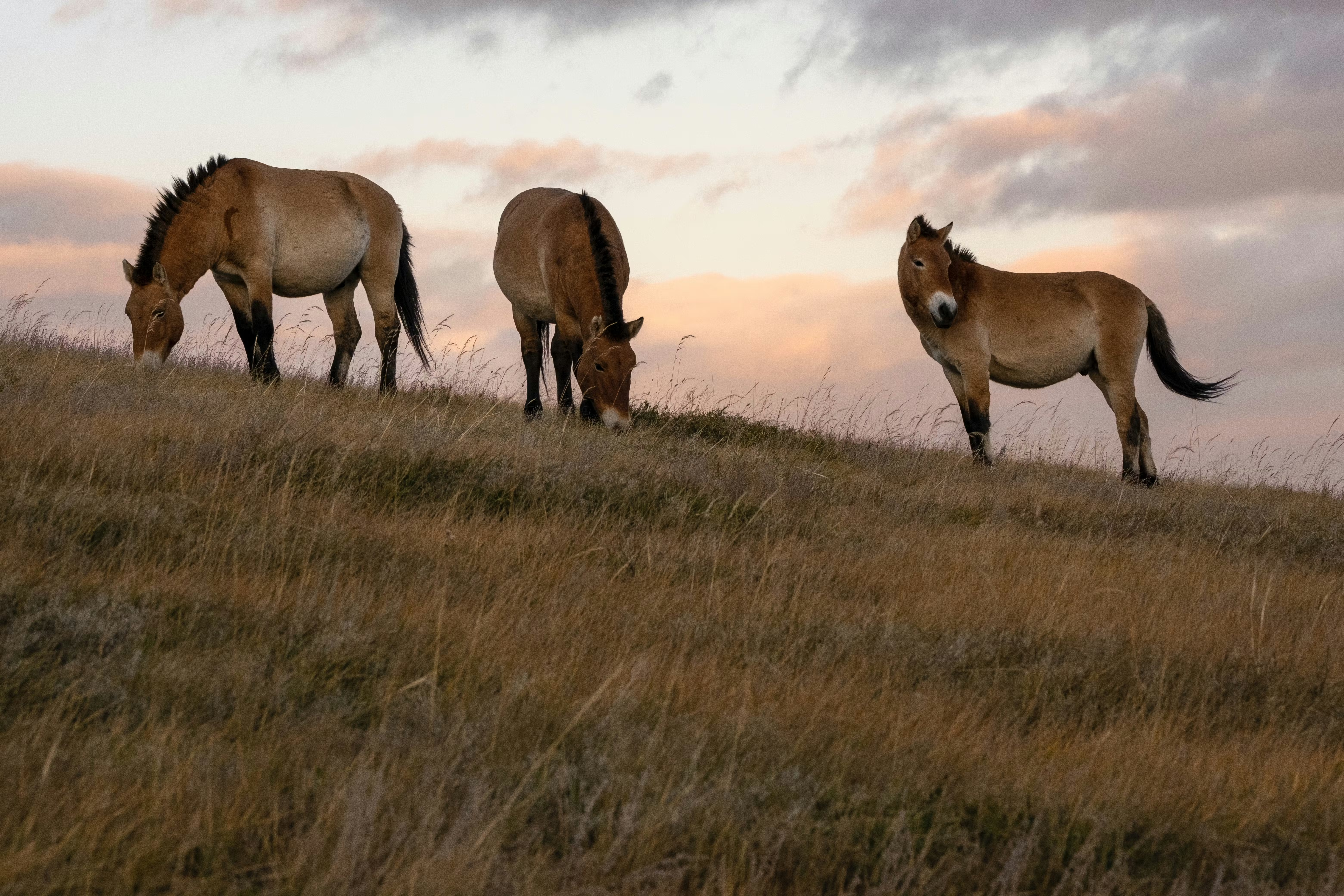
The Przewalski’s horse is not a feral domestic horse gone wild. It is a separate evolutionary lineage that diverged from the ancestor of modern horses between 38,000 and 160,000 years ago and was never domesticated. It stands about 1.2 to 1.4 meters at the shoulder, noticeably smaller than a riding horse, and looks like the animal the grassland itself designed: dun coat that vanishes against dry grass, dark dorsal stripe, and a stiff mane that stands straight up and sheds every year rather than growing long. Nothing decorative. Everything built to survive.
Mongolians call it Takhi, meaning “spirit” or “worthy of worship,” and they never tried to break it. This is a culture that domesticated horses before almost anyone else on Earth, that put children on horseback before they could walk, and that built the largest contiguous land empire in history from the saddle. The Mongols looked at the Takhi and left it alone. In their folklore, these were the riding mounts of the gods, creatures whose refusal to submit to any rider made them sacred rather than useless. Nomads admired the Takhi for the same quality they valued in themselves: the ability to survive on open land without anyone’s help.
In 1226, during Genghis Khan’s final campaign against the Tangut empire, a herd of wild Takhi spooked Khan’s mount and threw him to the ground. His advisors read it as an omen and urged him to turn back. He pressed on anyway. He was dead within months. The incident was recorded in the Secret History of the Mongols, not as trivia, but as a warning. The spirit horse had spoken, and the most powerful man alive had failed to listen.

The Collapse
For most of its deep history, the Takhi ranged across open grassland from western Europe to China. As settled agriculture spread over the past several thousand years, that grassland started to disappear. Expanding farmland and growing herds of domestic livestock pushed the wild horses steadily eastward, off the best grazing land and away from reliable water. By the 18th century, the Takhi had been compressed into a final refuge: the Dzungarian Basin, a strip of semi-desert along the Mongolia-China border.
Even there, they couldn’t find peace. Takhi stallions are fiercely territorial. They attack domestic stallions on sight, steal mares from herders’ stock, and fight to the death over water and grazing. Nomads whose livelihoods depended on their domestic herds drove the wild horses out wherever they found them. Meanwhile, the Qing dynasty saw the Takhi as a different kind of target entirely. In 1750, Emperor Qianlong organized a massive imperial battue, a hunt using thousands of beaters to drive game into a killing zone, not to protect herders, but as a display of military power across his Central Asian territories. The sweep killed an estimated 200 to 300 wild horses in a single day, a devastating blow to a population that was already small and shrinking.

Explore our Mongolia Tours
Ultimate Mongolia: Naadam Festival & Gobi Desert Tour
A 12-day expedition through the Gobi Desert and Naadam Festival, from the Flaming Cliffs and ancient Karakorum to Hustai’s wild horses
Wild Mongolia: Among Eagle Hunters & Ancient Empires
A 14-day Mongolia tour from the Kazakh eagle hunters of Bayan-Ölgii to Naadam Festival, ancient Karakorum & Hustai’s wild horses
Then, at the turn of the 20th century, the people who wanted to save the Takhi arrived and made everything worse. Between 1897 and 1903, European expeditions entered the Dzungarian Gobi to capture foals for Western zoos. Captive breeding, they believed, could save what the wild clearly could not. Riders on relay horses chased herds across open desert until the foals collapsed from exhaustion. Stallions and mares that charged to protect their young were shot. Surviving foals were stuffed into burlap sacks and hauled by camel, rail, and ship to Europe. For every foal that reached a zoo alive, several more had died during capture or on the journey. Roughly 52 survived the trip. Within a few years, the majority were dead, killed by stress, disease, and enclosures nothing like the land they were built for.
Of those 52, only 12 ever produced offspring. Add one wild-caught mare taken in 1947, the last horse ever captured from the wild, and you have 13 founders. Thirteen animals carrying the entire genetic future of a species that had roamed the Earth for hundreds of thousands of years.
World War II nearly erased even that. German soldiers slaughtered the breeding herd at Ukraine’s Askania-Nova reserve, the most genetically valuable collection in captivity. The American population died out completely. By 1945, roughly 31 Przewalski’s horses remained alive on Earth, nearly all at Prague Zoo and Munich’s Hellabrunn Zoo.
Prague became the last line of defense. Its breeding program has never been interrupted: nine decades, over 250 foals. In 1959, Czech zoologist Erna Mohr launched a registry tracking every living individual. Jiří Volf maintained it for three decades, quietly building the genealogical blueprint that would make reintroduction possible. For years, his record-keeping was the only thing standing between the Takhi and a slow fade into irrelevance, just another zoo curiosity that people stopped bothering to breed.

Reintroduction to the Wild
Keeping the species alive in zoos was never the point. Returning it to the wild was.
In 1977, Germany and the Netherlands began building semi-wild reserves, transitional landscapes where zoo-born horses could relearn the instincts they would need in the wild: forming herds, finding water, moving without fences.
The first reintroductions targeted Mongolia. In 1992, the same year those sixteen horses landed in Ulaanbaatar, two programs launched simultaneously. Hustai Nuruu, a 50,000-hectare reserve southwest of the capital, is now a UNESCO Biosphere Reserve sheltering 380 to 450 free-ranging Takhi, the largest single population on Earth. The second site, Takhin Tal, built its herd in the far harsher conditions of the Great Gobi. A third site, Khomiin Tal in the western grasslands, was established in 2004 and crossed 100 horses by 2020. And then something remarkable happened that no one had planned for. The return of the Takhi doubled populations of saiga antelope, Mongolian gazelle, and Siberian ibex in the surrounding area. Wild sea buckthorn forests expanded tenfold. The horse wasn’t just being saved. It was an ecosystem engineer, reshaping the land in ways that benefited everything else living on it.
The momentum spread. China launched its own program in 1985 and now holds over 900 horses. Hungary, Russia, and even the Chernobyl Exclusion Zone maintain growing herds. In June 2024, a Czech Air Force transport delivered seven Takhi to Kazakhstan, the first Przewalski’s horses in that country in roughly 200 years.
The Bottom Line
Today, somewhere between 2,000 and 2,700 Przewalski’s horses exist globally, split between free-ranging herds and managed populations. The IUCN status has been upgraded twice, from Extinct in the Wild to Critically Endangered in 2008, then to Endangered in 2011. Every single one of them traces back to those 13 founders.
The challenges haven’t gone away. Genetic diversity remains dangerously thin. Dzud events are growing more frequent with climate change. Disease, livestock competition, and habitat pressure are constant. No single site yet holds the 1,000 breeding individuals conservationists consider a minimum viable wild population.
But the Takhi is running on the Mongolian steppe again. It is grazing in the Gobi, breeding in Kazakhstan, and reshaping entire ecosystems in western Mongolia. Thirty-one horses in 1945. Over 2,000 now. The spirit horse earned its name.