
Five of the world’s fourteen highest peaks, the ancient Silk Road, and hospitality so persistent you’ll lose count of the number of chai invitations you’ll get. Pakistan’s northern mountains and valleys have drawn adventurers for decades, but the question everyone asks first isn’t about Hunza’s apricot orchards or K2’s shadow. It’s about safety.
The short answer is that Pakistan’s tourist corridor is significantly safer than mass media and government advisories suggest. International tourism has grown substantially since the pandemic, with 2023 marking a record year approaching one million visitors. The country that once dominated terrorism headlines in the 2000s has transformed its northern heartland into one of Asia’s most welcoming destinations. But the nuance matters enormously. Pakistan is a nation of sharp regional contrasts, and the difference between where tourists go and where security incidents occur is the key to understanding the real picture.

Understanding Travel Advisories
Here’s a number that might surprise you: Pakistan sits at the same US State Department advisory level (Level 3, “Reconsider Travel”) as Colombia, which welcomed over 4 million tourists in 2023. Guatemala, Uganda, and the Philippines share this rating too. Serbia and Bosnia, countries that emerged from devastating 1990s conflicts to become thriving tourist destinations, once carried similar warnings before security stabilized—exactly the trajectory Pakistan is on today.
The pattern reveals something important: government advisories assess worst-case scenarios and liability, not typical tourist experience. They’re calibrated for citizens who might venture anywhere in a country, not travelers sticking to established tourist circuits. A Level 3 advisory for Colombia doesn’t stop backpackers from exploring Cartagena and Medellín. The same logic applies to Pakistan’s spectacular northern corridor, home to the Karakoram Highway (the world’s highest paved international road) and valleys where 7,000-meter peaks frame ancient apricot orchards and turquoise glacial rivers.
Advisory Levels in Perspective
Pakistan shares the same US Level 3 advisory as Colombia, which welcomed 4+ million tourists in 2023.
Guatemala, Uganda, and the Philippines all carry identical ratings while maintaining thriving tourism industries.
Serbia and Bosnia once had similar warnings before becoming popular European destinations—Pakistan is on the same trajectory.

The Tourist Corridor
What makes Pakistan’s tourist heartland distinct isn’t just spectacular scenery. It’s a fundamentally different security and cultural environment from the regions that generate media headlines.
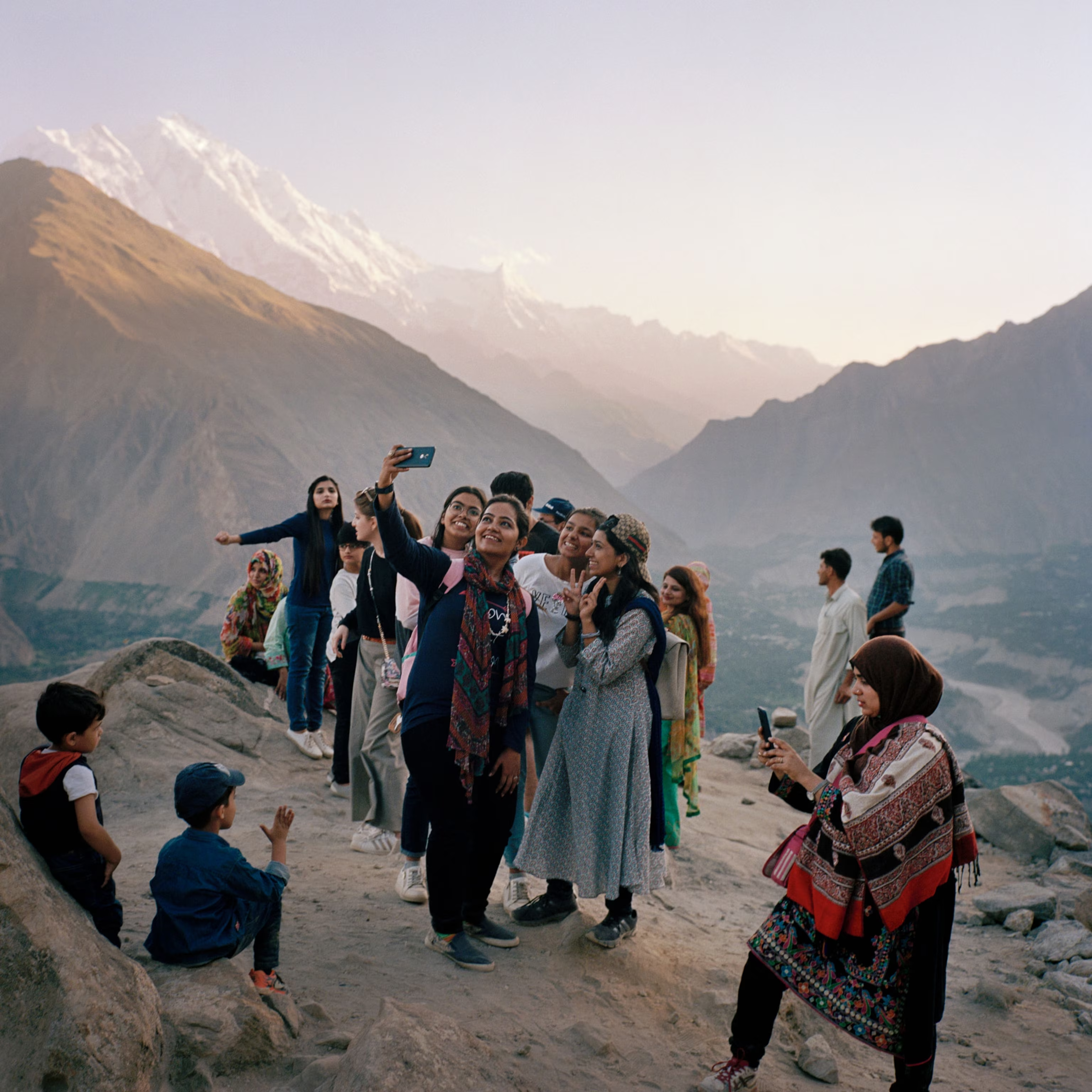
The Hunza Valley represents the clearest example. The Ismaili Muslim majority population maintains the country’s highest literacy rates and a culture renowned for tolerance and education. Women run businesses openly, foreign visitors have been welcomed continuously since the 1970s Hippie Trail era, and no terrorist attacks have affected tourists here. The valley has earned its reputation as the safest entry point for first-time visitors to Pakistan, though the welcoming culture extends well beyond Hunza’s borders.
This safety isn’t accidental. Gilgit-Baltistan (the semi-autonomous region comprising Hunza, Skardu, Gilgit city, Fairy Meadows, and the Karakoram Highway corridor) operates under different administrative and social dynamics than mainland Pakistan. The region’s isolation bred self-reliance, and its sectarian makeup (predominantly Shia and Ismaili) creates distinct cultural norms around hospitality and community safety.
Islamabad, Pakistan’s purpose-built capital, consistently ranks as the country’s safest major city. Its wide tree-lined avenues, the striking Faisal Mosque nestled against the Margalla Hills, and the Lok Virsa Heritage Museum offer a gentle introduction to the country. The hills themselves provide hiking trails minutes from the city center. Lahore, the cultural capital, has developed dedicated tourist police units and maintains low crime rates in visitor-frequented areas like the Walled City, the Badshahi Mosque, and the legendary food streets around Gawalmandi.

Regional Safety at a Glance
Gilgit-Baltistan (Hunza, Skardu, Gilgit, Fairy Meadows): Safest region, well-established tourism, no restrictions
Islamabad and Lahore: Low crime, tourist police present, avoid political demonstrations
Swat Valley: Reopened but UK advises against; other nationalities visit regularly
Balochistan & KPK border areas: Restricted for foreign tourists; avoid entirely
Swat Valley presents the most complex case. Once Taliban-controlled from 2007 to 2009, it reopened after military operations and now features the Malam Jabba ski resort and stunning mountain scenery. Japanese, Chinese, and Northern European tourists visit regularly. However, a September 2024 roadside bomb hit a diplomatic convoy in the area, and the UK Foreign Office still advises against all travel to the district. Other governments are less restrictive, but Swat requires more careful consideration than Hunza or Skardu.
Safety in Perspective
Here’s what the statistics don’t capture: how it actually feels to travel in Pakistan. Western travelers consistently report a jarring disconnect between their expectations and their experience.

Samantha Shea, an American travel writer who moved to Hunza Valley in 2021 and now calls it home, put it bluntly in Business Insider: she notes that while Miami had the proximity to crime common in urban areas, Hunza offered daily peace and a community-oriented environment she’d never experienced in big-city America.
The crime context supports this. Pakistan’s homicide rate is approximately 3.9 per 100,000, lower than the United States (6.3 per 100,000) and far lower than many popular tourist destinations in Latin America. Violent crime against foreign tourists in the tourist areas is extraordinarily rare. The dangers tourists actually face are mostly infrastructure-related (think washed-out roads and traffic accidents), not criminal.
Of course, Pakistan’s past casts a long shadow. The terrorism headlines of the 2000s shaped a generation’s perception of the country, and those images don’t fade easily. But the security transformation since 2014 represents one of the most significant and underreported stories of the past decade. From a peak of nearly 4,000 terrorism incidents in 2009, the country achieved an 89 percent decline by 2017.
Geographic concentration matters enormously: over 95 percent of incidents in 2024 occurred in Khyber Pakhtunkhwa and Balochistan, regions already restricted for foreign tourists. Violence targeting foreigners has almost exclusively affected Chinese infrastructure workers on major development projects, not tourists.

For Female Travelers
The question of whether Pakistan is “safe for women” deserves a nuanced answer, and the women who’ve spent extended time there offer the most honest perspective. Samantha Shea didn’t just visit Pakistan—she married a Pakistani national and settled permanently in Hunza. Her assessment for women considering the trip: “Hunza is a very, very safe environment… The people in Hunza are truly just no other people I’ve come across.”
That said, regional differences are dramatic and matter more for women than for men. In non-tourist areas, staring is constant and unavoidable, ranging from curious to uncomfortable depending on where you are. Minor harassment occurs: catcalling, requests for WhatsApp contacts, occasional unwanted contact in crowded spaces. Multiple bloggers note these incidents happened less frequently than in parts of India, but the attention can feel relentless for Western women unaccustomed to it.
Recommendations for Female Travelers
Wear shalwar kameez (available in bazaars for Rs. 800-1,500) as it dramatically reduces unwanted attention.
Address men as “bhai” (brother) to establish familial framing in interactions.
Choose accommodations carefully—hotels and family guesthouses where single women are more common.
Hunza Valley is consistently cited as the best destination for solo women; Peshawar and interior Sindh represent the opposite extreme.
The Real Risks: Roads and Altitude
For most tourists, infrastructure poses greater danger than security threats—but these risks are entirely manageable with proper planning and expertise from EcoVoyager.
Road Safety
The Karakoram Highway ranks among the world’s most dramatic roads, and also among the most challenging. The southern section between Mansehra and Chilas passes through areas where landslides present hazards during monsoon season, and guardrails don’t exist on many mountain sections.
The solution: fly in. Domestic flights to Gilgit and Skardu bypass the problematic southern highway entirely. Once in Gilgit-Baltistan, it is important to travel with experienced local drivers who know the roads intimately and drive in a way that tourists find comfortable. EcoVoyager works exclusively with vetted local guides and drivers who understand seasonal conditions, know when to wait out weather, and have contingency plans for delays. This transforms a potentially stressful journey into a scenic adventure with backup plans built in.

Altitude Sickness
Altitude sickness affects travelers above 2,400 meters, putting Hunza (2,500m), Skardu (2,500m), and certainly Khunjerab Pass (4,693m) in the risk zone. High Altitude Pulmonary Edema typically manifests on the second night above 2,500 meters.
Prevention is straightforward: Acetazolamide (Diamox) prevents altitude sickness with 75 percent effectiveness when started the day before ascent. Proper acclimatization (spending 2-3 days at moderate altitude before ascending higher) makes a significant difference. Stay hydrated, avoid alcohol for the first few days, and ascend gradually.
Managing Altitude Risk
Hunza (2,500m) and Skardu (2,500m) sit in the altitude risk zone; Khunjerab Pass reaches 4,693m.
Acetazolamide (Diamox) prevents altitude sickness with 75% effectiveness when started the day before ascent.
Acclimatization is key: spend 2-3 days at moderate altitude before ascending higher.
Travel insurance with evacuation coverage is essential—helicopter evacuation is expensive.
EcoVoyager builds acclimatization time into itineraries rather than rushing between high-altitude destinations. Our Pakistan itineraries are designed with altitude progression in mind, include emergency protocols, and work with local partners who can coordinate medical response if needed. The medical infrastructure in Gilgit-Baltistan has improved significantly in recent years, though helicopter evacuation remains expensive, which is why travel insurance with evacuation coverage is essential.

The Bottom Line
The gap between Pakistan’s reputation and its reality is vast. Perception from a troubled past, media coverage, and existing government advisories paint the entire country with the same brush, but the tourist corridor operates in a fundamentally different security environment than other areas. Hunza has been welcoming foreign visitors safely for fifty years. The hospitality is genuine and overwhelming in ways that warnings cannot capture.
For adventure travelers who do their homework, Pakistan offers something increasingly rare: landscapes that rival anywhere on Earth, a culture that hasn’t been commodified by mass tourism, and people who treat visitors not as walking wallets but as honored guests. The question isn’t whether Pakistan is safe. It’s whether you’re willing to look past the headlines and discover what’s actually there.