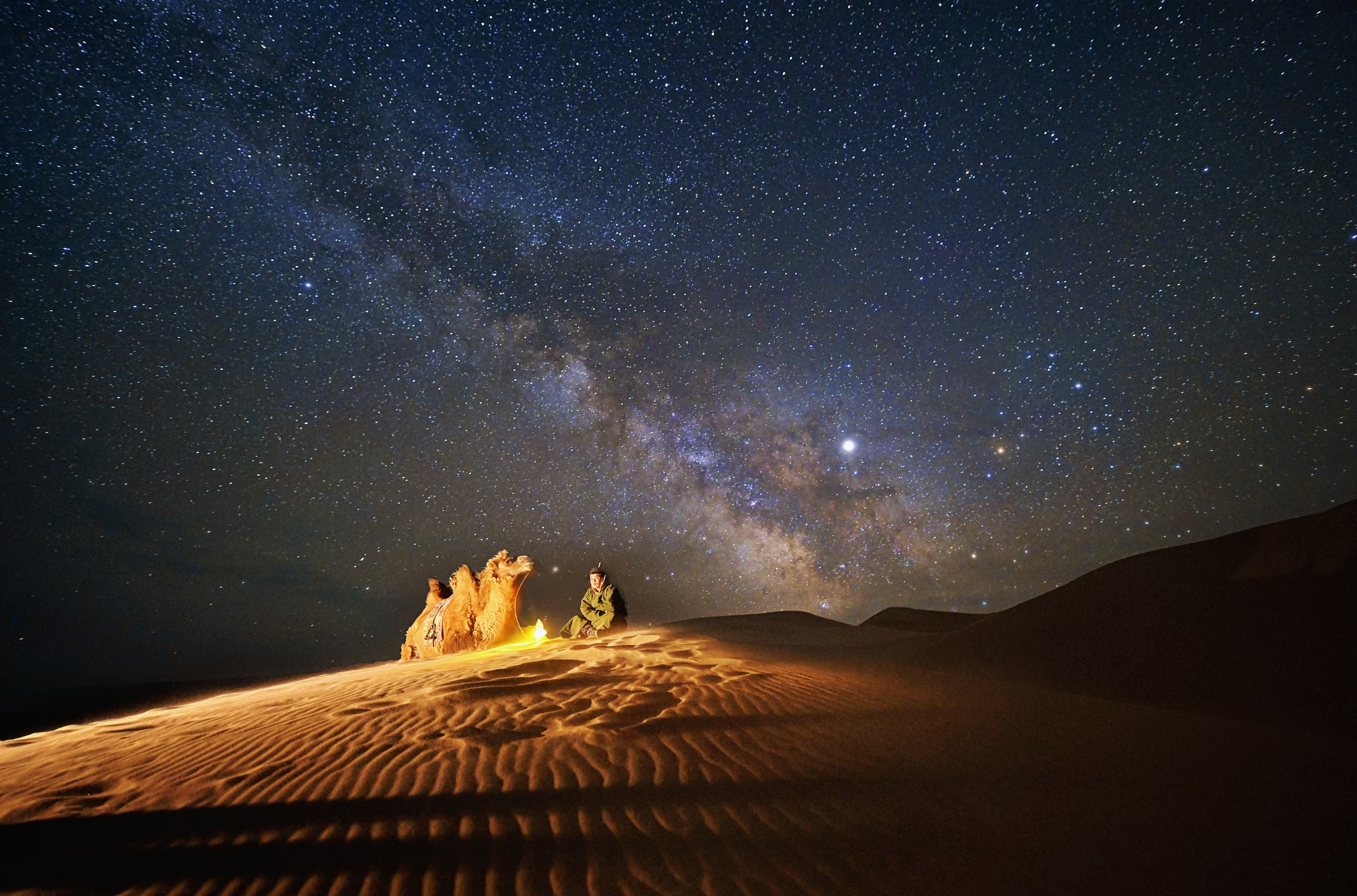
Forget the Sahara-style sand sea. Mongolia’s Gobi is a 1.3-million-square-kilometer expanse of gravel plains, painted canyons, ice-filled gorges, and yes, some truly enormous dunes. They make up less than five percent of the landscape. The rest is a shape-shifting wilderness where snow can fall on the same ground that baked at 40°C the week before, where nomadic families still move their herds of goats, sheep, horses, and camels between seasonal pastures, and where you can drive for hours without seeing another human being. This is one of the last places on Earth where you can still feel genuinely, thrillingly alone.

About the Gobi
The name “Gobi” translates roughly to “waterless place” in Mongolian, and the description holds up. Water sources outside of a handful of modern establishments are essentially nonexistent, and conservation is a way of life here, not a marketing slogan. But “waterless” does not mean lifeless. The Gobi supports an astonishing range of ecosystems: alpine meadows in the Altai foothills, red sandstone badlands, frozen canyon floors, and an oasis village or two tucked into river valleys that seem to appear out of nowhere.
The Mongolian Gobi sits at an average elevation of around 1,500 meters. Its continental climate is one of the most extreme on the planet, swinging from minus 40°C in January to above 40°C in July. The area falls primarily within Gurvan Saikhan National Park, named for the “Three Beauties” mountain range, which at 27,000 square kilometers is one of the largest protected areas in Central Asia. According to local legend, three sisters once refused a wealthy merchant who sought to marry all of them, and transformed themselves into the mountain ridges to immortalize their defiance.
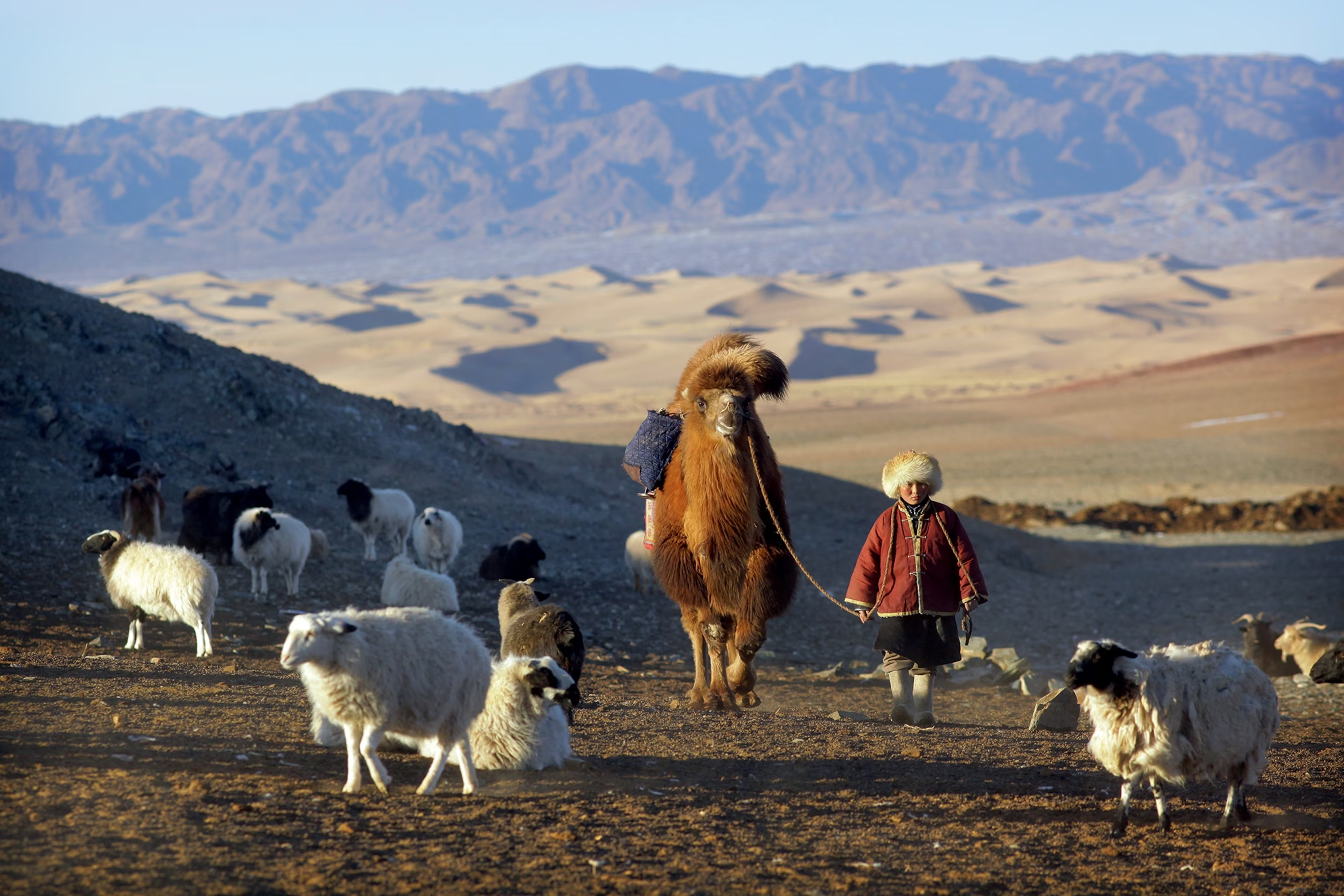
Half of Mongolia’s roughly three million people still live a nomadic or semi-nomadic lifestyle, and in the Gobi, that tradition remains especially strong. Families move between seasonal pastures with their herds of goats, sheep, horses, and camels, living in gers, the circular felt tents that have been their mobile homes for centuries. The multilayered felt-and-cotton walls resist scorching summer heat and brutal winter cold alike. For visitors, staying with a nomadic family or at a ger camp is not a curated “cultural experience.” It’s simply how people live here.
The Scale of Things
Mongolia has more horses than people. You can drive for hours on unpaved tracks without seeing a road sign, a building, or a cell tower.
At night, the sky is so thick with stars that navigation by constellation feels not just possible but necessary. One traveler described it as seeing the curvature of the Earth from ground level.
This is a place that recalibrates your sense of scale.
The Flaming Cliffs (Bayanzag)
Beginning in 1922, American explorer Roy Chapman Andrews, widely considered the real-life inspiration for Indiana Jones, led a series of expeditions into the Gobi and in July 1923 made one of the most significant paleontological discoveries in history: the first fossilized dinosaur eggs ever found. He also unearthed the first Velociraptor specimen. The site, formally called Bayanzag but universally known as the Flaming Cliffs for the way the ochre-red sandstone ignites at sunset, remains one of the most important fossil grounds on Earth, having yielded more than 80 species of dinosaur to date.
You don’t need to be a paleontologist to appreciate this place. The eroded landscape is otherworldly. Japanese scientists have confirmed that the soil composition here matches that of Mars. That Martian resemblance has inspired the MARS-V Project, a Mongolian-led initiative building a full Mars analog station in the Gobi that expects to welcome its first paying tourists by 2029 for month-long survival simulations at around $6,000 per person. You can walk the ridgeline at dusk and watch the cliffs glow orange, red, and deep amber as the sun drops. Fossils still emerge naturally from the rock as wind and rain do their work. On organized expeditions, visitors occasionally find genuine fragments just lying on the surface. The Gobi is one of the few places on Earth where you can stumble over a 70-million-year-old bone on a casual afternoon walk.

Khongoriin Els (The Singing Dunes)
Stretching roughly 100 kilometers along the northern edge of the Gurvan Saikhan range, Khongoriin Els is the largest sand dune formation in the Gobi. Individual dunes reach 200 to 300 meters high, and when the wind catches the sand at the right angle, they produce a deep, resonant hum, the “singing” that gives them their name. The dunes are the anchor of a full day (or more) of activity: climb them at dawn or dusk for staggering panoramic views, take a sunset camel trek along the base with a local herding family, or simply camp at the edge of the sand sea and watch the light show as the dunes shift from gold to rose to violet. Some ger camps arrange sandboarding on the lower slopes, and the green river valleys running along the northern edge of the dune field offer easy walks through terrain that feels nothing like the desert it borders.
Climbing the Dunes
The ascent is deceptively tough. You’ll be on all fours at points, sliding back in the soft sand, baking under an unobstructed sun. A determined hiker can reach the top in one to two hours.
The reward is a panoramic view of dunes rolling to the horizon on one side and green river valleys on the other, a juxtaposition that doesn’t seem possible until you see it.
Sunset camel rides through the dune fields are offered by local families and ger camps.
The Bactrian camels you’ll ride here are themselves remarkable. Two-humped and shaggy, they’re far larger in person than you’d expect. Mongolia’s domesticated Bactrian camel population plummeted to around 200,000 in the 1990s after the democratic revolution upended the state-managed livestock system. Today, thanks in large part to tourism and festivals that created new demand for camel products and experiences, the population has rebounded to roughly 480,000.

Yolyn Am (Eagle Valley)
This one defies every expectation you have about deserts. Yolyn Am is a narrow gorge cut into the Gurvan Saikhan mountains where, due to the depth and orientation of the canyon walls, ice persists year-round in the shadowed recesses, even as the surrounding desert bakes above 30°C. The walk in is about three kilometers, following a stream that appears seemingly from nowhere after days of dry landscape. The canyon walls close in progressively until you’re threading between rock faces just meters apart, with Buddhist prayer flags strung overhead and yaks grazing at the entrance.
Named for the lammergeier (bearded vulture) that nests in the cliffs, Yolyn Am is also prime habitat for ibex and, in the higher reaches, the elusive snow leopard. You’re unlikely to see one (fewer than a thousand remain in the southern Gobi, and they are among the shyest predators on Earth), but knowing they’re watching from somewhere among the rock spires adds an electric charge to the walk.

Petroglyphs and Ancient Rock Art
At Havtsgait valley, roughly a thirty-minute drive from Three Camel Lodge, a steep hike leads to a series of rock drawings made by the Gobi’s earliest inhabitants between 15,000 and 40,000 years ago. The images depict long-horned ibex, horses, and hunting scenes. Researchers have also documented petroglyphs at Zagan Bogd dating back over 3,000 years, showing wild sheep, camels, and ibexes, many of the same species that still live here. Notably absent from the ancient art: the Gobi bear, apparently already too shy to be seen even millennia ago.
The Ten Thousand Camel Festival
Held annually in early February in the Gobi’s Umnugovi province, this festival was launched in 1997 by the Amazing Gobi Tourism Association specifically to help save the dwindling Bactrian camel population. Today it features camel polo, camel racing, ice archery, singing competitions, and beauty pageants for both elaborately groomed camels and their festively dressed herders. Locals arrive from across the country wearing their finest deels (traditional robes). It’s one of the most authentically Mongolian events you can attend, with almost no international tourists present.

Shambala and Khamariin Khiid
Near the Gobi gateway town of Sainshand, two Buddhist pilgrimage sites offer a contemplative counterpoint to the adventure-heavy itinerary. Built in the 1830s by the revered monk Danzan Ravjaa, the Khamariin Khiid monastery and the nearby Shambala site, sometimes called the “World Energy Center,” sit in open desert where the vast emptiness itself becomes the draw. Author Peter Matthiessen, who wrote the classic travelogue The Snow Leopard, speculated that the Gobi might be the mythical Shambala mentioned in Tibetan sacred texts, and he returned here at the end of his life. Both sites are reachable by car in about forty minutes from Sainshand.