

Mongolia
Amarbayasgalant Monastery
Amarbayasgalant Monastery
Location
Amarbayasgalant Monastery
49.4667° / 105.0333°


Experience Amarbayasgalant Monastery, Your Way
Skip the standard itineraries. We'll design a journey around your interests, timeline, and travel style — with exclusive access you won't find elsewhere.

Things to Do in Amarbayasgalant Monastery
Starting points for your perfect trip
Architectural Masterpiece Exploration
Explore 28 temples arranged in perfect symmetry along a north-south axis within red-brown walls enclosing a 207-by-175-meter complex. The Tsogchin Dugan—a 32-meter assembly hall—channels rainwater through four central pillars. Discover vibrant murals and gilded Buddhist statues throughout.
Zanabazar's Legacy
Learn about the 'Michelangelo of Asia'—the first Bogd Gegeen who created the Soyombo script now on Mongolia's flag and sculpted masterworks like the White Tara. The monastery was built as his final resting place; his mummified remains were transferred here in 1779.
Sacred Valley Discovery
Walk through ancient Turkic burial sites dating from the 3rd–7th centuries, marked by geometric stone arrangements across the valley floor. Hike to the hillside stupa with 'Buddha's Eyes' and the monument to Gelugpa masters for panoramic views across the Iven Valley.

Living Monastic Tradition
Attend morning prayers in the Tsogchin Dugan, where around 50 monks chant mantras beneath towering red pillars and colorful banners. Time your visit for the mid-August Gongoriin Bumba ceremony—one of Mongolia's most important Buddhist rituals with Tsam masked dances performed only here.
Stalinist Purge History Walk
Trace the monastery's survival through the 1937-38 Stalinist purges that destroyed nearly all of Mongolia's 750 monasteries. Learn how sympathetic commanders delayed destruction, worshippers hid Zanabazar's mummified body in surrounding mountains, and UNESCO restoration began in 1975.
Nomadic Valley Horseback Ride
Ride Mongolian horses through the Iven Valley grasslands surrounding the monastery, following pastures nomadic families have used for generations. Pass ancient Turkic burial stones, ford shallow streams, and view the monastery complex from the hillsides imperial surveyors chose in 1727.
Stories from Amarbayasgalant Monastery
Built by Emperors for a Saint
Amarbayasgalant Monastery—the “Monastery of Tranquil Felicity”—was commissioned in 1727 by the Qing Emperor Yongzheng to honor Zanabazar, Mongolia’s first Bogd Gegeen and the spiritual mentor of the emperor’s own father, Kangxi. Construction continued until 1736 under the Qianlong Emperor, creating one of the three largest Buddhist monastic centers in Mongolia. Legend holds that surveyors discovered two boys named Amur and Bayasgalant playing on the steppe where the monastery now stands—inspiring its name.
The monastery served as Zanabazar’s final resting place; his mummified remains were transferred here in 1779, drawing pilgrims from across the Tibetan-Mongolian Buddhist world. Unlike the eclectic temple collection at Erdene Zuu, Amarbayasgalant displays remarkable stylistic unity—its architecture resembling the Yonghegong Palace in Beijing, with Chinese aesthetics, Manchu imperial planning, and Mongolian craftsmanship woven together. The valley itself holds spiritual significance stretching back millennia; ancient Turkic-era graves dating from the 3rd to 7th centuries cover the surrounding grasslands, marked by geometric patterns of large boulders.
Getting to Amarbayasgalant Monastery
Private 4x4 Transfer
Bus to Darkhan + Local Taxi
Internal Valley Exploration
Travel with EcoVoyager
Amarbayasgalant lies 360 kilometers north of Ulaanbaatar—325 kilometers on paved roads through Darkhan plus 35 kilometers on dirt tracks through the Iven Valley, requiring 6–7 hours of driving through northern Mongolia's forest-steppe landscape. EcoVoyager arranges experienced 4x4 drivers who know the unmarked final approach, coordinates overnight stays in ger camps near the monastery, times visits for morning prayers in the Tsogchin Dugan, and provides knowledgeable guides who illuminate the monastery's Qing-era architecture, Zanabazar's artistic legacy, and the remarkable story of survival through the Stalinist purges that destroyed nearly all of Mongolia's 750 monasteries.

Explore More
Other Mongolia Destinations

Terkhiin Tsagaan Nuur
High in the Khangai Mountains, where ancient lava dammed the Terkh River eight thousand years ago, Terkhiin Tsagaan Nuur mirrors...
Explore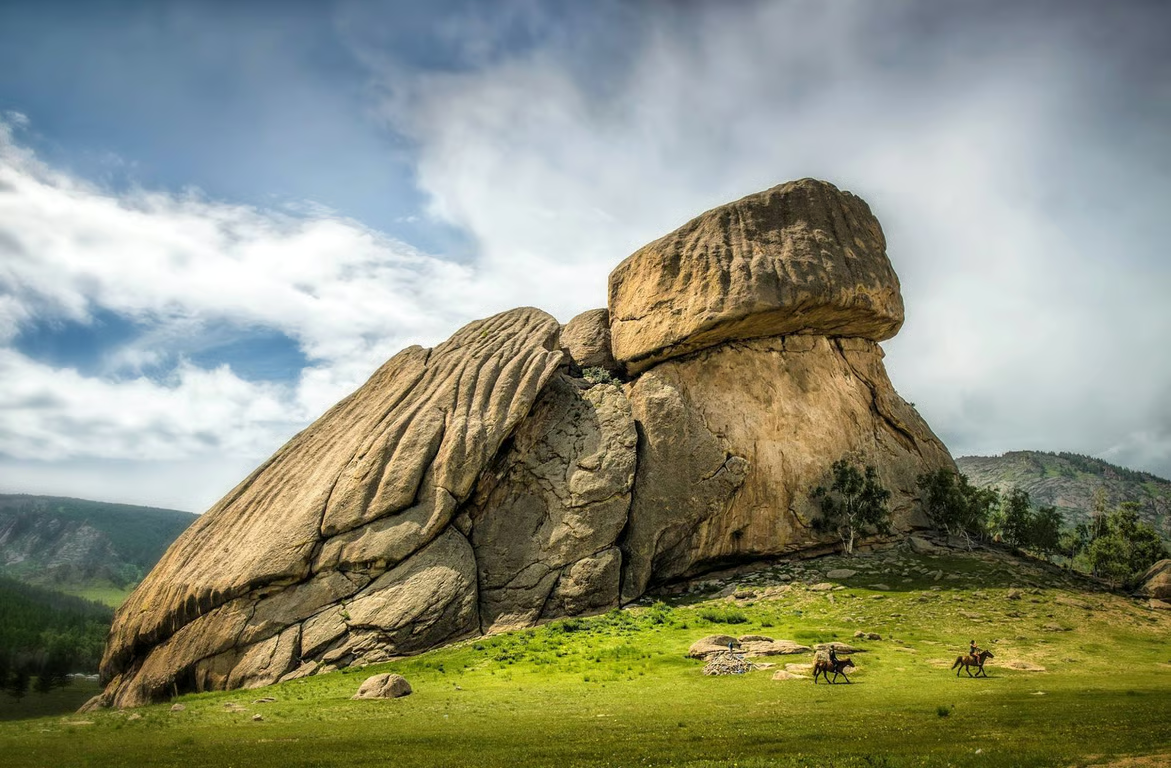
Gorkhi Terelj National Park
Just 60 kilometers from Ulaanbaatar, where granite towers rise from forested valleys and the Terelj River winds through alpine meadows,...
Explore
Orkhon Valley
In the green heart of Mongolia, where the Orkhon River carves through volcanic basalt and grasslands stretch to the horizon,...
Explore
Altai Tavan Bogd National Park
At Mongolia's far western edge, where three nations converge beneath the Altai Mountains, lies one of Earth's last wilderness frontiers....
Explore
Ölgii
In Mongolia's far west, where the Altai Mountains rise along the borders of Russia and China, Kazakh eagle hunters still...
Explore
Khuvsgul Lake
Cradled between snow-capped peaks and Siberian taiga lies Khuvsgul—Mongolia's largest freshwater lake and one of the world's oldest and clearest....
Explore
Hustai National Park
Two hours from Ulaanbaatar lies Hustai National Park, sanctuary of the takhi—the world's last truly wild horse. These stocky horses...
Explore
Gobi Desert
Stretching across southern Mongolia lies the Gobi—Asia's largest desert and one of the world's most misunderstood landscapes. This is no...
Explore
Ulaanbaatar Mongolia
In the broad valley of the Tuul River, surrounded by four sacred mountains, lies the world's coldest capital city—a place...
ExploreSwipe to explore more