

Mongolia
Orkhon Valley
Orkhon Valley
Location
Orkhon Valley
47.1925° / 102.8135°


Orkhon Valley Tours
Wild Mongolia: Among Eagle Hunters & Ancient Empires
Ultimate Mongolia: Naadam Festival & Gobi Desert Tour
Experience Orkhon Valley, Your Way
Skip the standard itineraries. We'll design a journey around your interests, timeline, and travel style — with exclusive access you won't find elsewhere.


Things to Do in Orkhon Valley
Starting points for your perfect trip
Ancient Capitals Discovery
Walk through ruins where Genghis Khan founded Karakorum in 1220, when the Mongol Empire stretched from Korea to Hungary. Visit the museum's 3,000+ artifacts including the famous stone turtles, then explore Khar Balgas—the 8th-century Uyghur capital with its haunting walls 30km north.
Erdene Zuu Monastery Exploration
Enter Mongolia's oldest surviving Buddhist monastery, founded in 1586 using stones from ancient Karakorum. Walk the perimeter of 108 white stupas, explore temples housing centuries-old Buddhist art, and witness monks chanting in halls that survived both Mongol wars and Communist purges.
Nomadic Life Immersion
Stay with a herding family in their ger, learning daily rhythms unchanged for generations. Help round up livestock at dawn, make airag (fermented mare's milk) and aaruul (dried curd), and ride Mongolian horses—the sturdy breed that carried Genghis Khan's armies across the steppe.
Waterfall and Monastery Trek
Journey to Ulaan Tsutgalan waterfall, where the Orkhon River plunges 24 meters through volcanic basalt formed 20,000 years ago. Continue to remote Tuvkhun Monastery perched at 2,300 meters, where Zanabazar created the Soyombo script—now Mongolia's national symbol—in 1686.
Orkhon River Horseback Expedition
Ride Mongolian horses along the Orkhon River through corridors nomadic armies used for two millennia. Cross wildflower meadows between volcanic basalt formations, ford shallow river crossings, and camp overnight in the valley with herding families who share stories around dung-fueled stoves.
Göktürk Inscription Discovery
Visit the Orkhon inscriptions—the oldest known Turkic writing carved in the 8th century on stone monuments recording the founding of the Göktürk Khaganate. These stelae offer a window into Central Asian civilization centuries before the Mongol Empire reshaped the continent.

Stories from Orkhon Valley
Cradle of Nomadic Empires
The Orkhon Valley Cultural Landscape, inscribed as a UNESCO World Heritage Site in 2004, encompasses 121,967 hectares of grassland along Mongolia’s longest river. For over two millennia, this fertile corridor through the Khangai Mountains has drawn successive waves of nomadic peoples who recognized its strategic value—abundant water, rich pastures, and a favorable microclimate that made it ideal for both herding and rare permanent settlement.
The valley’s history as a seat of imperial power begins with the Xiongnu (the ancient enemies of Han China), continues through the Göktürk Khaganate whose Orkhon inscriptions represent the oldest Turkic writing, and reaches its zenith with the Uyghur Empire and the Mongol Empire. At Khar Balgas, 30 kilometers north of modern Kharkhorin, stand the haunting ruins of Ordu-Baliq—the Uyghur capital from 744-840 CE that was the first walled city in Mongolian history, complete with palaces, temples, and markets served by the Silk Road. The 1,124-kilometer Orkhon River that nourishes this valley flows north to eventually reach Lake Baikal, carrying the waters—and the stories—of Central Asia to Siberia.
Getting to Orkhon Valley
Private 4x4 Transfer
Public Bus from Ulaanbaatar
Internal Valley Transfers
Travel with EcoVoyager
The Orkhon Valley lies 360 kilometers southwest of Ulaanbaatar—5 to 7 hours on paved roads through rolling steppe to Kharkhorin, the modern town near ancient Karakorum. EcoVoyager arranges experienced 4x4 drivers for the unpaved tracks beyond Kharkhorin that lead to the waterfall and Tuvkhun Monastery, coordinates ger camp accommodations across the valley, times visits to Erdene Zuu for morning prayers when monks chant in candlelit halls, and provides expert local guides who illuminate two millennia of imperial history from the Xiongnu through the Mongol Empire across this remarkable landscape.

Explore More
Other Mongolia Destinations

Terkhiin Tsagaan Nuur
High in the Khangai Mountains, where ancient lava dammed the Terkh River eight thousand years ago, Terkhiin Tsagaan Nuur mirrors...
Explore
Amarbayasgalant Monastery
In a remote valley at the foot of Mount Büren-Khaan, where the Iven River flows through grasslands scattered with ancient...
Explore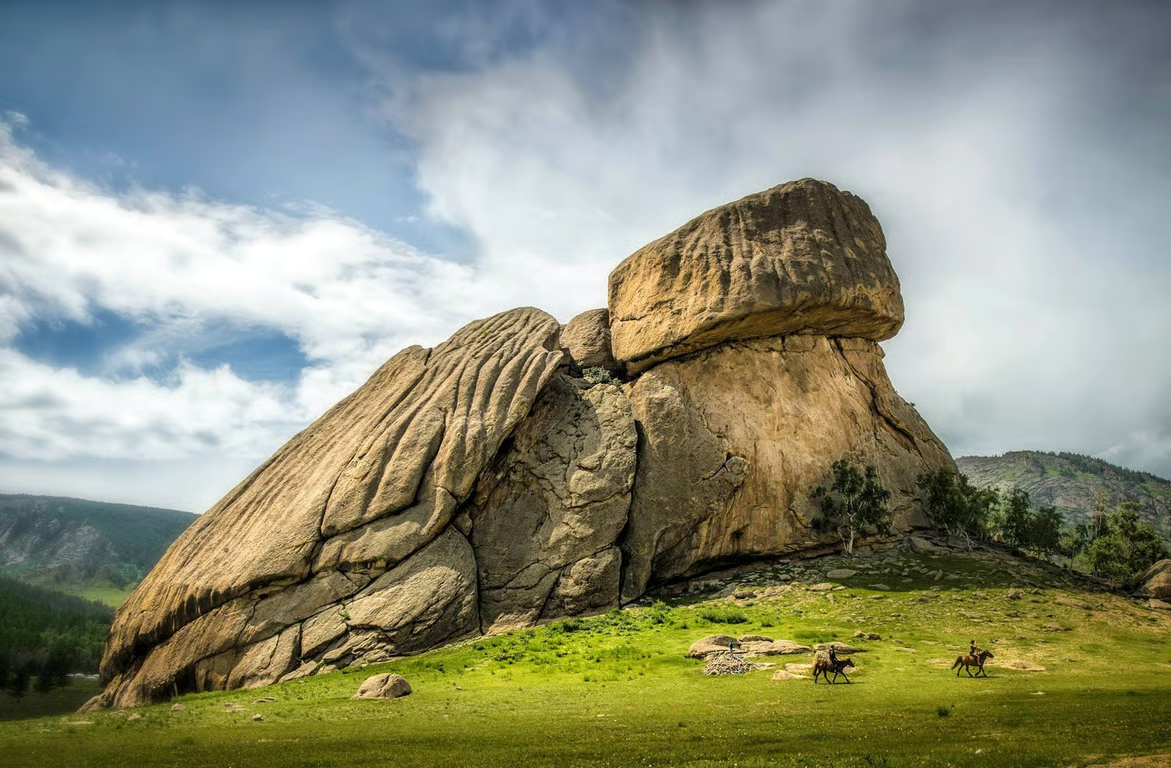
Gorkhi Terelj National Park
Just 60 kilometers from Ulaanbaatar, where granite towers rise from forested valleys and the Terelj River winds through alpine meadows,...
Explore
Altai Tavan Bogd National Park
At Mongolia's far western edge, where three nations converge beneath the Altai Mountains, lies one of Earth's last wilderness frontiers....
Explore
Ölgii
In Mongolia's far west, where the Altai Mountains rise along the borders of Russia and China, Kazakh eagle hunters still...
Explore
Khuvsgul Lake
Cradled between snow-capped peaks and Siberian taiga lies Khuvsgul—Mongolia's largest freshwater lake and one of the world's oldest and clearest....
Explore
Hustai National Park
Two hours from Ulaanbaatar lies Hustai National Park, sanctuary of the takhi—the world's last truly wild horse. These stocky horses...
Explore
Gobi Desert
Stretching across southern Mongolia lies the Gobi—Asia's largest desert and one of the world's most misunderstood landscapes. This is no...
Explore
Ulaanbaatar Mongolia
In the broad valley of the Tuul River, surrounded by four sacred mountains, lies the world's coldest capital city—a place...
ExploreSwipe to explore more