Travel to Iwokrama Rainforest
371,000 Hectares of Rainforest at the Heart of Guyana
Iwokrama Rainforest
371,000 Hectares of Rainforest at the Heart of Guyana
Ecovoyager Experiences
Iwokrama Rainforest Tours
Handcrafted expeditions into the remote corners of Iwokrama Rainforest, led by local experts, designed for the curious traveller.
Featured
IWOKRAMA RAINFOREST
Legends of El Dorado: Guyana's Hidden Wilderness
From thundering waterfalls to pristine rainforests and endless savannas, discover the untamed landscapes that inspired South America's greatest legend
Experience Iwokrama Rainforest, Your Way
Skip the standard itineraries. We design journeys around your interests, timeline, and curiosity with exclusive access you won't find on any platform.


Things to Do in Iwokrama Rainforest
Starting points for your perfect trip
Dawn on the Canopy Walkway
Be first on the Iwokrama Canopy Walkway at sunrise when monkeys, toucans, and macaws are most active thirty meters above the forest floor. Four suspension platforms give aerial access to species rarely visible from the ground, accompanied by a Makushi naturalist guide.
Jaguar Drives on the Forest Trail
Drive the Linden to Lethem trail at dawn and dusk searching for jaguars, pumas, and tapirs crossing the forest road to drink at creeks. Iwokrama is one of few places in South America where wild jaguars are regularly encountered in daylight, with guides who track the sighting locations.
Turtle Mountain Summit Hike
A 2-hour climb through varzeaand terra firme forest to a summit overlooking unbroken rainforest canopy stretching to the horizon. The hike begins with a boat transfer across the Essequibo River and ends with the only wide-angle view of Iwokrama's interior.
Night Boat on the Essequibo
Search the Essequibo River by spotlight for black caiman emerging from the banks at night. Boats drift along the forest edge looking for the red glow of caiman eyes, while the night forest fills with the calls of nocturnal birds, bats, and frogs.
Design Your Custom Trip
Tell us about your dream adventure. Our travel specialists respond within 24 hours with a personalised itinerary.
371,000 Hectares of Rainforest at the Heart of Guyana
A Closer Look at Iwokrama Rainforest
The Green Heart of Guyana
The Iwokrama Forest covers 371,000 hectares at the geographic center of Guyana, running along the Essequibo River between Georgetown to the north and the Rupununi Savanna to the south. The reserve sits in a transition zone where Amazon basin ecosystems meet the older, harder rock of the Guiana Shield, producing a biodiversity crossover that has made Iwokrama a focus of scientific research since the 1990s. The Iwokrama International Centre for Rain Forest Conservation and Development was established in 1996 to demonstrate that tropical rainforest could be managed for both conservation and sustainable economic use.
Wildlife surveys have recorded over 500 bird species, an estimated 200 mammal species, and 420 fish species in the reserve. Lim & Engstrom (2001) documented 86 bat species in the reserve, the highest recorded bat diversity of any protected area in the world. Iwokrama has built a reputation for reliable wild jaguar sightings along the Linden to Lethem trail, where jaguars are regularly encountered in daylight. Harpy eagles nest in the forest interior, black caiman patrol the Essequibo, and giant otters fish the oxbow lakes.
work the oxbow lakes along the river’s course.
The Iwokrama Partnership and the Makushi
The name Iwokrama comes from the Makushi language, meaning ‘place of refuge,’ a reference to the Iwokrama Mountains where ancestors sought shelter from Carib raids. The Makushi people have lived across this region for thousands of years, maintaining a working knowledge of the forest’s plants, animals, fishing grounds, and seasonal cycles. Sixteen mainly Makushi indigenous communities work with the Iwokrama International Centre through the North Rupununi District Development Board, under a 2005 Collaborative Management Agreement giving communities direct authority over research, tourism, and resource use within the reserve.
This partnership has become an influential model of co-management in tropical conservation. Rangers, boat captains, lodge staff, and wildlife guides at Iwokrama are primarily Makushi, and the income from ecotourism, sustainable timber, and research fees flows back into community development projects. Visitors staying at Iwokrama River Lodge or Atta Rainforest Lodge are hosted by people whose families have worked these forests for generations, and whose understanding of the landscape far exceeds what any outside guide could offer.
The Canopy Walkway and Turtle Mountain
The Iwokrama Canopy Walkway is the most well-known attraction in the reserve, a series of four aerial platforms connected by suspension bridges at roughly thirty meters above the forest floor. Opened in November 2003 and operated from Atta Rainforest Lodge, the walkway gives visitors direct access to a layer of forest usually reserved for monkeys, sloths, and birds. Dawn visits offer the best wildlife activity, when red howler monkeys call across the forest, channel-billed toucans move through the fruiting trees, and the occasional scarlet macaw flashes overhead.
Beyond the walkway, the reserve offers Turtle Mountain, a forested hill that rises from the west bank of the Essequibo River. The 2-hour hike to the summit climbs through varzeaand terra firme forest before reaching a viewpoint over an unbroken carpet of rainforest canopy stretching to the horizon. Boat trips on the Essequibo search for black caiman at night and giant otter family groups by day. The Linden to Lethem trail that cuts through the reserve provides one of the most reliable places in South America to encounter wild jaguars, sometimes seen during daylight hours along the road itself.
From the Journal
Stories from Iwokrama Rainforest
Field notes, cultural encounters, and trail dispatches from our guides and travellers in Iwokrama Rainforest.
Wildlife
Jaguars in Guyana: What the Forest Actually Offers
Guyana holds one of the last intact jaguar landscapes on Earth, not because the forest was saved, but because it was never lost. Here is what that means for travelers who want to understand what a forest jaguar encounter actually involves.
Read Full StoryMore from the Journal
Destinations
DESTINATIONS
Iwokrama Rainforest, Guyana: The Complete Guide
The green heart of Guyana: wild jaguars, a canopy walkway in the treetops, record-breaking biodiversity, and a forest run by the Makushi people. Here is when to go, what to see, how to get there, and how to do it well.
Read Story
Destinations
DESTINATIONS
A Guide to Seeing Jaguars in Guyana
Guyana is one of the last countries on Earth where the jaguar still occupies nearly all of its historic habitat. Scientists put the national density at somewhere between 1.5 and 2.6 jaguars per hundred square kilometers, with pockets in the Rupununi savannas running higher. For travelers, that makes Guyana one of the few countries where tracking a wild, unhabituated jaguar is a genuine option.
Read Story
Destinations
DESTINATIONS
Guyana Birding: Why South America's Best-Kept Secret Is the World's Next Great Birding Destination
836 species. Five potoos on one trip. Harpy Eagles at monitored nests. The world’s last reliable site for the critically endangered Red Siskin. Guyana’s rainforest is 80 percent intact, and almost no one is here.
Read StoryBest Time to Visit Iwokrama Rainforest
Dry season for jaguars and overland access
Getting to Iwokrama Rainforest
Choose your route. Every option arrives at the same destination.
Overland on the Linden to Lethem Trail
Charter Flight to Fair View Airstrip
Overland on the Linden to Lethem Trail
The main access route to Iwokrama. Drive south from Georgetown through Linden, then continue on the graded laterite road through dense rainforest to the Essequibo River crossing at Kurupukari. A pontoon ferry carries vehicles across to Iwokrama River Lodge on the west bank. The drive passes through some of Guyana's most dramatic interior forest, and wildlife can be spotted along the road at dawn and dusk.
Charter Flight to Fair View Airstrip
Private charter aircraft land at the Fair View airstrip near Iwokrama River Lodge for travelers with tight schedules or those combining Iwokrama with Kaieteur Falls or Rupununi lodges on the same trip. Flights operate out of Georgetown's Ogle Airport on small aircraft with weight restrictions.
Travel with EcoVoyager
Ecovoyager builds Iwokrama into most Guyana interior itineraries, connecting the reserve with Surama Eco-Lodge and onward to the Rupununi Savanna. We coordinate accommodation at Iwokrama River Lodge and Atta Rainforest Lodge, dawn canopy walkway excursions, jaguar drives on the forest trail, and night boat trips on the Essequibo.
Plan Your Iwokrama Rainforest Trip
Custom Travel Inquiry
Tell us about your plans and our specialists will craft a personalised itinerary within 24 hours.
Explore More
Other Guyana Destinations
Explore more destinations across Guyana.
Georgetown
Georgetown sits at the mouth of the Demerara River on Guyana's Atlantic coast, built on land that lies almost a...
ExploreShell Beach
Along 90 miles of Guyana's Atlantic coast northwest of Georgetown, four species of sea turtles return each year to nest...
ExploreRupununi Savanna
In southwestern Guyana, the Amazon rainforest breaks open into approximately 13,000 square kilometers of tropical grassland rolling toward the Brazilian...
ExploreKaieteur Falls
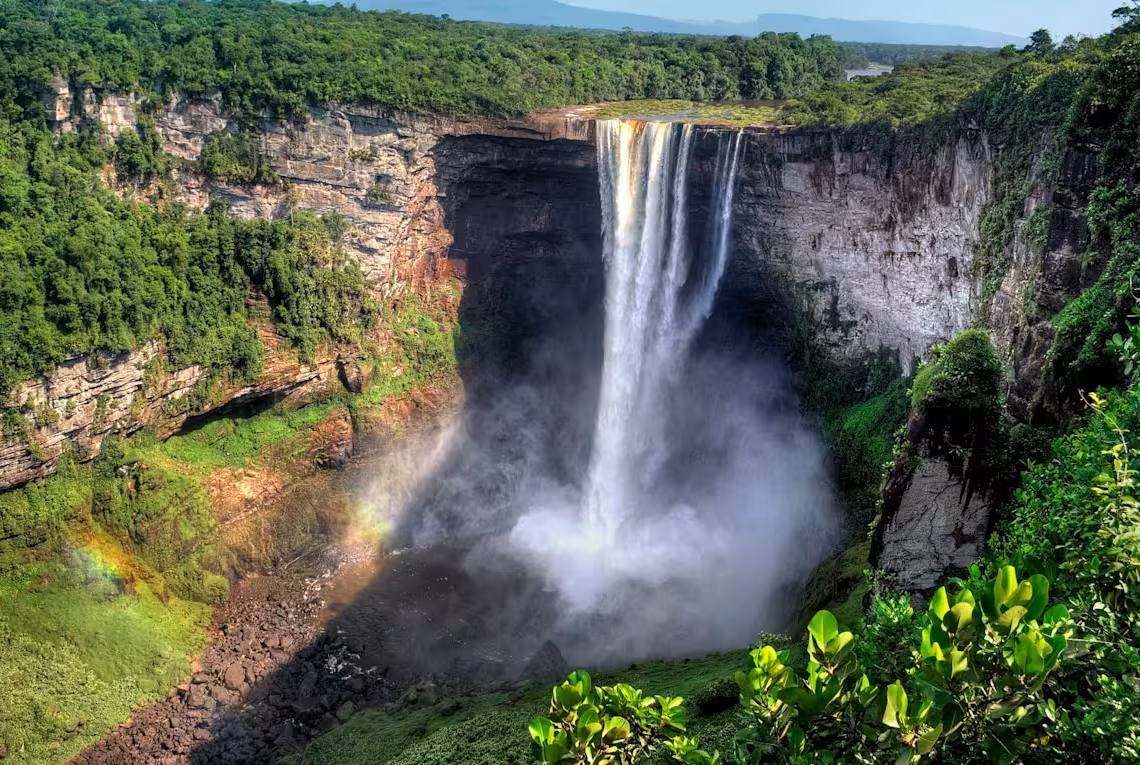
Deep in Guyana's Amazon rainforest, where the Potaro River cuts through billion-year-old Guiana Shield sandstone, Kaieteur Falls drops 741 feet...
Explore