

Namibia
Damaraland
Damaraland
Location
Damaraland
-20.4900° / 14.3700°




Experience Damaraland, Your Way
Skip the standard itineraries. We'll design a journey around your interests, timeline, and travel style — with exclusive access you won't find elsewhere.


Things to Do in Damaraland
Starting points for your perfect trip
Black Rhino Tracking on Foot
Join Save the Rhino Trust rangers to track critically endangered black rhinos through the Palmwag Concession. Leave your vehicle and follow ancient spoor across volcanic plains, approaching these magnificent creatures on foot—one of Africa's most thrilling conservation experiences.
Desert Elephant Encounter
Track desert-adapted elephants along the dry riverbeds of the Huab and Aba-Huab valleys. These remarkable animals can walk 70 kilometers daily in search of water, digging for moisture in sandy riverbeds. Watch family groups rest beneath ana trees as golden light floods the valley.
Twyfelfontein Rock Art at Sunset
Explore Namibia's first UNESCO World Heritage Site with a local guide as fading light illuminates 6,000-year-old San engravings. See the famous Dancing Kudu and Lion Man panels, where over 2,500 petroglyphs depict rhinos, elephants, giraffes, and spiritual beliefs of ancient hunter-gatherers.

Starlight Sleepout Experience
Fall asleep under some of the clearest night skies on Earth. Damaraland's remoteness means zero light pollution—watch the Milky Way arc overhead, spot the Southern Cross and Magellanic Clouds, and wake to desert silence broken only by birdsong at dawn.

Petrified Forest
Walk a geological timeline spanning 280 million years near Khorixas. The Petrified Forest preserves tree trunks up to 34 meters long, turned to stone by silicification. Nearby, Organ Pipes rise as 4-meter dolerite columns while Burnt Mountain glows fiery orange at sunrise.

Damara Living Museum
At the Damara Living Museum near Twyfelfontein, elders demonstrate traditions predating written history: fire-making by hand, leather tanning, medicine from desert plants, and bush food foraging. The Damara are among Namibia's oldest peoples, their click language linking them to the Khoisan.

Stories from Damaraland
A Landscape Forged by Fire and Time
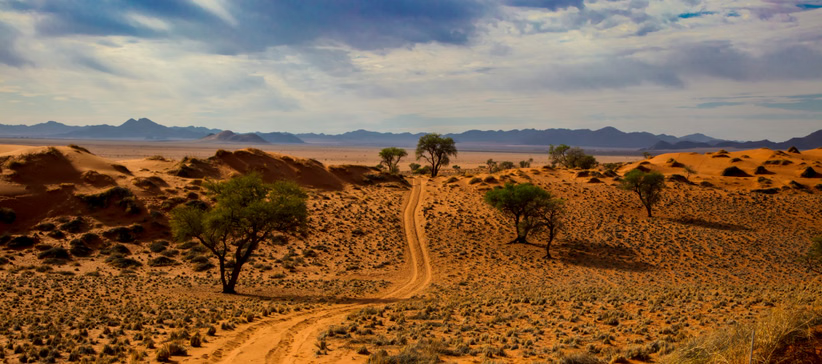
Damaraland occupies a vast swath of Namibia’s Kunene Region, wedged between the Skeleton Coast and Etosha National Park. This is a landscape shaped by cataclysmic forces—125 million years ago, when Africa and South America still formed the supercontinent Gondwana, massive volcanic eruptions created the basalt formations that define the region today. The Etendeka lava flows spread across nearly 600,000 hectares, while the Brandberg Massif—Namibia’s highest peak at 2,573 meters—rises dramatically from the surrounding plains.
But Damaraland’s geological wonders span far deeper time. Near Khorixas, the Petrified Forest preserves tree trunks up to 34 meters long and 6 meters in circumference—remnants of ancient forests that flourished 280 million years ago before being buried, mineralized, and eventually exposed by erosion. Nearby, the Organ Pipes showcase perfect hexagonal dolerite columns formed 150 million years ago, while Burnt Mountain’s clinker-like slopes reveal where molten magma baked ancient shales at temperatures exceeding 1,000°C.
Getting to Damaraland
Charter Flight to Palmwag/Twyfelfontein
Self-Drive from Windhoek
Self-Drive from Swakopmund
Travel with EcoVoyager
Damaraland stretches across Namibia's Kunene Region between the Skeleton Coast and Etosha, with attractions spread across hundreds of kilometers of gravel roads requiring experienced navigation. EcoVoyager arranges charter flights to private airstrips at Palmwag and Twyfelfontein, coordinates 4x4 drivers who know every dried riverbed crossing, and partners with conservation-focused lodges where tourism directly funds rhino protection and community conservancies. Our local guides include Save the Rhino Trust trackers for on-foot rhino encounters, Damara cultural interpreters at the Living Museum, and specialist geologists who bring the 280-million-year record at the Petrified Forest to life.

Explore More
Other Namibia Destinations

Walvis Bay Lagoon
Along Namibia's Atlantic coast, the world's oldest desert surrenders to the sea, creating one of Africa's most important wetlands. The...
Explore
Himba Villages
In Namibia's remote northwest, where the Kunene River marks the Angolan border, live the Himba — one of Africa's last...
Explore
Spitzkoppe
Rising 700 meters from the ancient Namib Desert floor, Spitzkoppe's granite peaks have stood sentinel for 120 million years —...
Explore
Caprivi Strip
Stretching like a narrow finger 450 kilometers into southern Africa, the Caprivi Strip, now officially the Zambezi Region, defies everything...
Explore
Kolmanskop Ghost Town
Rising from the ancient Namib Desert lies Kolmanskop—a haunting testament to fortune and impermanence. In 1908, a railway worker discovered...
Explore
Swakopmund
Captain Curt von François founded Swakopmund on August 8, 1892, raising beacons on a shore where the Namib—the world's oldest...
Explore
Windhoek
Jonker Afrikaner, a powerful Oorlam leader from the Cape, established a settlement around Windhoek’s permanent hot springs in 1840, building...
Explore
Fish River Canyon
The Nama people called this place ‘ai-gams’ and understood the canyon long before European surveyors reached it in the 1830s....
Explore
Etosha National Park
German colonial governor Friedrich von Lindequist proclaimed Etosha as Game Reserve No. 2 in 1907, responding to the near-extermination of...
Explore
Skeleton Coast
Portuguese sailors called this 500-kilometer Atlantic coastline ‘As Areias do Inferno’ in the 1500s, and the San people named it...
Explore
Sossusvlei
The Namib has maintained arid conditions for 55 to 80 million years, making it the oldest desert on Earth, and...
ExploreSwipe to explore more