

Namibia
Fish River Canyon
Fish River Canyon
Location
Fish River Canyon
-27.5843° / 17.6067°


Experience Fish River Canyon, Your Way
Skip the standard itineraries. We'll design a journey around your interests, timeline, and travel style — with exclusive access you won't find elsewhere.


Things to Do in Fish River Canyon
Starting points for your perfect trip
Five-Day Canyon Trail Expedition
Descend 550 meters via chain-assisted rock scrambles into the canyon for a five-day, 85-kilometer trek. Navigate boulder-strewn riverbeds past Sulphur Springs and Three Sisters, swim in natural pools, and sleep under some of Africa’s darkest skies before reaching the Ai-Ais thermal springs.
Ai-Ais Hot Springs Soak
Soak in Ai-Ais’s sulphurous thermal waters—“burning water” in Nama—bubbling at 57°C where geothermal heat meets the canyon’s southern end, first recorded by a herder in 1850.
Hell’s Bend Rim Walk
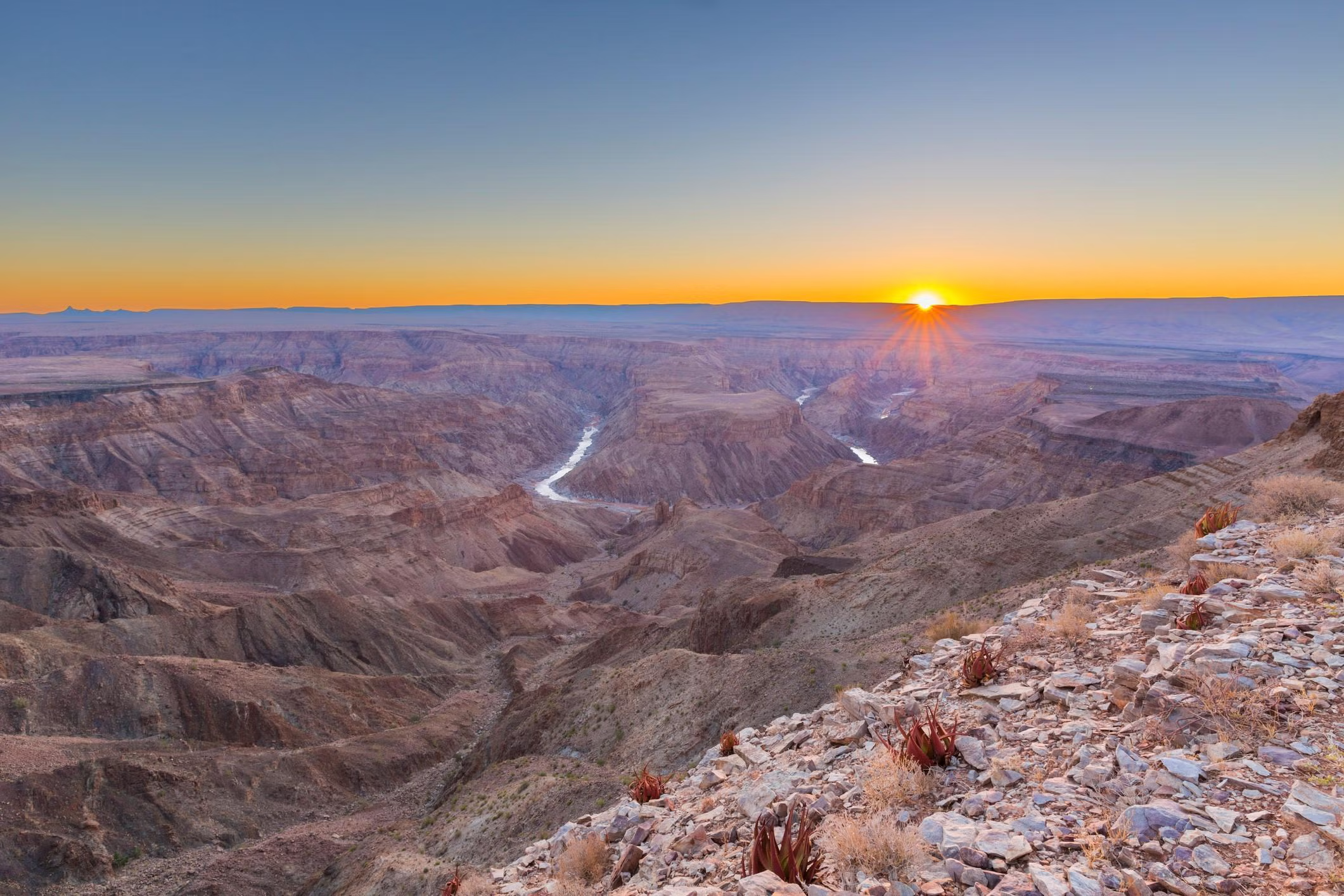
Walk the canyon rim to Hell’s Bend, where the Fish River curves 180 degrees through 550-meter walls of 1.8-billion-year-old gneiss. Black eagles and lanner falcons ride thermals below as 770-million-year-old dolerite dykes stripe the exposed rock face like dark veins.
Gondwana Canyon Park Wildlife Safari
Track Hartmann’s mountain zebra, gemsbok, and springbok across 126,000 hectares of restored wilderness in Gondwana Canyon Park, created from former sheep farms in 1996. Quiver trees up to 300 years old dot the landscape while klipspringers balance on cylindrical hooves among the boulders.

Desert Stargazing at the Canyon’s Edge
Some of Africa’s darkest skies open above Fish River Canyon, where zero light pollution reveals the Milky Way’s core, the Magellanic Clouds, and the Southern Cross. Guided astronomy sessions from canyon-edge lodges use telescopes to resolve star clusters invisible from urban skies.

Canyon Roadhouse Vintage Collection
Step into the Canyon Roadhouse, where over 50 vintage cars, motorcycles, and petrol pumps salvaged from Namibia’s desert highways fill the grounds of this lodge 20 kilometers from the canyon rim. Dine on Namibian game and local craft beer beneath a ceiling lined with old license plates.
Stories from Fish River Canyon
A Chasm Half a Billion Years in the Making
The Fish River Canyon stretches 160 kilometers through Namibia’s parched south, plunges 550 meters at its deepest point, and spans 27 kilometers at its widest. This is Africa’s largest canyon and the second largest on Earth after the Grand Canyon. Yet unlike its American counterpart, which receives six million visitors annually, fewer than 60,000 people make the journey here each year. Those who do find themselves alone with geology so ancient it predates complex life on Earth. The Nama people, who have lived in this region for centuries, tell of a giant serpent whose death throes carved the gorge, a creation story that speaks to the canyon’s scale and power.
The canyon’s formation began roughly 500 million years ago when tectonic forces fractured the crust into a massive north-south graben, a dropped block along which the Fish River began cutting downward. The Dwyka glaciation 300 million years ago deepened the channel further, and when Gondwana split apart 120 million years ago, the rising African continent gave the river renewed erosive power. Today, the canyon exposes layers of rock stretching back 1.8 billion years: gneiss and granite from Earth’s earliest eras, cut through by 770-million-year-old dolerite dykes that stripe the walls like dark veins. Geothermal activity along these ancient fault lines feeds the hot springs at Ai-Ais, where water emerges at 57°C from deep underground.
Getting to Fish River Canyon
Drive from Windhoek
Via Keetmanshoop
Internal Canyon Transfers
Travel with EcoVoyager
Fish River Canyon lies 500 kilometers south of Windhoek in Namibia’s remote |Karas Region, where the semi-arid plateau drops 550 meters into Africa’s largest gorge. EcoVoyager arranges overland transfers with experienced drivers who know the gravel roads, coordinates stays at characterful canyon-edge lodges including Gondwana Canyon Village and Fish River Lodge, and secures hiking trail permits through Namibia Wildlife Resorts months in advance. Our local partners provide naturalist-guided canyon rim walks, wildlife tracking in the 126,000-hectare Gondwana Canyon Park, and shuttles between Hobas viewpoint and Ai-Ais hot springs, turning one of Africa’s most demanding wilderness areas into a managed expedition.

Explore More
Other Namibia Destinations

Walvis Bay Lagoon
Along Namibia's Atlantic coast, the world's oldest desert surrenders to the sea, creating one of Africa's most important wetlands. The...
Explore
Himba Villages
In Namibia's remote northwest, where the Kunene River marks the Angolan border, live the Himba — one of Africa's last...
Explore
Spitzkoppe
Rising 700 meters from the ancient Namib Desert floor, Spitzkoppe's granite peaks have stood sentinel for 120 million years —...
Explore
Caprivi Strip
Stretching like a narrow finger 450 kilometers into southern Africa, the Caprivi Strip, now officially the Zambezi Region, defies everything...
Explore
Kolmanskop Ghost Town
Rising from the ancient Namib Desert lies Kolmanskop—a haunting testament to fortune and impermanence. In 1908, a railway worker discovered...
Explore
Damaraland
In Namibia's rugged northwest lies Damaraland—a landscape of red sandstone mountains, petrified forests, and ephemeral rivers where the impossible becomes...
Explore
Swakopmund
Captain Curt von François founded Swakopmund on August 8, 1892, raising beacons on a shore where the Namib—the world's oldest...
Explore
Windhoek
Jonker Afrikaner, a powerful Oorlam leader from the Cape, established a settlement around Windhoek’s permanent hot springs in 1840, building...
Explore
Etosha National Park
German colonial governor Friedrich von Lindequist proclaimed Etosha as Game Reserve No. 2 in 1907, responding to the near-extermination of...
Explore
Skeleton Coast
Portuguese sailors called this 500-kilometer Atlantic coastline ‘As Areias do Inferno’ in the 1500s, and the San people named it...
Explore
Sossusvlei
The Namib has maintained arid conditions for 55 to 80 million years, making it the oldest desert on Earth, and...
ExploreSwipe to explore more