




Travel to Deosai National Park
Deosai National Park, Pakistan
Deosai National Park
Deosai National Park, Pakistan
Experience Deosai National Park, Your Way
Skip the standard itineraries. We design journeys around your interests, timeline, and curiosity with exclusive access you won't find on any platform.

Things to Do in Deosai National Park
Starting points for your perfect trip
Himalayan Brown Bear Tracking
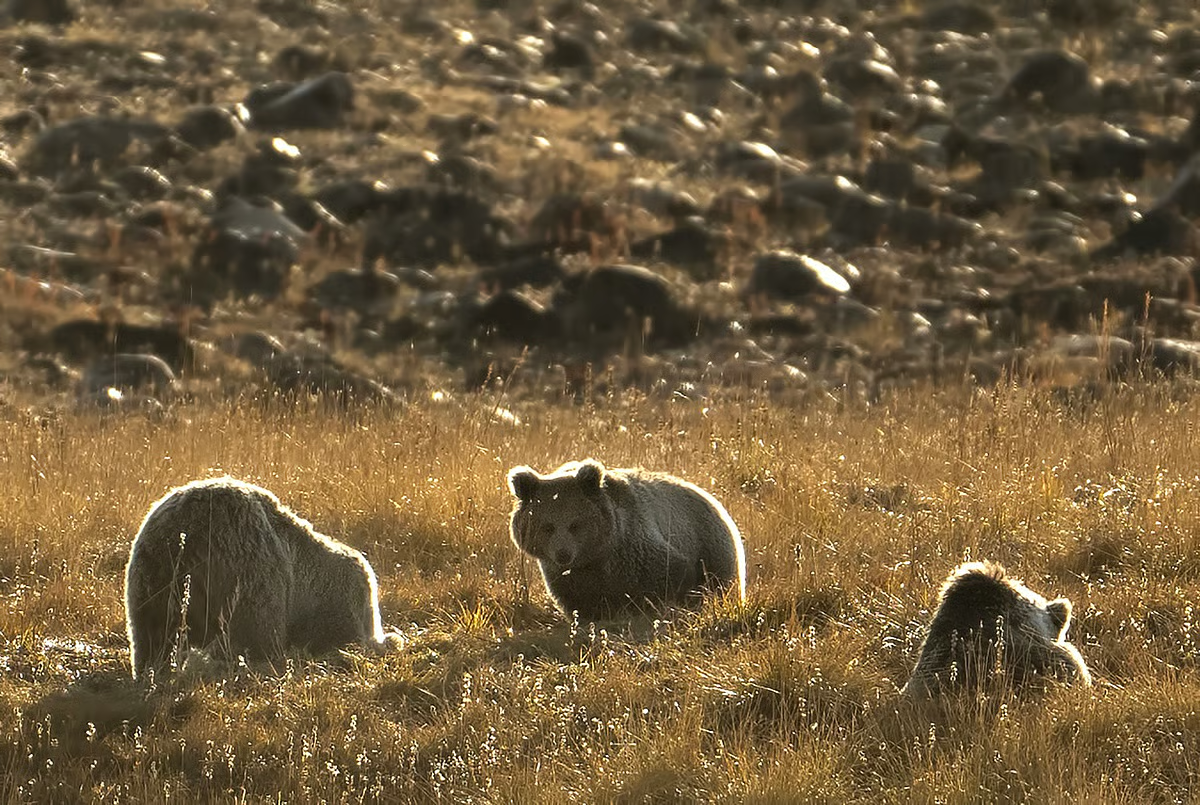
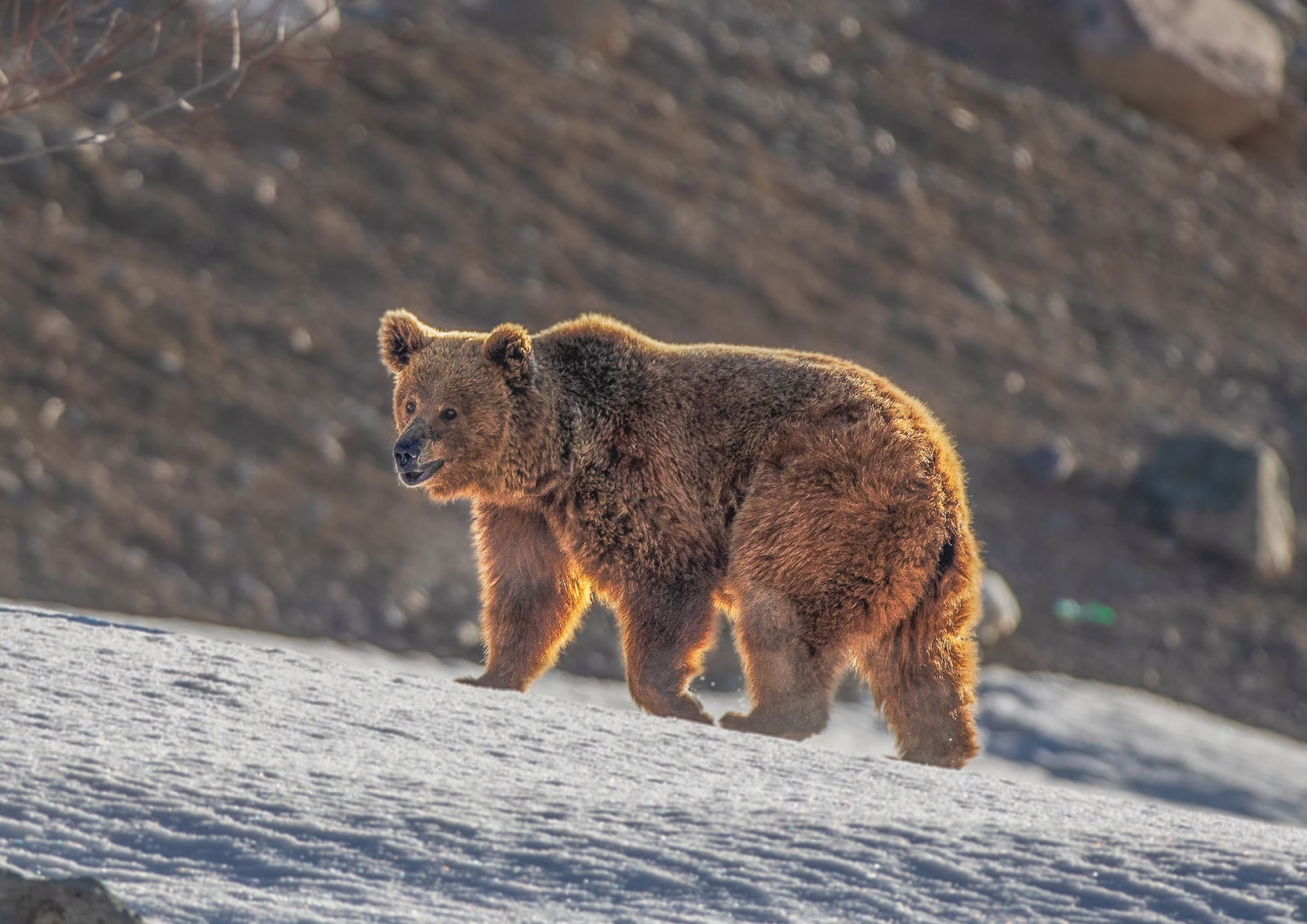
Track critically endangered Himalayan brown bears with expert guides across open grasslands where mothers and cubs forage on wild rhubarb and marmots. From just 19 bears in 1993 to over 75 today, Deosai represents one of Asia’s greatest conservation recoveries.
Sheosar Lake at Sunrise
Camp at 4,250-meter Sheosar Lake—one of the highest alpine lakes on Earth—to watch first light illuminate Nanga Parbat’s 8,126-meter peak reflected in mirror-still waters. After dark, the Milky Way stretches horizon to horizon in zero light pollution.
Deosai Wildflower Trek
Time your visit for July when the plateau erupts into blue poppies, buttercups, primroses, and edelweiss across 3,000 square kilometers. Deosai hosts 342 recorded plant species, many with medicinal uses known to local Balti communities for centuries.

Nanga Parbat Viewpoint Trek
Hike to viewpoints where the ninth-highest peak on Earth reveals its full 8,126-meter profile rising from the plateau’s edge. On clear mornings from Sheosar Lake, watch Nanga Parbat glow pink at sunrise while Tibetan wolves patrol distant ridgelines.
Burji La: K2 Viewpoint Climb
Ascend to 4,800 meters at Burji La for views of K2, Broad Peak, and the Karakoram Range stretching north. The climb gains 700 meters from the plateau floor, passing a centuries-old rock cairn at the summit marking an ancient route between Skardu and the high passes.
Bara Pani Snow Trout Fishing
Cast for snow trout in Deosai’s largest river at 4,100 meters, where the cold, clear waters of Bara Pani—meaning ‘Big Water’ in Urdu—produce fish of remarkable size. Camp riverside with Nanga Parbat visible from the hillside above.
Design Your Custom Trip
Tell us about your dream adventure. Our travel specialists respond within 24 hours with a personalised itinerary.
Where Giants Walk and Flowers Bloom at the Roof of the World
A Closer Look at Deosai National Park

The Second Roof of the World
At an average elevation of 4,114 meters, Deosai is second only to Tibet’s Changtang Plateau among the world’s highest plateaus. Stretching across 3,000 square kilometers between the Skardu and Astore districts of Gilgit-Baltistan, this vast alpine expanse sits at the convergence of the Himalayas, Karakoram, and Hindu Kush mountain ranges—a geological crossroads found nowhere else on Earth that creates one of the planet’s most extraordinary high-altitude ecosystems. The Balti people call it ‘Ghbiarsa,’ meaning ‘summer’s place,’ because for eight months each year the plateau lies buried beneath meters of snow, completely inaccessible to the outside world. Colonel Algernon Durand of the British Army crossed Deosai in 1899 and described it as ‘a most desolate scene’ of bare plains stretching for miles.
When summer arrives in June, Deosai undergoes one of nature’s most dramatic transformations. The snow retreats to reveal rolling grasslands that stretch to every horizon, punctuated by crystal-clear streams, marshlands, and lakes fed by glacial meltwater from surrounding peaks that rise above 5,000 meters. The plateau’s unique position—facing the monsoon-affected outer Himalayas—gives it higher rainfall than the arid valleys of Baltistan below, nurturing an explosion of wildflowers that carpets the land in vivid color from late June through August. UNESCO has placed Deosai on its World Heritage tentative list, recognizing its outstanding universal value as one of the planet’s highest freshwater wetland ecosystems and a critical corridor for high-altitude biodiversity.
Sanctuary of the Himalayan Brown Bear
Deosai National Park was formally established on May 14, 1993, by the Government of Gilgit-Baltistan for one primary purpose: to save the Himalayan brown bear from extinction in Pakistan. When the park was declared under the Northern Areas Wildlife Preservation Act of 1975, researchers found just 19 bears clinging to survival on the plateau—the last viable population in the country. Poaching for pelts and traditional medicine, combined with habitat loss from overgrazing by livestock, had pushed this ancient lineage to the brink. The Himalayan brown bear represents one of Earth’s oldest bear lineages, having diverged from all other brown bears and polar bears some 658,000 years ago during a glaciation event that isolated them in their mountain refuge.
Three decades of dedicated conservation have achieved remarkable results. The bear population has grown from those 19 survivors to over 75 individuals today—a recovery made possible by community partnerships, strict anti-poaching patrols, regulated grazing agreements with local herders, and the establishment of buffer zones around critical habitat. Unlike brown bears elsewhere that shelter in dense forests, Deosai’s bears inhabit open alpine grasslands above the treeline, making them unusually visible to patient observers during summer months. They emerge from hibernation in April or May, spending the warm season foraging on wild rhubarb, roots, and golden marmots—their primary protein source—before returning to dens around October as snow reclaims the plateau.
Wildlife Beyond the Bears
While the brown bear draws visitors to Deosai, the plateau supports an entire community of high-altitude specialists adapted to life above 4,000 meters. Golden marmots—large, sociable rodents related to groundhogs—create extensive burrow colonies across the grasslands, their piercing whistling alarm calls echoing across the plateau whenever predators approach. The bears themselves rely heavily on marmots for protein, and watching a bear dig determinedly into a marmot colony while the residents scatter is one of Deosai’s most compelling wildlife spectacles. Tibetan wolves patrol the plateau in small packs, hunting marmots and occasionally taking livestock from herders along the park boundaries—encounters that remain an ongoing source of human-wildlife conflict requiring careful management.
Deosai lies within BirdLife International’s Western Himalaya Endemic Bird Area, hosting over 100 species of resident and migratory birds across its vast grasslands and wetland systems. Golden eagles soar overhead scanning for prey, while lammergeier vultures—the bearded vultures of legend—circle on thermals searching for bones to crack on the rocks below, a feeding behavior unique among raptors. Snow trout grow to remarkable sizes in the plateau’s cold, oxygen-rich streams, particularly in Bara Pani, the ‘Big Water’ that serves as Deosai’s largest river and most popular fishing destination. And somewhere in the remote ranges surrounding the plateau, snow leopards hunt ibex on the high ridges, though confirmed sightings within the park remain exceptionally rare.
Explore More
Other Pakistan Destinations
Explore more destinations across Pakistan.
Makli Necropolis
When the Sufi saint Sheikh Hamad Jamali established his khanqah on this limestone plateau in the 14th century, he set...
ExploreHarappa
Before Egypt’s pyramids reached their golden age, before classical Greece was imagined, the people of Harappa had already mastered urban...
ExplorePeshawar
Where empires carved their path through the Khyber Pass, Peshawar stands as one of South Asia’s oldest continuously inhabited cities—2,500...
ExploreKarachi
Pakistan's largest city sprawls along the Arabian Sea where Baloch fishermen built the village of Kolachi and Alexander's admiral Nearchus...
ExploreMohenjo-daro
Five thousand years ago, when Stonehenge was just beginning and the Egyptian pyramids were newly built, a city of 40,000...
ExploreTaxila Pakistan
Before Oxford or Bologna existed, students from across Asia gathered in Taxila to study medicine, mathematics, and philosophy under the...
ExploreKhunjerab Pass
At 4,693 meters, Khunjerab Pass is the world’s highest paved international border crossing—the dramatic culmination of the Karakoram Highway where...
ExploreIslamabad
This is the threshold of the high places. Islamabad rises where the Pothohar Plateau meets the Margalla Hills—a planned capital...
ExplorePassu
The Passu Cones pierce the sky like Gothic spires—a row of impossibly sharp peaks that locals call Tupopdan, ‘the sun-gulping...
ExploreNanga Parbat
At 8,126 meters, Nanga Parbat claimed 31 lives before Hermann Buhl reached its summit alone and without supplemental oxygen on...
ExploreK2 Base Camp
Stand at the foot of the world's second-highest mountain—and by many measures its most dangerous. K2 rises 8,611 meters above...
ExploreKarakoram Highway
They called it impossible—a road through the highest mountains on Earth. For 20 years, 24,000 Pakistani and Chinese workers carved...
ExploreSwat Valley
German mountaineers called it the Switzerland of the East, but Swat Valley's story runs far deeper than alpine beauty. This...
ExploreFairy Meadows
German mountaineers searching for a route to Nanga Parbat's summit named this alpine grassland Märchenwiese—'Fairy Tale Meadows'—struck by its otherworldly...
ExploreLahore
Where the Ravi River flows past marble palaces and minarets that have witnessed six centuries of empire, Lahore preserves the...
ExploreSkardu
Where the Indus and Shigar rivers converge beneath the world's greatest concentration of 8,000-meter peaks, Skardu commands the gateway to...
ExploreHunza Valley
Where three of Earth's mightiest mountain ranges converge—the Karakoram, Himalayas, and Hindu Kush—lies a valley that inspired the legend of...
Explore