




Skardu
Skardu, Pakistan
Experience Skardu, Your Way
Skip the standard itineraries. We design journeys around your interests, timeline, and curiosity with exclusive access you won't find on any platform.


Things to Do in Skardu
Starting points for your perfect trip
K2 & Concordia Base Camp Trek
Journey to Concordia at the confluence of the Baltoro and Godwin-Austen glaciers, where K2's 8,611-meter pyramid dominates a natural amphitheater of 8,000-meter peaks. Trek past Trango Towers and Masherbrum along the 62-kilometer Baltoro Glacier to the throne room of the mountain gods.
Deosai Plateau Wildlife Safari
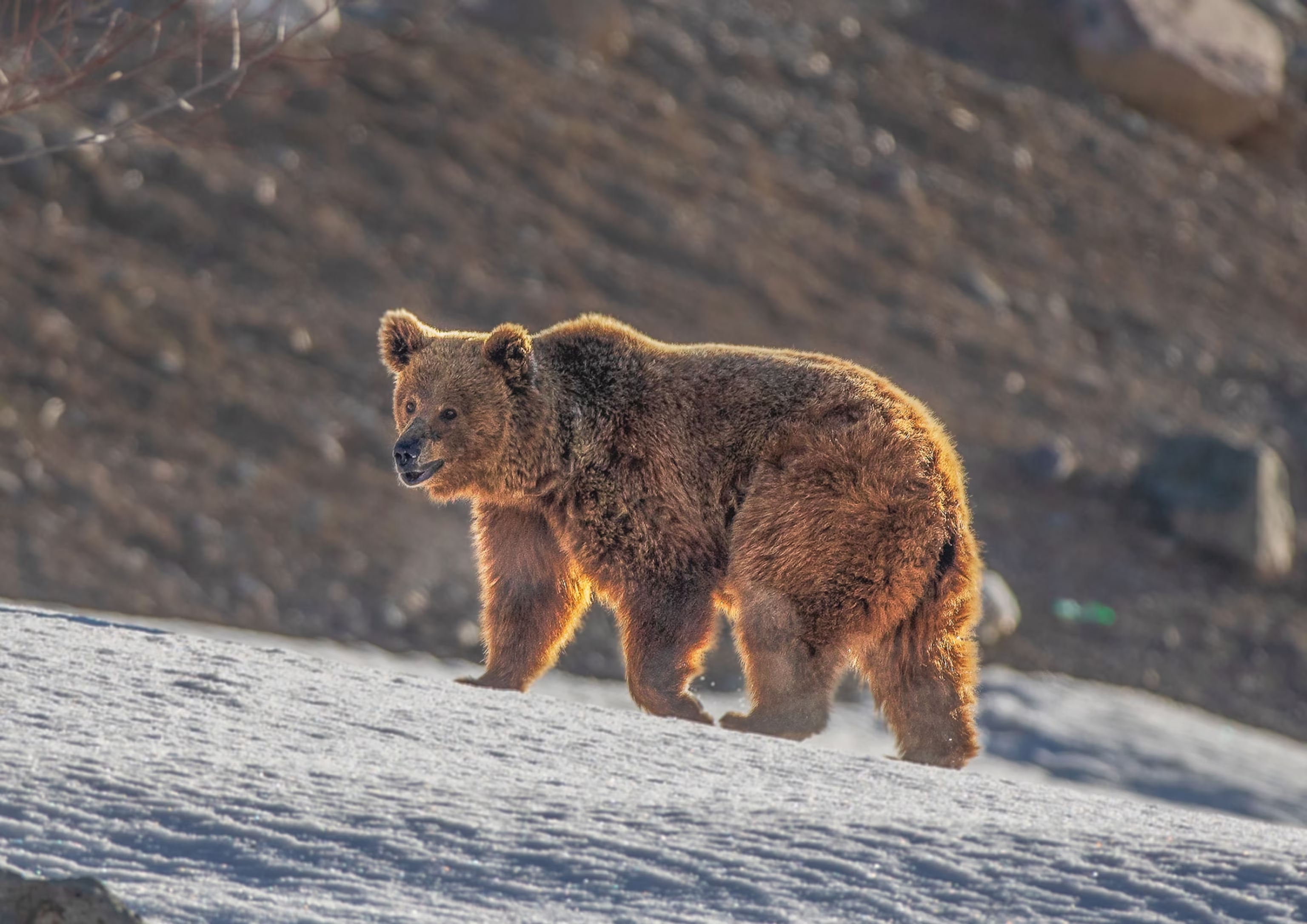
Explore 843-square-kilometer Deosai National Park at 4,114 meters—the world's second-highest plateau. Search for the Himalayan brown bear, whose population recovered from 19 in 1993 to over 78 today, alongside Tibetan wolves, golden marmots, and over 124 bird species.
Ancient Kingdom Heritage Tour
Discover 16th-century Kharpocho Fort built by the Maqpon dynasty 40 meters above the valley floor, and UNESCO-awarded Shigar Fort Palace restored by the Aga Khan Trust and now a heritage hotel. Visit the 8th-century Manthal Buddha Rock with its meditating Buddha surrounded by 20 bodhisattvas.
Lake District & Shangri-La Experience
Experience Skardu's legendary lakes: heart-shaped Shangrila Lake with its aircraft-fuselage restaurant that inspired comparisons to James Hilton's Lost Horizon, and crystal-clear Upper Kachura Lake reaching 70-meter depths surrounded by apricot orchards and Himalayan forest.
Shigar Valley Apricot & Culture Trail
Drive 45 minutes from Skardu into Shigar Valley, where terraced apricot orchards produce the dried fruit that has sustained Balti communities for centuries. Visit traditional homes with intricate woodcarving, taste dried apricot preparations, and explore the ancient irrigation channels.
Satpara Lake & Cold Desert Expedition
Visit Satpara Lake just 7 km from Skardu, then continue into the Skardu Cold Desert—a surreal high-altitude sand landscape at 2,226 meters where wind-sculpted dunes sit beneath snow-capped Karakoram peaks. The juxtaposition of desert and glacier creates one of Earth's most improbable scenes.
Design Your Custom Trip
Tell us about your dream adventure. Our travel specialists respond within 24 hours with a personalised itinerary.
Gateway to the Throne Room of the Mountain Gods
A Closer Look at Skardu

The Throne Room of the Mountain Gods
Skardu commands one of Earth’s most extraordinary geographical positions. At 2,500 meters elevation, where the Indus River—born in Tibet and destined for the Arabian Sea—meets the Shigar River flowing from K2’s glaciers, the valley opens into a 10 by 40-kilometer basin surrounded by peaks reaching 4,500 to 5,800 meters. Yet these are merely the foothills: within 25 kilometers of each other rise K2 at 8,611 meters, Broad Peak at 8,051 meters, and Gasherbrum I at 8,080 meters—four of the world’s fourteen 8,000-meter peaks clustered in what mountaineers call the Baltoro Muztagh.
The Baltoro Glacier extends 62 kilometers from these giants, making it the world’s fifth-longest outside polar regions. At its head lies Concordia, where the Baltoro meets the Godwin-Austen Glacier descending from K2’s south face. Photographer Galen Rowell named this amphitheater ‘the throne room of the mountain gods’—and standing here, surrounded by ten of the world’s thirty highest peaks within a 24-kilometer radius, the description feels inadequate. Nearly 70% of all trekking and mountaineering permits issued for Pakistan each year are for the Baltoro region, making this the country’s premier adventure destination.
Kingdoms of the Karakoram
For over 700 years, the Maqpon dynasty ruled Baltistan from Skardu, building the imposing Kharpocho Fort—’King of Forts’ in Balti—on a rocky spur 40 meters above the valley floor. Constructed by Ali Sher Khan Anchan in the late 16th century, the seven-story fortress commanded views of all approach routes and served as capital until Dogra forces from Kashmir conquered the region in 1840. The fort’s design echoed the Potala Palace in Lhasa, reflecting Baltistan’s deep historical ties to Tibet—the region was part of the Tibetan Buddhist cultural sphere from the 7th century until Islam arrived in the 14th century.
In nearby Shigar Valley, the Amacha dynasty built Fong Khar—’Palace on the Rock’—in the early 17th century. Raja Hassan Khan brought Kashmiri craftsmen to construct this three-story palace atop a massive boulder, incorporating Mughal garden traditions and exquisite woodcarving. Abandoned in the early 20th century, the fort faced ruin until the Aga Khan Trust for Culture undertook a $1.4 million restoration from 1999 to 2004. The work earned a UNESCO Asia Pacific Award of Excellence in 2006, and the palace now operates as a heritage hotel, its royal halls transformed into a museum preserving Balti royal artifacts while generating revenue for local communities.
The Land of Giants
South of Skardu, the landscape transforms dramatically. The Deosai Plains—meaning ‘Land of Giants’ in the local Shina language—stretch across 843 square kilometers at an average elevation of 4,114 meters, making this the world’s second-highest plateau after Tibet’s Changtang. In Balti, locals call it ‘Ghbiarsa’—summer’s place—because only during June through September does the snow release its grip, revealing wildflower meadows so dense they carpet entire valleys in yellow, purple, and white. Sheosar Lake, at 4,142 meters, reflects the surrounding peaks in waters so clear you can count stones on the bottom.
This harsh, beautiful plateau harbors one of conservation’s most remarkable success stories. When Deosai was declared a National Park in 1993, only 19 Himalayan brown bears survived here—the species hunted nearly to extinction across its range. Today, that population has recovered to over 78 individuals, representing the only stable population in the entire Himalayan ecosystem. The park also shelters snow leopards, Tibetan wolves, golden marmots, Siberian ibex, and over 124 bird species including golden eagles and lammergeiers. UNESCO has placed Deosai on its Tentative List for World Heritage status, recognizing its outstanding biodiversity at this extreme altitude.
Explore More
Other Pakistan Destinations
Explore more destinations across Pakistan.
Deosai National Park
Rising above 4,000 meters in the western Himalayas lies Deosai—the second-highest plateau on Earth and one of Pakistan’s last truly...
ExploreMakli Necropolis
When the Sufi saint Sheikh Hamad Jamali established his khanqah on this limestone plateau in the 14th century, he set...
ExploreHarappa
Before Egypt’s pyramids reached their golden age, before classical Greece was imagined, the people of Harappa had already mastered urban...
ExplorePeshawar
Where empires carved their path through the Khyber Pass, Peshawar stands as one of South Asia’s oldest continuously inhabited cities—2,500...
ExploreKarachi
Pakistan's largest city sprawls along the Arabian Sea where Baloch fishermen built the village of Kolachi and Alexander's admiral Nearchus...
ExploreMohenjo-daro
Five thousand years ago, when Stonehenge was just beginning and the Egyptian pyramids were newly built, a city of 40,000...
ExploreTaxila Pakistan
Before Oxford or Bologna existed, students from across Asia gathered in Taxila to study medicine, mathematics, and philosophy under the...
ExploreKhunjerab Pass
At 4,693 meters, Khunjerab Pass is the world’s highest paved international border crossing—the dramatic culmination of the Karakoram Highway where...
ExploreIslamabad
This is the threshold of the high places. Islamabad rises where the Pothohar Plateau meets the Margalla Hills—a planned capital...
ExplorePassu
The Passu Cones pierce the sky like Gothic spires—a row of impossibly sharp peaks that locals call Tupopdan, ‘the sun-gulping...
ExploreNanga Parbat
At 8,126 meters, Nanga Parbat claimed 31 lives before Hermann Buhl reached its summit alone and without supplemental oxygen on...
ExploreK2 Base Camp
Stand at the foot of the world's second-highest mountain—and by many measures its most dangerous. K2 rises 8,611 meters above...
ExploreKarakoram Highway
They called it impossible—a road through the highest mountains on Earth. For 20 years, 24,000 Pakistani and Chinese workers carved...
ExploreSwat Valley
German mountaineers called it the Switzerland of the East, but Swat Valley's story runs far deeper than alpine beauty. This...
ExploreFairy Meadows
German mountaineers searching for a route to Nanga Parbat's summit named this alpine grassland Märchenwiese—'Fairy Tale Meadows'—struck by its otherworldly...
ExploreLahore
Where the Ravi River flows past marble palaces and minarets that have witnessed six centuries of empire, Lahore preserves the...
ExploreHunza Valley
Where three of Earth's mightiest mountain ranges converge—the Karakoram, Himalayas, and Hindu Kush—lies a valley that inspired the legend of...
Explore