

Pakistan
Islamabad
Islamabad
Location
Islamabad
33.6800° / 73.0500°


Experience Islamabad, Your Way
Skip the standard itineraries. We'll design a journey around your interests, timeline, and travel style — with exclusive access you won't find elsewhere.


Things to Do in Islamabad
Starting points for your perfect trip
Taxila: Walking Through Millennia
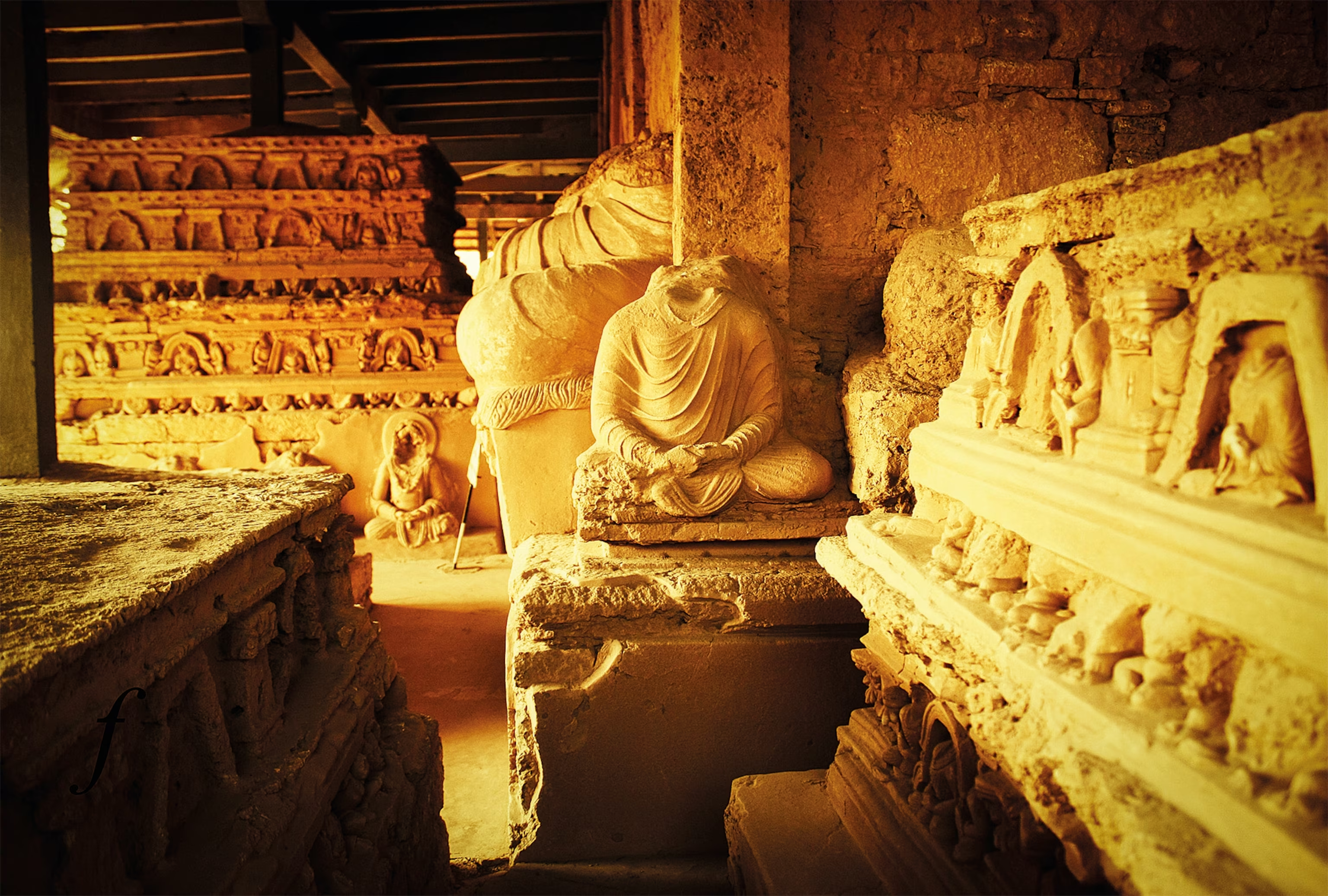
Explore humanity’s great crossroads: Dharmarajika Stupa where Ashoka enshrined Buddha’s relics, Jaulian monastery with 1,800-year-old stucco Buddhas, and Sirkap’s grid streets after Alexander. The Taxila Museum holds world-class Gandharan art where Greek realism met Buddhist spirituality.
Faisal Mosque at Golden Hour
Visit Pakistan’s national mosque at sunset as its Bedouin tent form transforms from white to gold against the Margallas. Turkish architect Vedat Dalokay’s 1969 design features South Asia’s tallest minarets at 90 meters, with Sadequain’s calligraphic mosaics beneath a 600-bulb chandelier.
Margalla Hills Wildlife Trek
Join an early morning wildlife walk through the Margalla Hills leopard reserve, home to at least five common leopards, pangolins, and 300+ bird species. Learn to read pugmarks before reaching Daman-e-Koh viewpoint, where the capital spreads below with Faisal Mosque marking its northern edge.

Saidpur Village Heritage Walk
Step back 500 years to a village founded in 1530. Saidpur preserves a 1580 Hindu temple, Sikh gurdwara, and Mughal architecture along cobblestone lanes—Emperor Jahangir mentioned it in his autobiography. Now restored, it hosts art galleries and restaurants with mountain views.

Shah Allah Ditta Caves & Buddhist Murals
Descend into cave shelters on Margalla Trail 7 where 2,400-year-old Buddhist-era murals survive on rock walls alongside meditation niches carved by monks. The surrounding woodland harbors grey goral, barking deer, and golden jackals in one of the capital’s most atmospheric ancient sites.

Pir Sohawa Sunset
Drive to the highest point in the Margalla Hills at 1,200 meters for panoramic views from Islamabad’s grid to distant Himalayan foothills. After sunset, reduced light pollution above the capital reveals clear night skies for constellation identification and astrophotography.

Stories from Islamabad
A Capital Built From Vision
In 1959, President Ayub Khan commissioned Greek architect Constantinos Doxiadis to create something audacious: a capital city from nothing. Karachi’s colonial associations and refugee pressures made it unsuitable; Pakistan needed a city that could symbolize unity and controlled growth. Doxiadis chose a site on the Pothohar Plateau, sheltered by the Margalla Hills, and designed a master plan based on his theory of ekistics, the science of human settlements. The result was a city divided into lettered and numbered sectors, each containing its own schools, parks, and markets. Streets were designed to separate cars from pedestrians. Green spaces were woven throughout. Growth was planned to occur without losing human scale.
Construction began in 1961. By 1967, Islamabad officially became the national capital. The Secretariat was designed by Italian architect Gio Ponti, the National Assembly by American Edward Durell Stone. But it is the 1986 Faisal Mosque that defines the skyline. Funded by Saudi King Faisal and designed by Turkish architect Vedat Dalokay, the mosque won an international competition with a design that abandoned traditional domes for an eight-sided concrete shell inspired by Bedouin tents. The four 90-meter minarets, influenced by Turkish tradition, frame a prayer hall that can accommodate 10,000 worshippers inside and 100,000 in the surrounding grounds. Against the dark green of the Margallas, the white mosque has become Pakistan’s most recognizable symbol.
Getting to Islamabad
International Flights to Islamabad
Flights to Gilgit & Skardu
Karakoram Highway Overland
Travel with EcoVoyager
Islamabad sits at 508 meters elevation on the Pothohar Plateau in northern Pakistan, sheltered by the Margalla Hills and connected by international flights through Islamabad International Airport to Dubai, Istanbul, London, and major Asian hubs. EcoVoyager coordinates seamless airport transfers, arranges expert archaeological guides for Taxila’s 18 UNESCO-inscribed sites 35 kilometers northwest, provides wildlife-focused treks into the Margalla Hills leopard reserve, and organizes comfortable accommodation for acclimatization before heading north. Domestic flights to Gilgit and Skardu pass directly alongside Nanga Parbat’s 8,126-meter summit, while the Karakoram Highway begins its 1,300-kilometer journey from nearby Rawalpindi.

Explore More
Other Pakistan Destinations

Deosai National Park
Rising above 4,000 meters in the western Himalayas lies Deosai—the second-highest plateau on Earth and one of Pakistan’s last truly...
Explore
Makli Necropolis
When the Sufi saint Sheikh Hamad Jamali established his khanqah on this limestone plateau in the 14th century, he set...
Explore
Harappa
Before Egypt’s pyramids reached their golden age, before classical Greece was imagined, the people of Harappa had already mastered urban...
Explore
Peshawar
Where empires carved their path through the Khyber Pass, Peshawar stands as one of South Asia’s oldest continuously inhabited cities—2,500...
Explore
Karachi
Pakistan's largest city sprawls along the Arabian Sea where Baloch fishermen built the village of Kolachi and Alexander's admiral Nearchus...
Explore
Mohenjo-daro
Five thousand years ago, when Stonehenge was just beginning and the Egyptian pyramids were newly built, a city of 40,000...
Explore
Taxila Pakistan
Before Oxford or Bologna existed, students from across Asia gathered in Taxila to study medicine, mathematics, and philosophy under the...
Explore
Khunjerab Pass
At 4,693 meters, Khunjerab Pass is the world’s highest paved international border crossing—the dramatic culmination of the Karakoram Highway where...
Explore
Passu
The Passu Cones pierce the sky like Gothic spires—a row of impossibly sharp peaks that locals call Tupopdan, ‘the sun-gulping...
Explore
Nanga Parbat
At 8,126 meters, Nanga Parbat claimed 31 lives before Hermann Buhl reached its summit alone and without supplemental oxygen on...
Explore
K2 Base Camp
Stand at the foot of the world's second-highest mountain—and by many measures its most dangerous. K2 rises 8,611 meters above...
Explore
Karakoram Highway
They called it impossible—a road through the highest mountains on Earth. For 20 years, 24,000 Pakistani and Chinese workers carved...
Explore
Swat Valley
German mountaineers called it the Switzerland of the East, but Swat Valley's story runs far deeper than alpine beauty. This...
Explore
Fairy Meadows
German mountaineers searching for a route to Nanga Parbat's summit named this alpine grassland Märchenwiese—'Fairy Tale Meadows'—struck by its otherworldly...
Explore
Lahore
Where the Ravi River flows past marble palaces and minarets that have witnessed six centuries of empire, Lahore preserves the...
Explore
Skardu
Where the Indus and Shigar rivers converge beneath the world's greatest concentration of 8,000-meter peaks, Skardu commands the gateway to...
Explore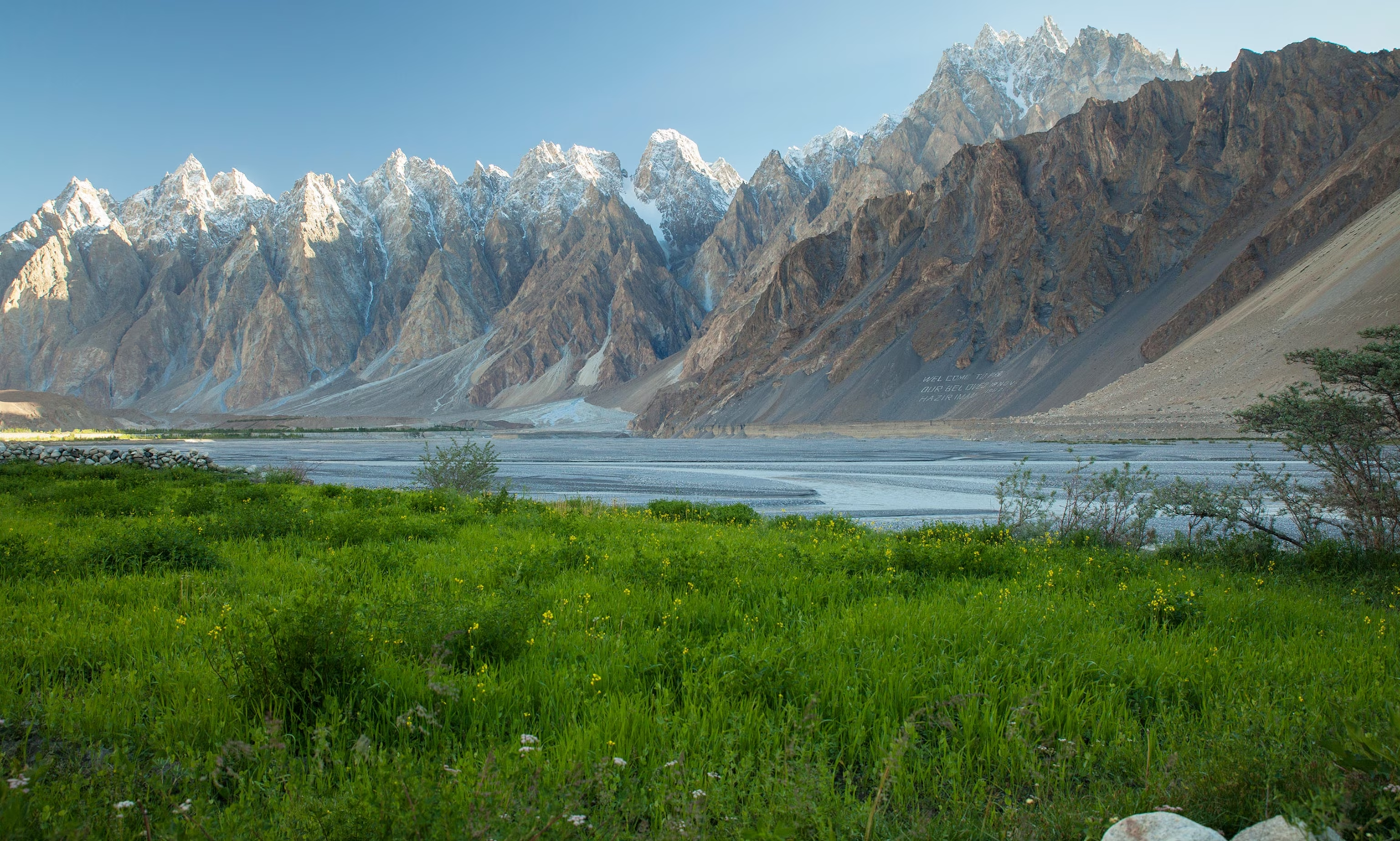
Hunza Valley
Where three of Earth's mightiest mountain ranges converge—the Karakoram, Himalayas, and Hindu Kush—lies a valley that inspired the legend of...
ExploreSwipe to explore more