

Kyrgyzstan
Arslanbob
Arslanbob
Location
Arslanbob
41.3408° / 72.9283°




Experience Arslanbob, Your Way
Skip the standard itineraries. We'll design a journey around your interests, timeline, and travel style — with exclusive access you won't find elsewhere.


Things to Do in Arslanbob
Starting points for your perfect trip
Walnut Forest
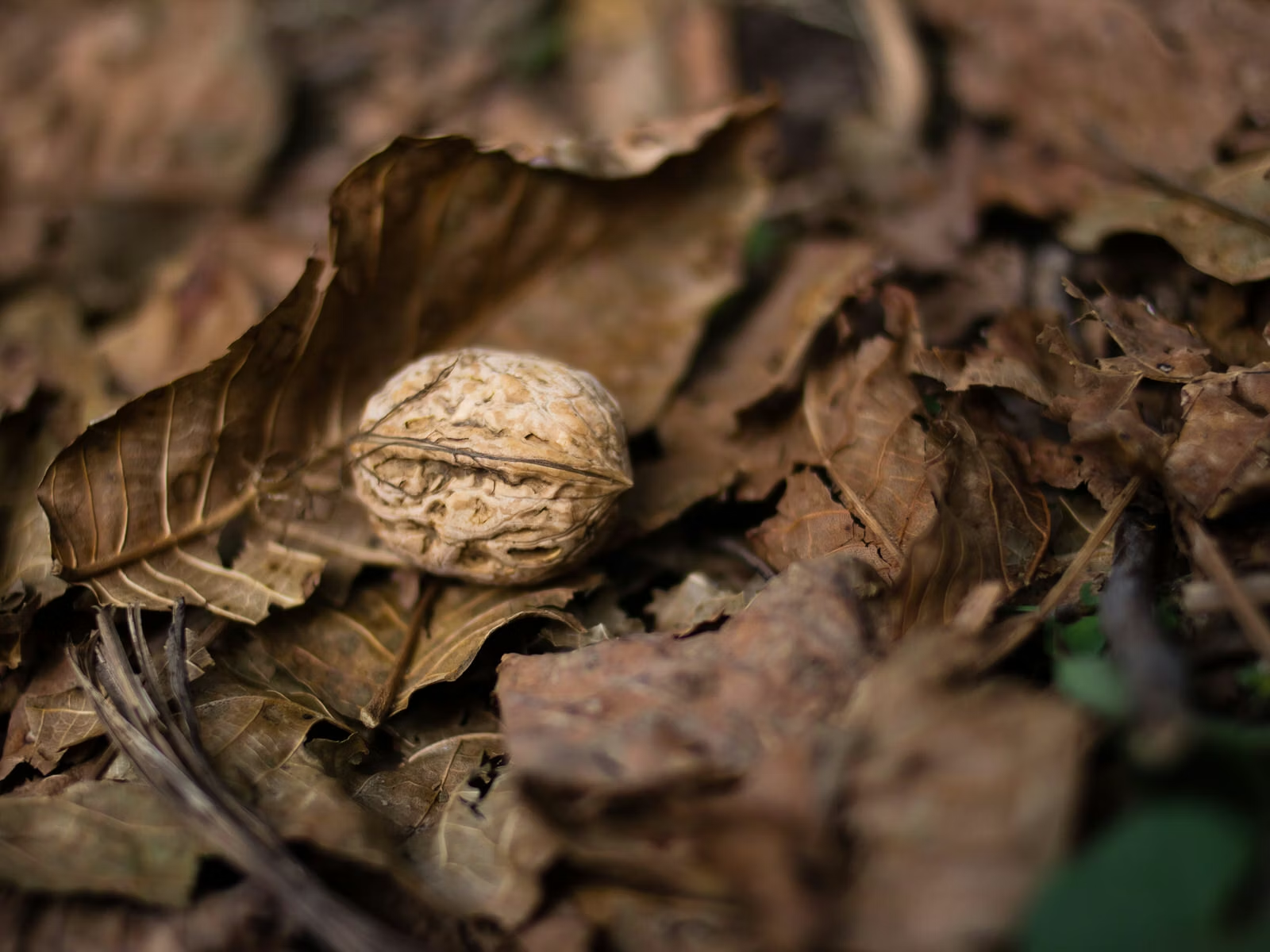
Walk through 11,000 hectares of the world's largest natural walnut forest, where trees up to 1,000 years old tower 30 meters high and 2 meters in diameter. In September, join local families at ancestral harvest camps, learning gathering techniques passed down for generations.
Holy Lake Trek
A demanding 4-day trek through the Babash-Ata Mountains to Kol Mazar, the sacred Holy Lake at 3,200 meters. Cross the Chakmak Tash Pass at 3,262 meters and Ontomo Pass at 3,400 meters, camp on alpine jailoos, and witness local Muslim pilgrims performing rituals at this revered site.
Waterfall Circuit
Hike to both of Arslanbob's waterfalls—the 80-meter Big Waterfall cascading through a dramatic cliff face north of the village, and the 23-meter Small Waterfall with its prayer caves, including the Cave of the 40 Angels where a holy woman reportedly once lived and prayed.
Uzbek Cultural Homestay
Stay with local families through the Community Based Tourism network in this predominantly Uzbek village. Learn to prepare traditional plov over open flame, sample walnut-honey zhansak sweets, and share stories around the evening dastarkhan spread with homemade walnut oil and fresh bread.

Horseback Expedition to the Sere Valley
Ride Kyrgyz horses from Arslanbob across the Chakmak Tash Pass at 3,262 meters, descending into the Sere Valley where yaks graze alpine meadows. The 3-day loop through CBT Arslanbob includes camping on jailoos and passing through landscapes unchanged since Silk Road caravans.

Mazar of Arslanbob-Ata & Sufi Heritage
The 16th-century mazar of Arslanbob-Ata features walnut-wood door frames with ram's horn carvings and adjoins a mosque with an ornate ceiling. This complex is the center of the Hairy Ishans, a Sufi order from the Yasawiya tradition. Pilgrims travel from across Central Asia to pray here.

Stories from Arslanbob
The Birthplace of Walnuts
Arslanbob occupies a fertile valley at 1,500 meters elevation in the Babash-Ata Mountains of southern Kyrgyzstan, where the western Tien Shan ranges descend toward the Fergana Valley. The village of roughly 16,000 predominantly Uzbek inhabitants guards the world’s largest natural walnut forest, an 11,000-hectare expanse stretching across slopes that scientists believe may be the genetic origin of all cultivated walnuts worldwide. Archaeological evidence and oral tradition place the settlement’s founding around 1120 CE, attributed to a revered Sufi figure named Arslanbob-Ata who is said to have planted the first groves and established the village’s spiritual foundations.
The forest’s significance extends far beyond its size. Legend credits Alexander the Great with carrying Arslanbob’s walnuts to Greece during his Central Asian campaigns, giving rise to the Russian name “Greek nut.” More recent botanical research suggests individual trees can live for a millennium, reaching 30 meters in height and 2 meters in diameter. Beyond walnuts, the forest shelters pistachios, almonds, cherries, plums, apples, and pears—over 130 species of trees and shrubs creating an edible landscape that has sustained communities since before Soviet cartographers first mapped these mountains. The Kyrgyz government designated the forest a protected zone, though families continue to hold ancestral harvesting rights.
Getting to Arslanbob
From Osh via Bazar-Korgon
From Bishkek via Shared Taxi
From Jalal-Abad
Travel with EcoVoyager
Arslanbob occupies a fertile valley on the western slopes of the Babash-Ata range, 80 kilometers from Jalal-Abad and 700 kilometers from Bishkek. EcoVoyager connects you with Uzbek guides who grew up harvesting these forests, opening doors to family guesthouses, private walnut grove explorations, and horseback expeditions across 3,200-meter passes to the sacred Holy Lake. Our local partners through the Community Based Tourism network arrange harvest-season participation, mazar pilgrimages with knowledgeable cultural interpreters, and multi-day treks that independent travelers rarely access. You experience the forest through the families who have tended it for centuries.

Explore More
Other Kyrgyzstan Destinations

Jyrgalan Valley
At 2,200 meters in the eastern Tien Shan, Jyrgalan has transformed from a dying Soviet coal town into Kyrgyzstan's most...
Explore
Sary-Chelek Biosphere Reserve
At 1,880 meters in Kyrgyzstan's western Tien Shan, Sary-Chelek Lake lies cradled by ancient walnut forests in one of Central...
Explore
Peak Lenin Base Camp
At 3,600 meters in the Achik-Tash Valley, Base Camp sits beneath 7,134-meter Peak Lenin, the most frequently summited 7,000-meter peak...
Explore
Ala-Kul Lake
First documented by Russian explorer Putimtsoff in 1811, Ala-Kul earned its Kyrgyz name — "Motley Lake" — from surface waters...
Explore
Tash Rabat
At 3,200 meters in the remote Kara-Koyun gorge of Kyrgyzstan’s Inner Tien Shan, Tash Rabat emerges from a mountainside like...
Explore
Jeti-Oguz
Protected as a geological monument in 1975, the Jeti-Oguz formation takes its Kyrgyz name from seven blood-red sandstone cliffs that...
Explore
Skazka Canyon
On the southern shore of Issyk-Kul, Central Asia’s largest alpine lake, wind and water have sculpted Neogene-era sediments into a...
Explore
Burana Tower
Rising from the Chuy Valley 80 kilometers east of Bishkek, the 11th-century Burana Tower is the sole surviving monument of...
Explore
Osh
At 1,000 meters where the Fergana Valley meets the Pamir-Alay foothills, Osh has anchored Silk Road trade for over 3,000...
Explore
Karakol
At 1,770 meters near Issyk-Kul’s eastern tip, Karakol has evolved from an 1869 Russian military outpost into Kyrgyzstan’s adventure capital...
Explore
Song-Kul Lake
At 3,016 meters in the Inner Tian Shan, Song-Kul is Kyrgyzstan's second-largest lake and its largest freshwater body, a 270-square-kilometer...
Explore
Ala Archa National Park
Rising from 1,500 to 4,895 meters just 40 kilometers south of Bishkek, Ala Archa National Park compresses the full drama...
Explore
Bishkek
Sprawling at 800 meters across the Chuy Valley beneath the snow-capped Kyrgyz Ala-Too range, Bishkek is Central Asia's greenest capital—a...
Explore
Issyk-Kul Lake
Mentioned by Chinese envoy Zhang Qian in 138 BCE and crossed by Buddhist monk Xuanzang in 629 CE, Issyk-Kul has...
ExploreSwipe to explore more