

Pakistan
Karakoram Highway
Karakoram Highway
Location
Karakoram Highway
36.3167° / 74.6500°


Experience Karakoram Highway, Your Way
Skip the standard itineraries. We'll design a journey around your interests, timeline, and travel style — with exclusive access you won't find elsewhere.


Things to Do in Karakoram Highway
Starting points for your perfect trip
Complete KKH Expedition to Khunjerab
Drive the full Karakoram Highway from Islamabad to the Chinese border—crossing where three mountain ranges meet, viewing Nanga Parbat and Rakaposhi, exploring ancient Ganish village, cruising Attabad Lake, and standing at Khunjerab Pass (4,714m), the highest paved border crossing.
Hunza Valley & Passu Cones Discovery
Immerse yourself in legendary Hunza Valley. Explore 700-year-old Baltit Fort, photograph the cathedral-like Passu Cones at 6,106m, cross the Hussaini Suspension Bridge over the Hunza River, and trek to Passu Glacier through landscapes that may have inspired the Shangri-La legend.
Attabad Lake & Friendship Tunnels
Experience one of Earth's most dramatic recent transformations. A 2010 landslide dammed the Hunza River and created this 21-km turquoise lake that swallowed the original highway. Boat across luminous waters, drive through the 7-km Friendship Tunnels that restored the route in 2015.

Rakaposhi Base Camp Trek
Trek to the foot of the 7,788m 'Shining Wall'—its 6,000-meter unbroken rise from the Hunza River is Earth's greatest continuous mountain face. Begin from Minapin village through walnut and juniper forest, camp at 3,100m beneath active glacial flanks with views no road can reach.

Eagle's Nest Sunrise & Duikar Village
Climb to the Duikar viewpoint above Karimabad before dawn for what many photographers call Pakistan's finest sunrise—Rakaposhi, Diran, Golden Peak, and Ultar Sar lit in sequence as light sweeps the Hunza Valley. Breakfast in the Burusho village below.

Khunjerab National Park & High Pastures
At the KKH's highest point, Khunjerab National Park protects 2,270 sq km of high-altitude steppe where Marco Polo sheep, Himalayan ibex, and snow leopards roam above 4,000m. Drive through Wakhi herder camps along the Chinese border and scan the ridgelines with your guide.

Stories from Karakoram Highway
Engineering the Impossible
The Karakoram Highway began as a Cold War dream—a strategic corridor linking China and Pakistan through terrain where only mule tracks had existed. Construction started in 1959 as a joint venture between the two nations, but no one anticipated what lay ahead. For twenty years, workers blasted through solid granite, bridged raging torrents, and carved roads into cliff faces where a single misstep meant certain death. Avalanches, landslides, and rockfalls claimed more than 810 Pakistani and 200 Chinese lives—an average of one death for every two kilometers of road.
The completed highway climbs from the Punjab plains to Khunjerab Pass at 4,714 meters, making it the highest paved international road on Earth. It crosses the point near Jaglot where three of the world’s mightiest mountain ranges—the Hindu Kush, Himalayas, and Karakoram—collide in a geological symphony of tectonic force. The Chinese workers who died are buried in a memorial cemetery in Gilgit, their sacrifice honored annually by both nations. When the road finally opened to the public in 1986, it was immediately dubbed the ‘Eighth Wonder of the World.’
Getting to Karakoram Highway
Drive from Islamabad to Gilgit
Fly to Gilgit
Gilgit to Khunjerab Pass
Travel with EcoVoyager
The Karakoram Highway demands time and flexibility—weather, landslides, and altitude all shape the journey. EcoVoyager coordinates the entire expedition, from comfortable transport with experienced mountain drivers to strategic overnight stops that allow proper acclimatization. We arrange accommodations from heritage hotels in Hunza to comfortable lodges in Passu, with local guides who know every viewpoint, suspension bridge, and hidden glacier along this legendary route.

Explore More
Other Pakistan Destinations

Deosai National Park
Rising above 4,000 meters in the western Himalayas lies Deosai—the second-highest plateau on Earth and one of Pakistan’s last truly...
Explore
Makli Necropolis
When the Sufi saint Sheikh Hamad Jamali established his khanqah on this limestone plateau in the 14th century, he set...
Explore
Harappa
Before Egypt’s pyramids reached their golden age, before classical Greece was imagined, the people of Harappa had already mastered urban...
Explore
Peshawar
Where empires carved their path through the Khyber Pass, Peshawar stands as one of South Asia’s oldest continuously inhabited cities—2,500...
Explore
Karachi
Pakistan's largest city sprawls along the Arabian Sea where Baloch fishermen built the village of Kolachi and Alexander's admiral Nearchus...
Explore
Mohenjo-daro
Five thousand years ago, when Stonehenge was just beginning and the Egyptian pyramids were newly built, a city of 40,000...
Explore
Taxila Pakistan
Before Oxford or Bologna existed, students from across Asia gathered in Taxila to study medicine, mathematics, and philosophy under the...
Explore
Khunjerab Pass
At 4,693 meters, Khunjerab Pass is the world’s highest paved international border crossing—the dramatic culmination of the Karakoram Highway where...
Explore
Islamabad
This is the threshold of the high places. Islamabad rises where the Pothohar Plateau meets the Margalla Hills—a planned capital...
Explore
Passu
The Passu Cones pierce the sky like Gothic spires—a row of impossibly sharp peaks that locals call Tupopdan, ‘the sun-gulping...
Explore
Nanga Parbat
At 8,126 meters, Nanga Parbat claimed 31 lives before Hermann Buhl reached its summit alone and without supplemental oxygen on...
Explore
K2 Base Camp
Stand at the foot of the world's second-highest mountain—and by many measures its most dangerous. K2 rises 8,611 meters above...
Explore
Swat Valley
German mountaineers called it the Switzerland of the East, but Swat Valley's story runs far deeper than alpine beauty. This...
Explore
Fairy Meadows
German mountaineers searching for a route to Nanga Parbat's summit named this alpine grassland Märchenwiese—'Fairy Tale Meadows'—struck by its otherworldly...
Explore
Lahore
Where the Ravi River flows past marble palaces and minarets that have witnessed six centuries of empire, Lahore preserves the...
Explore
Skardu
Where the Indus and Shigar rivers converge beneath the world's greatest concentration of 8,000-meter peaks, Skardu commands the gateway to...
Explore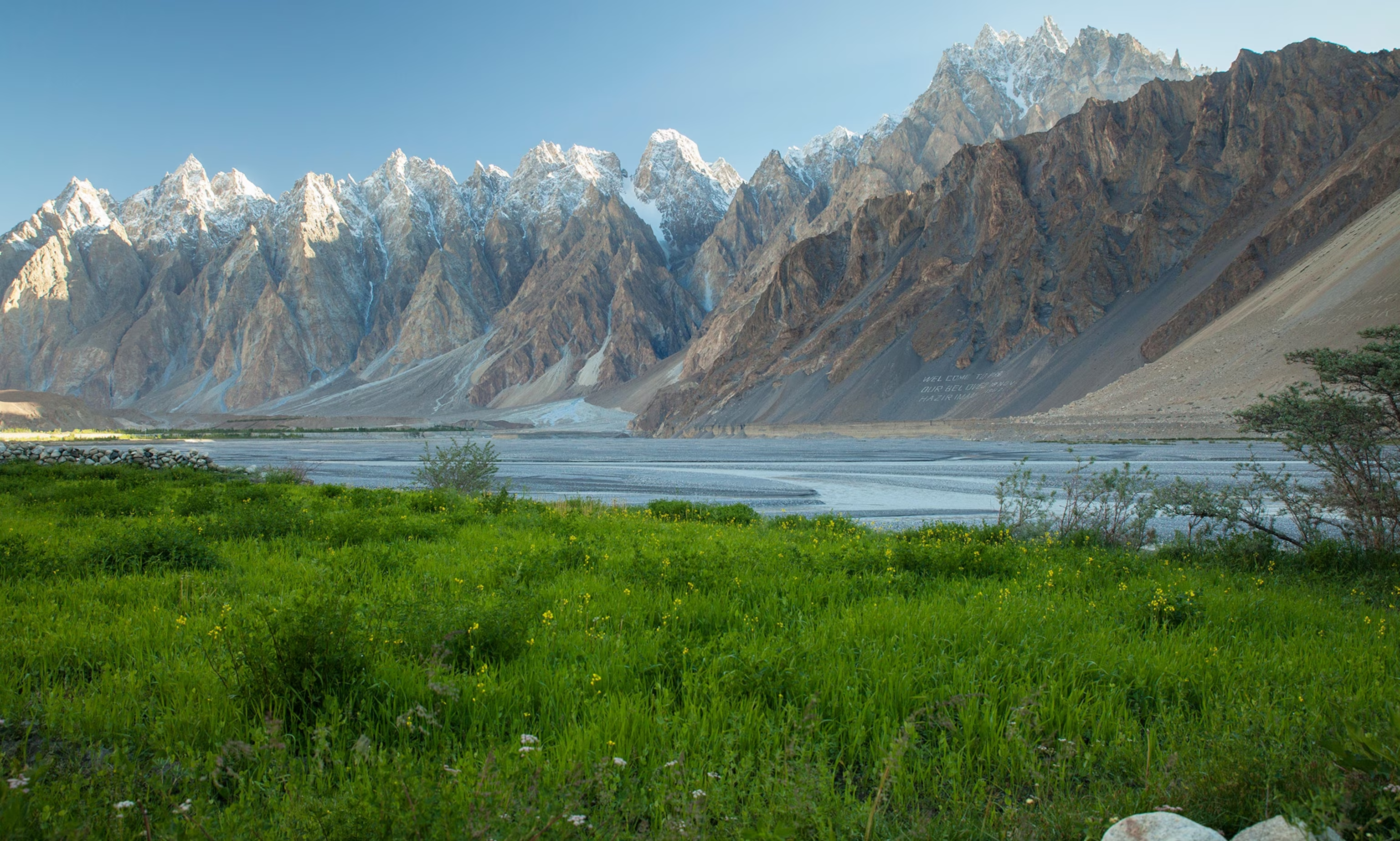
Hunza Valley
Where three of Earth's mightiest mountain ranges converge—the Karakoram, Himalayas, and Hindu Kush—lies a valley that inspired the legend of...
ExploreSwipe to explore more