

Pakistan
Makli Necropolis
Makli Necropolis
Location
Makli Necropolis
24.7519° / 67.7069°


Experience Makli Necropolis, Your Way
Skip the standard itineraries. We'll design a journey around your interests, timeline, and travel style — with exclusive access you won't find elsewhere.


Things to Do in Makli Necropolis
Starting points for your perfect trip
Jam Nizamuddin II Tomb & Samma Royal Cluster
The 11.4-meter square sandstone tomb of Jam Nizamuddin II, completed around 1510, features 14 decorative bands blending Quranic calligraphy with Hindu lotus motifs. Its Gujarati-style jharoka rises to 7.3 meters. The five-acre Samma cluster nearby spans the dynasty that ruled Thatta from 1335 to 1520.
Isa Khan Tarkhan II Mausoleum & Mughal Tombs
The two-story stone mausoleum of Isa Khan Tarkhan II, built before 1644, displays arcaded terraces, majestic cupolas, and walls so profusely carved that legend claims the craftsmen's hands were severed. Nearby, Diwan Shurfa Khan's tomb (d. 1638) showcases Central Asian glazed tilework in brilliant blue and turquoise.
Living Sufi Shrines & Pilgrimage Trail
Twenty-one active shrines within the necropolis draw Muslim and Hindu devotees daily. Sheikh Hamad Jamali's 14th-century khanqah anchors the pilgrimage circuit. Annual urs festivals transform the site with qawwali music, poetry recitations, and thousands of pilgrims — a living tradition unbroken for seven centuries.

Chaukhandi Tombs & Warrior Carvings
Located 29 kilometers south of Makli on the road from Karachi, the Chaukhandi necropolis features sandstone slab tombs carved with mounted warriors, weaponry, and jewelry — motifs unique to lower Sindh's funerary tradition. The distinctive pyramidal structures date from the 15th to 18th centuries.
Shah Jahan Mosque in Thatta
Built between 1647 and 1649 by Mughal Emperor Shah Jahan to thank Thatta for sheltering him during a rebellion, the mosque features 93 domes engineered for natural acoustics — a whisper at one end carries clearly across the prayer hall. Blue and white tilework covers over 6,000 square meters.
Bhambore Archaeological Site & Arab Arrival
The ruins of Bhambore, 65 kilometers southwest of Makli, mark where Muhammad bin Qasim landed in 711 CE — the event that brought Islam to the Indian subcontinent. Excavations reveal layers of Hindu, Buddhist, and early Islamic settlement. A 9th-century mosque here is among the earliest in South Asia.

Stories from Makli Necropolis
Little Makkah: Origins of a Sacred City
The name Makli carries the weight of legend. According to tradition, a pilgrim traveling to Mecca stopped at this hilltop and, overwhelmed by spiritual ecstasy, declared “Hadha Makkah Li”—“This is Mecca for me.” The Sufi saint Sheikh Hamad Jamali heard this story and named the place Makli, establishing a khanqah that would transform this limestone plateau into one of Islam’s most significant burial grounds outside Arabia. The plateau rises roughly 30 meters above the surrounding Indus Delta plain, its eastern edge formed by the Makli Hills ridge, stretching in a diamond shape from Pir Patho at the south to the Samma cluster in the north.
The necropolis rose to prominence under the Samma dynasty, Rajput princes who seized control of Thatta in 1335 and ruled until 1520. When the 14th-century ruler Jam Tamachi expressed his wish to be buried near Sheikh Jamali, he began a tradition that would see kings, queens, governors, saints, scholars, and philosophers interred here for the next four centuries. Thatta flourished as a center of Islamic learning, trade, and culture—European travelers called it an Eldorado of wealth and refinement—and Makli became the mirror of that golden age, its monuments growing ever more elaborate as successive dynasties sought to outdo their predecessors in architectural splendor.
Getting to Makli Necropolis
Private Car or Day Tour from Karachi
Public Transport from Karachi
Extended Sindh Heritage Circuit
Travel with EcoVoyager
Makli sits on a limestone plateau 98 kilometers east of Karachi and 6 kilometers from Thatta, Sindh's former capital at the apex of the Indus River Delta. EcoVoyager connects you with archaeologist-led walks through four centuries of funerary architecture, access to locked mausoleums that open only for guided visitors, and historian-narrated explorations of the Samma, Tarkhan, and Mughal tomb clusters. Our local partners combine Makli with Shah Jahan Mosque's 93 domes and the Chaukhandi Tombs en route, arranging dawn visits to avoid the midday heat and coordinating respectful engagement with the active Sufi shrines that most tour groups bypass.

Explore More
Other Pakistan Destinations

Deosai National Park
Rising above 4,000 meters in the western Himalayas lies Deosai—the second-highest plateau on Earth and one of Pakistan’s last truly...
Explore
Harappa
Before Egypt’s pyramids reached their golden age, before classical Greece was imagined, the people of Harappa had already mastered urban...
Explore
Peshawar
Where empires carved their path through the Khyber Pass, Peshawar stands as one of South Asia’s oldest continuously inhabited cities—2,500...
Explore
Karachi
Pakistan's largest city sprawls along the Arabian Sea where Baloch fishermen built the village of Kolachi and Alexander's admiral Nearchus...
Explore
Mohenjo-daro
Five thousand years ago, when Stonehenge was just beginning and the Egyptian pyramids were newly built, a city of 40,000...
Explore
Taxila Pakistan
Before Oxford or Bologna existed, students from across Asia gathered in Taxila to study medicine, mathematics, and philosophy under the...
Explore
Khunjerab Pass
At 4,693 meters, Khunjerab Pass is the world’s highest paved international border crossing—the dramatic culmination of the Karakoram Highway where...
Explore
Islamabad
This is the threshold of the high places. Islamabad rises where the Pothohar Plateau meets the Margalla Hills—a planned capital...
Explore
Passu
The Passu Cones pierce the sky like Gothic spires—a row of impossibly sharp peaks that locals call Tupopdan, ‘the sun-gulping...
Explore
Nanga Parbat
At 8,126 meters, Nanga Parbat claimed 31 lives before Hermann Buhl reached its summit alone and without supplemental oxygen on...
Explore
K2 Base Camp
Stand at the foot of the world's second-highest mountain—and by many measures its most dangerous. K2 rises 8,611 meters above...
Explore
Karakoram Highway
They called it impossible—a road through the highest mountains on Earth. For 20 years, 24,000 Pakistani and Chinese workers carved...
Explore
Swat Valley
German mountaineers called it the Switzerland of the East, but Swat Valley's story runs far deeper than alpine beauty. This...
Explore
Fairy Meadows
German mountaineers searching for a route to Nanga Parbat's summit named this alpine grassland Märchenwiese—'Fairy Tale Meadows'—struck by its otherworldly...
Explore
Lahore
Where the Ravi River flows past marble palaces and minarets that have witnessed six centuries of empire, Lahore preserves the...
Explore
Skardu
Where the Indus and Shigar rivers converge beneath the world's greatest concentration of 8,000-meter peaks, Skardu commands the gateway to...
Explore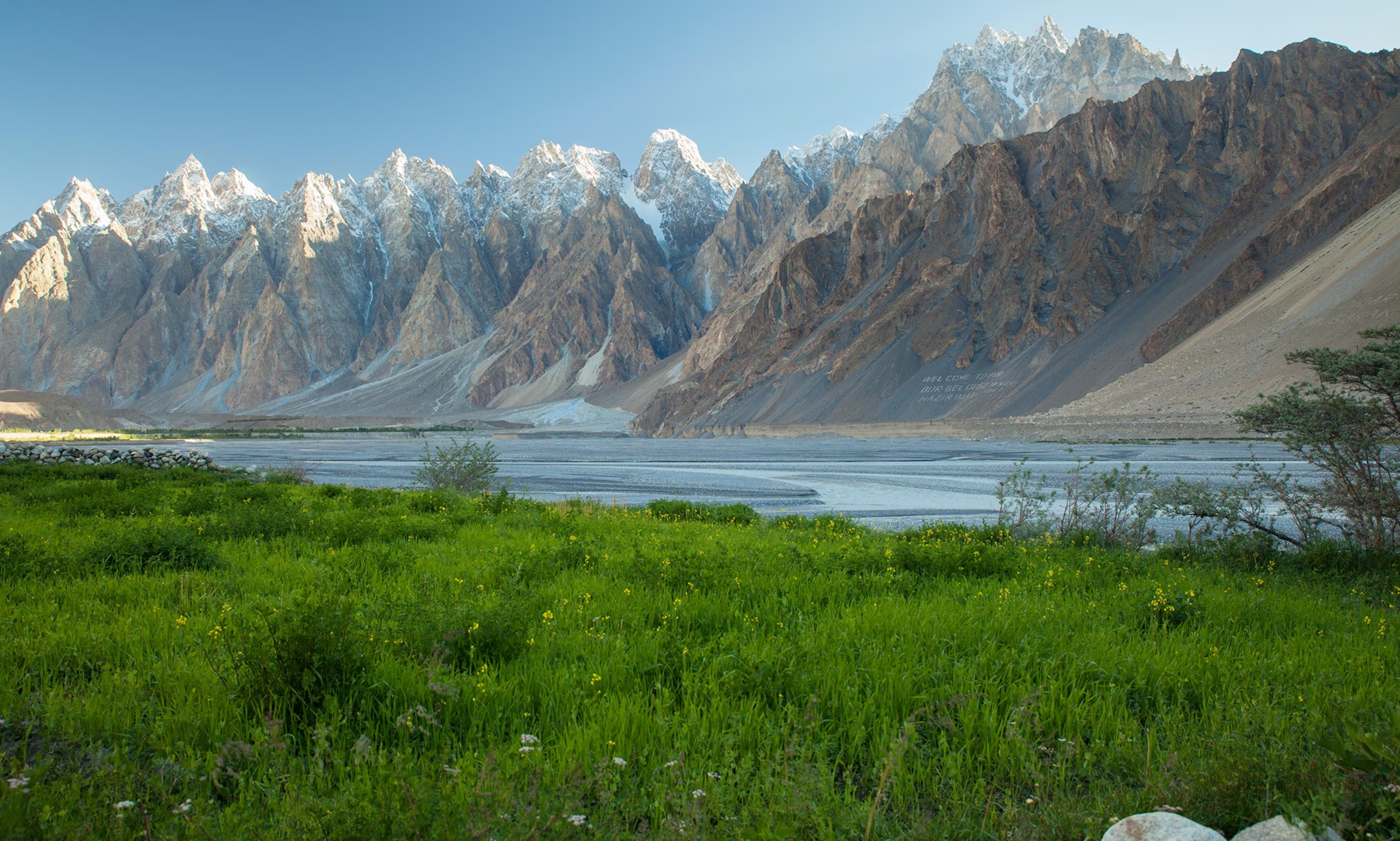
Hunza Valley
Where three of Earth's mightiest mountain ranges converge—the Karakoram, Himalayas, and Hindu Kush—lies a valley that inspired the legend of...
ExploreSwipe to explore more