


Travel to Gobi Desert
Gobi Desert, Mongolia
Gobi Desert
Gobi Desert, Mongolia
Ecovoyager Experiences
Gobi Desert Tours
Handcrafted expeditions into the remote corners of Gobi Desert, led by local experts, designed for the curious traveller.

Experience Gobi Desert, Your Way
Skip the standard itineraries. We design journeys around your interests, timeline, and curiosity with exclusive access you won't find on any platform.


Things to Do in Gobi Desert
Starting points for your perfect trip
Singing Dunes Expedition
Trek the towering Khongoryn Els dunes at sunset, when winds create an otherworldly humming across 180 kilometers of golden sand. Climb 300-meter peaks for panoramic views, then descend to a camel herder's camp in the oasis below.
Dinosaur Discovery Journey
Walk the Flaming Cliffs where Roy Chapman Andrews changed paleontology forever. Explore the red sandstone formations at golden hour, visit the local fossil museum, and search for fragments in the same sediments that yielded Velociraptor.
Ice Canyon & Vulture Valley
Descend into Yolyn Am, a dramatic gorge where ice persists into summer despite the surrounding desert. Hike four kilometers between towering cliffs, watching for lammergeier vultures, ibex, and the rare snow leopard's tracks.

Nomadic Camel Herder Immersion
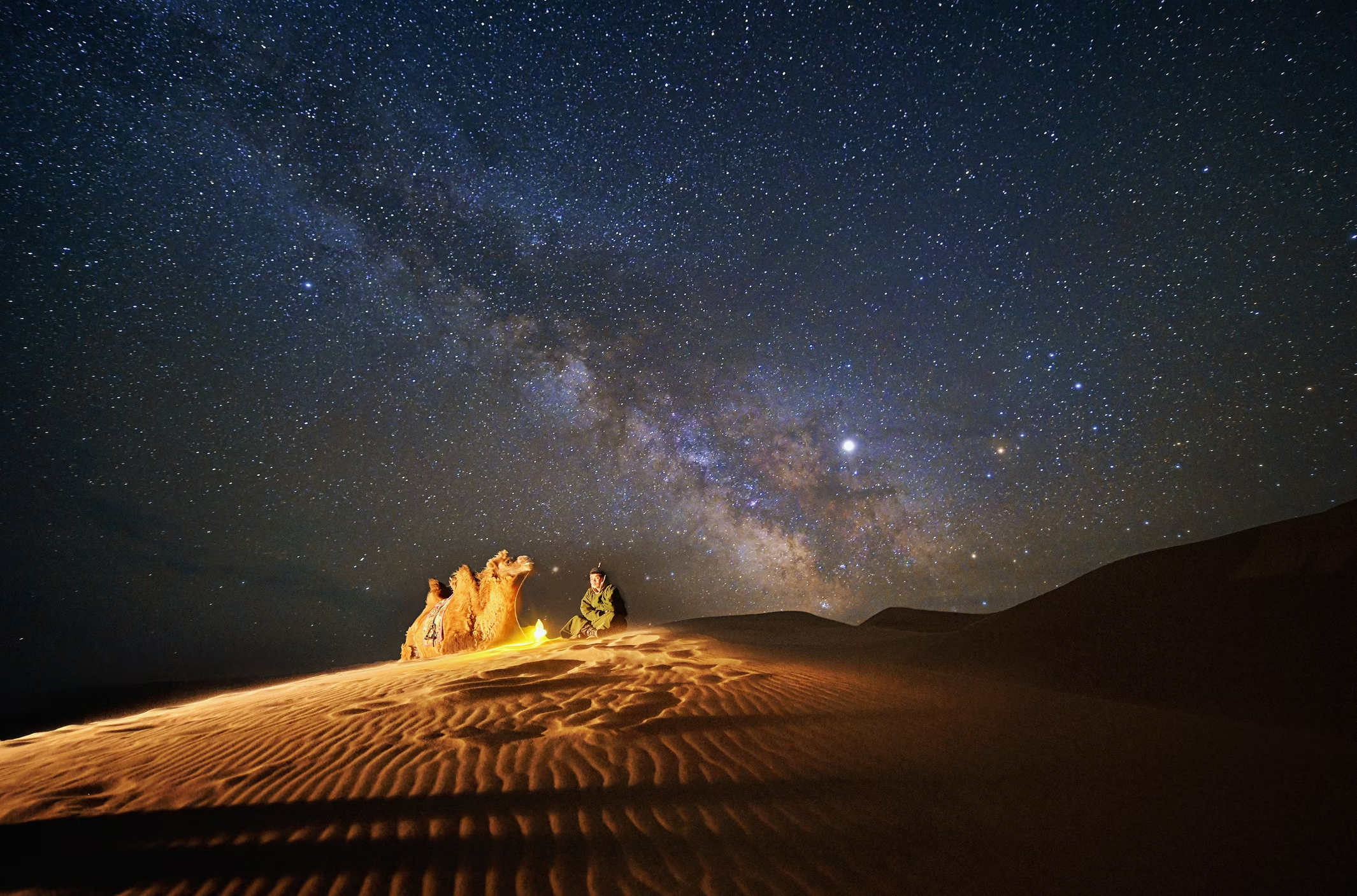
Spend days with a Bactrian camel herding family in the deep Gobi. Learn to milk camels, taste fermented camel yogurt, and ride across the steppe on these patient two-humped companions of the Silk Road.
Design Your Custom Trip
Tell us about your dream adventure. Our travel specialists respond within 24 hours with a personalised itinerary.
Where Dinosaurs Sleep and Dunes Sing
A Closer Look at Gobi Desert

The Desert That Defies Expectation
Forget everything you think you know about deserts. The Gobi—covering 1.3 million square kilometers across Mongolia and northern China—is not a sea of sand but a mosaic of gravel plains, rocky outcrops, mountain ranges, and hidden oases. Mongolians recognize 33 distinct types of Gobi, and true sand dunes cover only 3-5% of this vast territory. At elevations averaging 1,000 to 1,500 meters, this is also the world’s coldest desert, where temperatures plunge to minus 40°C in winter and soar above 40°C in summer.
The Gobi’s heart is protected within Gobi Gurvan Saikhan National Park—Mongolia’s largest at 27,000 square kilometers. Named for the ‘Three Beauties’ mountain ranges that rise dramatically from the desert floor, the park encompasses singing sand dunes, ice-filled canyons, and fossil-rich cliffs. This is a landscape shaped by the same tectonic forces that created the Himalayas, where 80 million years ago, dinosaurs roamed grasslands and marshes that have since turned to stone and sand.
Land of the Dinosaurs
In 1922, American explorer Roy Chapman Andrews led a caravan of camels and automobiles into the Gobi, searching for evidence of early humans. What he found changed paleontology forever. At a site his team named the Flaming Cliffs—for the way the red sandstone glowed at sunset—Andrews discovered the first scientifically recognized dinosaur eggs, proving these ancient creatures reproduced like modern birds and reptiles. The expedition also unearthed Velociraptor, Protoceratops, and Oviraptor, transforming our understanding of Cretaceous life.
Today, the Gobi remains one of the world’s richest dinosaur graveyards. The dry climate and soft sediments have preserved complete skeletons in positions that capture moments frozen 70-80 million years ago—including the famous ‘Fighting Dinosaurs’ fossil showing a Velociraptor locked in combat with a Protoceratops. At the Flaming Cliffs, visitors still find bone fragments eroding from the ancient sediments, though removing fossils without permits is strictly prohibited. The region’s paleontological significance continues to draw researchers from around the world.
Camels, Nomads & the Last Desert Bears
The two-humped Bactrian camel has defined life in the Gobi for over 4,000 years. Domesticated around 2500 BCE, these remarkable animals can carry 200 kilograms across trackless desert, survive weeks without water, and endure temperature swings from minus 40°C to plus 50°C. Mongolia’s 400,000 Bactrian camels provide nomadic herders with transportation, wool for textiles, and milk for sustenance. Each March, the Thousand Camel Festival celebrates this partnership, with camel races, polo matches, and beauty pageants drawing herders from across the region.
In the Gobi’s remote western reaches survives one of earth’s rarest mammals: the Mazaalai, or Gobi bear. Fewer than 40 of these small brown bears remain—the only bears on the planet adapted to desert life. They survive on wild rhubarb, berries, and insects around scattered oases in the Great Gobi Strictly Protected Area. Sharing this harsh habitat are wild Bactrian camels (a separate species from their domestic cousins, with only 950 remaining), snow leopards, ibex, and Mongolian wild ass—a community of survivors in one of earth’s most extreme environments.
From the Journal
Stories from Gobi Desert
Field notes, cultural encounters, and trail dispatches from our guides and travellers in Gobi Desert.
 Wildlife & Conservation
The Mazaalai's Ancient Genome: Why Science Is Rewriting the Story of Earth's Rarest Bear
A 2023 whole-genome study confirmed what conservationists feared: the Mazaalai is not simply an endangered subspecies but the oldest lineage of all brown bears on Earth. With fewer than 52 individuals surviving in Mongolia's Gobi Desert, the stakes of losing this animal have never been clearer.
Read Full StoryMore from the Journal
 Wildlife
WILDLIFE
The Mazaalai: Earth’s Rarest Bear Clings to Survival in Mongolia’s Gobi Desert
Fewer than 50 bears. A desert the size of France. Temperatures swinging from −40°C to 46°C. The Gobi bear wasn’t supposed to survive, and the story of how it has is one of the most remarkable conservation efforts on the planet.
Read Story Destinations
DESTINATIONS
Mongolia's Gobi Desert: A Complete Travel Guide
Singing sand dunes, dinosaur bones, and the rarest bear on Earth. The Gobi Desert is not what you think it is, and that’s exactly why you should go.
Read StoryExplore More
Other Mongolia Destinations
Explore more destinations across Mongolia.
Terkhiin Tsagaan Nuur
High in the Khangai Mountains, where ancient lava dammed the Terkh River eight thousand years ago, Terkhiin Tsagaan Nuur mirrors...
ExploreAmarbayasgalant Monastery
In a remote valley at the foot of Mount Büren-Khaan, where the Iven River flows through grasslands scattered with ancient...
ExploreGorkhi Terelj National Park
Just 60 kilometers from Ulaanbaatar, where granite towers rise from forested valleys and the Terelj River winds through alpine meadows,...
ExploreOrkhon Valley
In the green heart of Mongolia, where the Orkhon River carves through volcanic basalt and grasslands stretch to the horizon,...
ExploreAltai Tavan Bogd National Park
At Mongolia's far western edge, where three nations converge beneath the Altai Mountains, lies one of Earth's last wilderness frontiers....
ExploreÖlgii
In Mongolia's far west, where the Altai Mountains rise along the borders of Russia and China, Kazakh eagle hunters still...
ExploreKhuvsgul Lake
Cradled between snow-capped peaks and Siberian taiga lies Khuvsgul—Mongolia's largest freshwater lake and one of the world's oldest and clearest....
ExploreHustai National Park
Two hours from Ulaanbaatar lies Hustai National Park, sanctuary of the takhi—the world's last truly wild horse. These stocky horses...
ExploreUlaanbaatar Mongolia
In the broad valley of the Tuul River, surrounded by four sacred mountains, lies the world's coldest capital city—a place...
Explore