

By the time a Kyrgyz child can walk, the saying goes, they can already ride. It is not entirely metaphor. In the high summer pastures of the Tian Shan and Pamir-Alay, where families spend May to September moving herds between meltwater rivers and wildflower meadows, children are lifted onto the saddle before they can count to ten. Horses are not a hobby in Kyrgyzstan. They are how the country works.
For travelers, that changes what a horse trek here actually is. It is not a riding lesson with a view. It is a few days inside a culture that has organized itself around the horse for at least three thousand years, and still does.
Journeys behind this story

A Civilization Built in the Saddle
Kyrgyzstan is a country of mountains. Most of it sits above a thousand meters, with valleys walled off by passes that snow over for half the year. Settled farming works in only a handful of those valleys. The high pastures of the Tian Shan, the winter villages tucked into protected gorges, the trade routes between them: everything else requires an animal that can move people and herds across terrain that defeats wheels. For at least three thousand years, that animal has been the horse. The pattern of life it produced is called transhumance, the seasonal migration of whole family communities, with their herds, between winter camps in the lowland gorges and summer pastures, called jailoos, two and three thousand meters above. The Kyrgyz year, the diet, the architecture of the yurt, and the structure of clan and tribe all grew out of this arrangement.
The horses themselves earned a wider reputation. Two thousand years ago, the Han dynasty Chinese emperor Wu became obsessed with the animals bred along Kyrgyzstan’s southern flank in the Ferghana Valley, the broad basin that today straddles southern Kyrgyzstan, Uzbekistan, and Tajikistan, and Chinese chronicles called them Tien Ma, the Heavenly Horses. Silk Road caravans ran through Kyrgyz mountain passes for the next thousand years, leaving behind stone monuments like the caravanserai of Tash-Rabat, still standing in the At-Bashy mountains today as a stop on one of the country’s classic horse trails.
In Kyrgyz culture, a horse is not livestock. It is closer to family. A herder’s standing was historically measured by the size of his herd, with forty horses signaling real wealth, and the gift of a horse to an honored guest carried roughly the weight that handing over the keys to a new car carries in the West. The proverbs are concrete: “A man without a horse is not a man.” “Horses are the wings of the Kyrgyz.” Horses still appear in every life passage. Part of the kalym, the bride price the groom’s family pays at marriage, was traditionally counted in horseflesh. Wedding celebrations include kyz-kuumai, in which the bride is given the family’s fastest horse and a head start, and her suitor must catch her at full gallop, kissing her if he succeeds and being whipped back to the start with her riding crop if he fails. Funerals call for the slaughter of a mare and the sharing of the meat among mourners. A man’s saddle is sometimes hung above his grave.
The animal at the center of all this is the Kyrgyz Mountain horse. It is small by Western standards, about fourteen hands or four feet eight inches at the shoulder; most American and European riding horses stand a head taller. What the Kyrgyz horse gives up in size, it returns in toughness. It grazes through snow in winter, climbs scree slopes that defeat larger animals, and moves at a four-beat amble called the jorgo, a gait that feels less like a trot’s bounce and more like sitting in a chair as the ground passes under you. A Kyrgyz herder reads his horses the way other cultures read wine vintages: by gait, by character, by memory of bloodline four generations back. A particularly fast or smooth-gaited stallion has a name people in the next valley know. These are the horses you ride if you come.

Horseback Trekking in Kyrgyzstan
Riding here happens at altitude, between two and four thousand meters in most cases, through rolling green pasture, alpine lakes, and limestone canyons. The horses are calm and steady, though they have personalities. Days in the saddle run three to eight hours. Yurts run by herder families form the standard accommodation, with food cooked on iron stoves and a sky at night that justifies the entire journey.

Where to Ride
The Kilemche Valley to Son-Kul Lake is the classic introduction. A point-to-point ride from Kyzart village in central Naryn province climbs through the Kilemche jailoo, named “carpet” in Kyrgyz for the wildflowers that blanket its slopes from June through August, before cresting the Tuz Ashu pass at 3,400 meters and descending to Son-Kul at 3,016 meters. The route is gentle enough for first-time riders and runs through one of the country’s most active summer pasture communities. Yurts on the lakeshore serve kymyz, the fermented mare’s milk that is the Kyrgyz national drink, alongside fresh kurut cheese and komuz music as the evening light turns the water gold.
EcoVoyager runs this as the three-day Son-Kul by Horseback trek, and as the third riding leg of the twelve-day Kyrgyzstan Horse Riding Expedition.
Tash-Rabat to Panda Pass is the Silk Road heritage ride. From the fifteenth-century stone caravanserai mentioned earlier, a long day in the saddle climbs to Panda Pass at four thousand meters, with views down to the salt-rimmed border lake of Chatyr-Kul and into China beyond. Riders who want to descend to the lake itself need a border permit and an overnight at a herder yurt camp.
EcoVoyager includes this ride in the fifteen-day Wild Kyrgyzstan: Eagles, Nomads & the Ancient Silk Road tour, which overnights at the caravanserai.
The Chon Kemin Valley to Issyk-Kul is the northern leg. From Tar Suu village in the Chon Kemin Valley, a two-day ride climbs through the Akkytay pastures with panoramic views back across the valley, building toward the base of the Kalmak Ashu pass where camp is set in a high alpine meadow. The second day crosses the pass at 3,530 meters and descends through grazing country to the north shore of Lake Issyk-Kul at Balykchy.
EcoVoyager runs this as the first riding leg of the twelve-day Kyrgyzstan Horse Riding Expedition.

Semyonov Gorge to the Kungei Ala-Too jailoo is the north-shore forest ride. From Semyonovka village near Issyk-Kul’s northern shore, a few hours in the saddle climb up Semyonov Gorge along the Chon Ak-Suu River, through dense Tien Shan spruce forest, before opening onto a wide alpine jailoo at 2,010 meters beneath the glaciated peaks of the Kungei Ala-Too. Overnight with herder families.
EcoVoyager runs this as the first riding day of the eight-day Issyk-Kul Circuit Expedition, which circles the lake with two days in the saddle.
Bokonbaevo to Tash-Tar Ata is the south-shore high country. From Kara Tumshuk village near the southern shore of Issyk-Kul, a two-day ride climbs steadily through rolling highland pastures, crossing the Kyzyl-Kia area at 3,300 meters, with sunset views over the lake from a high mountain camp. The second day climbs to the summit of Tash-Tar Ata at 3,600 meters, the high point of the route, where the full expanse of Issyk-Kul opens out below, before descending to the Boz-Salkyn jailoo.
EcoVoyager runs this as the second riding leg of the twelve-day Kyrgyzstan Horse Riding Expedition.
The Alay Valley is the southern high country. A trek through the lower Alay Mountains crosses two passes: Airy Bell at 2,956 meters and Ak Tor at 3,557 meters. The summit of Ak Tor opens onto one of the great panoramas in Central Asia, the entire flat-bottomed Alay Valley stretched out below, framed to the south by the Trans-Alay Range and Lenin Peak at 7,134 meters. Nights are spent in working shepherd-family yurts in some of the most active nomadic country left on the continent.
EcoVoyager runs this as the six-day Alay Valley Horseback Trek, starting and ending in Osh.

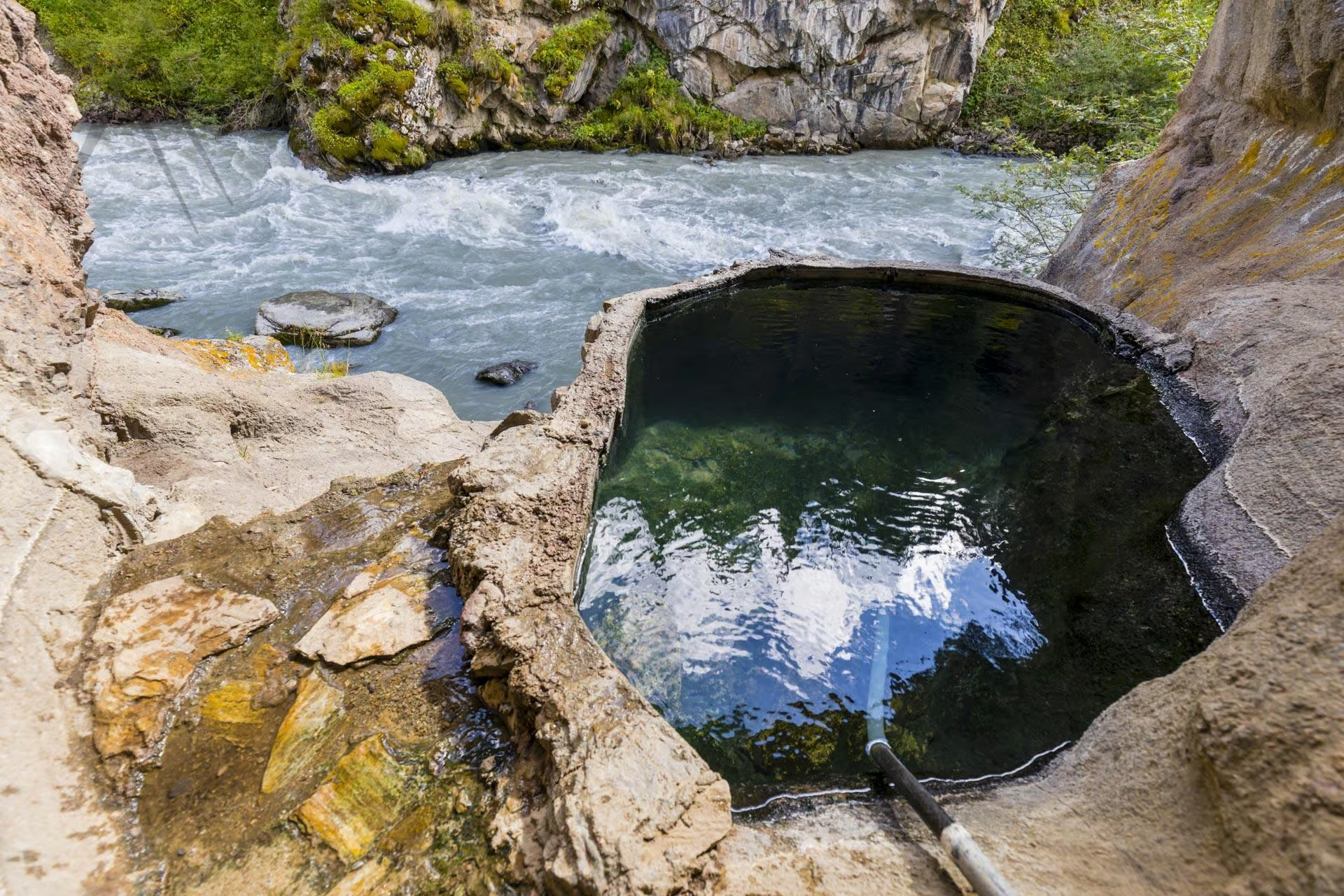
Jyrgalan to Altyn-Arashan is the eastern circuit. From the Jyrgalan Valley, a former coal-mining village in the eastern Terskey Ala-Too reborn as one of Central Asia’s most respected community-tourism bases, three riding days cross five passes above 3,300 meters, including the Ailanysh Pass at 3,676 meters. The route sleeps at the Boz-Uchuk plateau lakes, traverses the Ailanysh basin, and ends at the geothermal hot springs of Altyn-Arashan, where natural pools heated to 35 to 43 degrees Celsius sit in a pine-forested valley at 2,500 meters.
EcoVoyager runs this as the eight-day Jyrgalan to Altyn-Arashan Horseback Trek, with both shores of Issyk-Kul on the drives in and out.
The Jyrgalan River valley to Eki-Chat jailoo is the Manas-country day ride. From the village of Jyrgalan, a day in the saddle follows the Jyrgalan River up the valley, passing Tulpar-Tash, the legendary Horse Rock from the Manas epic, to a shepherd camp at the Eki-Chat jailoo at 2,610 meters before riding back.
EcoVoyager runs this as the second riding day of the eight-day Issyk-Kul Circuit Expedition.
A half-day in the Son-Kul jailoos is the lighter option for travelers who want to encounter horse culture without committing to multi-day riding. A morning’s ride from the lakeshore camp climbs into the surrounding pastures, past working shepherd yurts and herds of horses moving between water and grass, before turning back to the lake.
EcoVoyager folds this into the fifteen-day Wild Kyrgyzstan: Eagles, Nomads & the Ancient Silk Road tour, alongside the Tash-Rabat caravanserai, the walnut forests of Arslanbob, and a private demonstration with a multi-generation eagle hunter from the World Nomad Games.
The horse, the Kyrgyz say, is the wings of the Kyrgyz. For a few days in summer, on the right route with the right family, a traveler gets to borrow them.
EcoVoyager runs small-group and private horse expeditions in Kyrgyzstan from June through September. Browse the full collection of horseback trips or get in touch to start planning.