


Travel to Atacama Desert
San Pedro de Atacama, Chile
Atacama Desert
San Pedro de Atacama, Chile
Experience Atacama Desert, Your Way
Skip the standard itineraries. We design journeys around your interests, timeline, and curiosity with exclusive access you won't find on any platform.


Things to Do in Atacama Desert
Starting points for your perfect trip
El Tatio Geysers
Reach the world's highest geyser field at 4,320m before dawn, when 80 active geysers erupt at -20°C. Steam columns rise 10m as sunrise turns the field into light and vapor. El Tatio — "The Weeping Grandfather" in Kunza — is the third-largest geyser field on Earth and a Mars-life analogue.
Desert Stargazing
The Atacama offers 300+ cloudless nights and near-zero light pollution, hosting half the world's ground-based astronomy projects including ALMA — 66 radio telescopes at 5,050m. Through professional telescopes, observe Saturn's rings, Jupiter's moons, and nebulae invisible from the Northern Hemispher
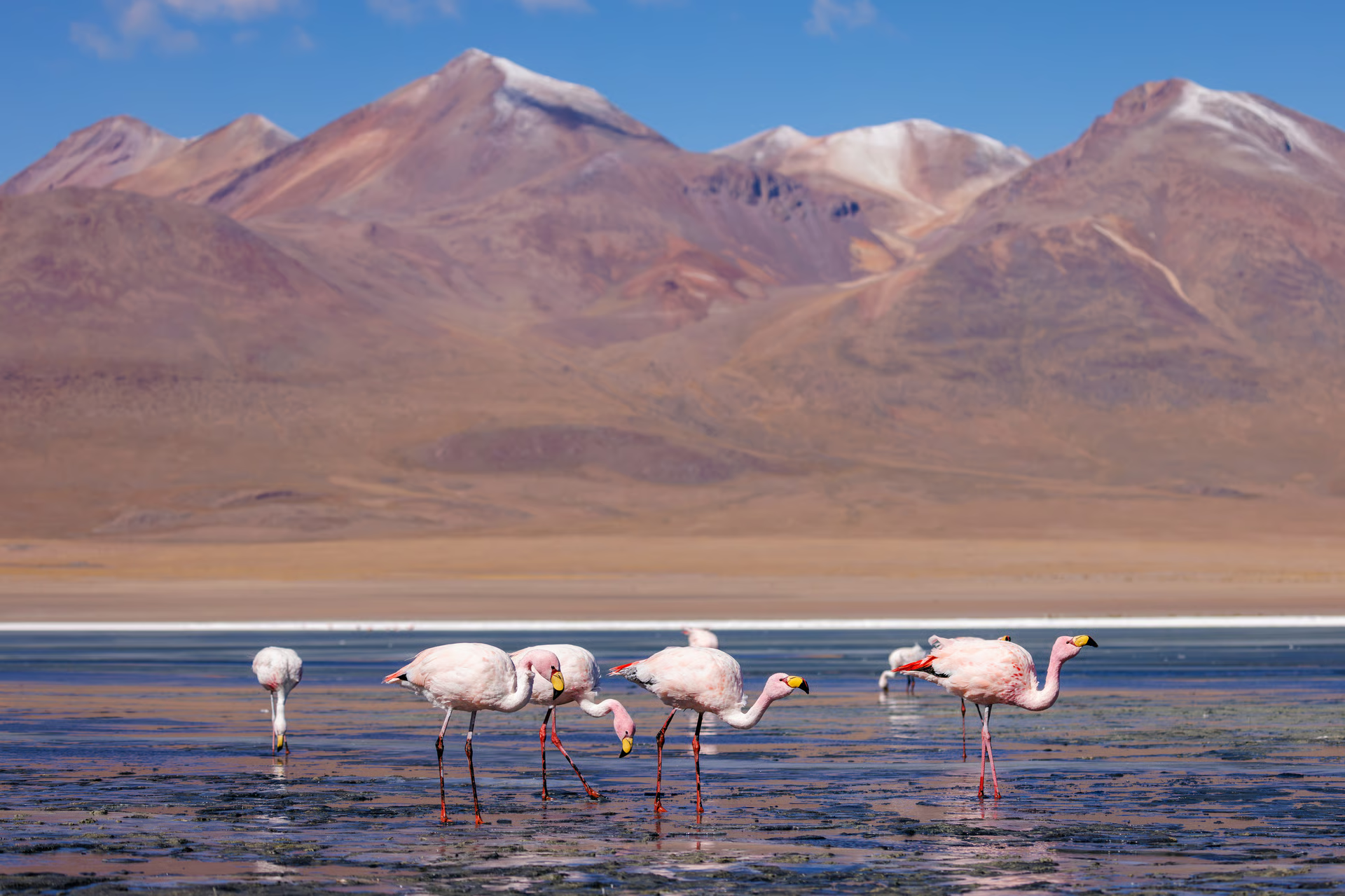
Salt Flat Flamingos
At Laguna Chaxa, three flamingo species feed in water that shouldn't exist in the driest desert on Earth. Chilean, Andean, and James's flamingos filter brine shrimp from salt-rimmed lagoons beneath volcanic peaks. The globally vulnerable Andean flamingo uses Chaxa as its key Chilean nesting site.
Pukará de Quitor
Walk the walls of Pukará de Quitor, a 12th-century fortress where 300 Atacameño defenders fell to Spanish forces in 1540. Then visit Aldea de Tulor, a village from 300 BC buried under sand for millennia. Together they span 10,000 years of Atacama life, from hunter-gatherers to the Lickanantay.
Altiplanic Lagoons & Piedras Rojas
At 4,100m, twin lagoons Miscanti and Miñiques sit beneath their namesake volcanoes, split by ancient lava. Nearby, Piedras Rojas reveals vivid red rock against turquoise water and white salt. Vicuñas graze the altiplano while three flamingo species patrol this remote sector of Los Flamencos Reserve.
Puritama Canyon & Thermal Springs
Follow the Puritama River through a desert canyon past 7m cardón cacti, then descend to eight geothermal pools at 3,475m. "Puritama" means "hot water" in the extinct Kunza language. The springs, used by Atacameño people for centuries, emerge at 28–33°C, heated by the Putana Volcano.
Design Your Custom Trip
Tell us about your dream adventure. Our travel specialists respond within 24 hours with a personalised itinerary.

Stories from Atacama Desert
The Oldest Desert, the Oldest People
The Atacama has been arid for at least 3 million years, making it the oldest desert on Earth. Some weather stations here have never recorded a single drop of rain. Yet this seeming emptiness conceals a landscape of extraordinary complexity: salt flats covering 3,000 square kilometers, volcanic peaks exceeding 5,900 meters, geothermal fields studied as analogues for Mars, and lagoons sustaining species found nowhere else.
Human settlement reaches back over 10,000 years. The Lickanantay, also known as the Atacameño, arrived as nomadic hunters when the region was wetter than it is today. As the land dried, they adapted with extraordinary ingenuity, developing irrigation systems, building fortified pukaras along the San Pedro River, and establishing trade networks stretching across the Andes. Their language, Kunza, was declared extinct in the mid-20th century, but revival programs launched in the early 2020s are working to reconstruct and teach it to younger generations. About half of San Pedro de Atacama’s 11,000 residents identify as Lickanantay, and tourism has become an important force in keeping traditional communities together.
Explore More
Other Chile Destinations
Explore more destinations across Chile.
Juan Fernández Islands
Discovered by Spanish navigator Juan Fernández in 1574, this remote volcanic archipelago 670 kilometers off the Chilean coast has captivated...
ExploreEaster Island
Settled by Polynesian navigators around the 12th century, Rapa Nui, also known as Easter Island, sits 3,700 kilometers from the...
ExploreCape Horn
Discovered in 1616 by Dutch navigators and named after the town of Hoorn in the Netherlands, Cape Horn is a...
ExploreTorres del Paine
Twelve million years of tectonic force thrust granite spires through older sedimentary rock, then Patagonian glaciers carved valleys, lakes, and...
ExploreCarretera Austral & Aysén
Chile’s Route 7 stretches 1,240 kilometers through some of the last truly wild landscapes on Earth, from Puerto Montt to...
ExploreChiloé Island
South America’s fifth-largest island sits separated from the Chilean mainland by the Chacao Channel, a narrow passage that created centuries...
ExploreLake District
Stretching from the Mapuche heartland south to Puerto Montt, Chile’s Lake District holds seven national parks, a dozen glacial lakes,...
ExploreChile Wine Country
Chile is the only major wine-producing country never touched by phylloxera, the root louse that devastated vineyards worldwide. Protected by...
ExploreValparaíso
Named by Spanish explorer Juan de Saavedra in 1536 after his hometown, Valparaíso rose to become the premier port on...
ExploreSantiago
Founded by Pedro de Valdivia in 1541 at the foot of a volcanic hill the indigenous Mapuche called Huelén, Santiago...
ExploreElqui Valley
Tucked between the Andes and the southern Atacama Desert, the Elqui Valley is a ribbon of green vineyards and ancient...
Explore