


Travel to Ranomafana National Park
Ranomafana, Madagascar
Ranomafana National Park
Ranomafana, Madagascar
Ecovoyager Experiences
Ranomafana National Park Tours
Handcrafted expeditions into the remote corners of Ranomafana National Park, led by local experts, designed for the curious traveller.

Experience Ranomafana National Park, Your Way
Skip the standard itineraries. We design journeys around your interests, timeline, and curiosity with exclusive access you won't find on any platform.


Things to Do in Ranomafana National Park
Starting points for your perfect trip
Golden Bamboo Lemur Encounter
Trek through bamboo groves at dawn with Centre ValBio-trained guides to observe the world's only cyanide-eating primate. Watch these critically endangered lemurs consume bamboo shoots containing lethal doses of poison, a mystery that still puzzles scientists. Only 1,000 remain on Earth.
Nocturnal Rainforest Safari
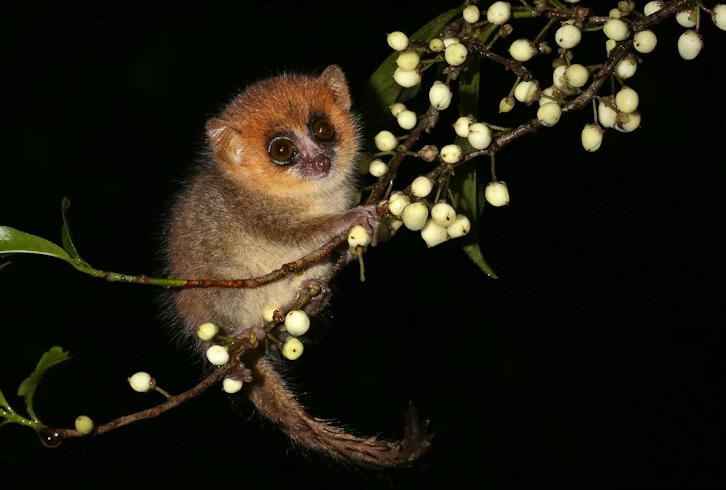
After dark, the forest transforms. Join expert spotters to find mouse lemurs with glowing eyes, sleeping chameleons, and bizarre insects that vanish by daylight. These tiny primates—among the world's smallest—often approach within arm's reach.
Waterfall Circuit
Follow the Namorona River through primary rainforest to cascading waterfalls, then soak in the thermal pools that give Ranomafana its name—'hot water' in Malagasy. Colonial-era bath houses blend with natural rock pools where volcanic heat meets rainforest cool.
Conservation Science Immersion
Visit Centre ValBio, the research station founded by Dr. Patricia Wright, for an exclusive behind-the-scenes look. Meet researchers studying lemur behavior, explore discoveries in primate genetics, and see how science and community conservation work together.
Design Your Custom Trip
Tell us about your dream adventure. Our travel specialists respond within 24 hours with a personalised itinerary.
Where Hot Springs Meet Rainforest Discovery
A Closer Look at Ranomafana National Park
The Rainforest That Changed Science
In 1986, American primatologist Patricia Wright arrived in Madagascar searching for the greater bamboo lemur—a species presumed extinct. What she found would transform conservation science. In the misty forests that would become Ranomafana National Park, Wright not only rediscovered her quarry but stumbled upon an entirely new species: the golden bamboo lemur, a creature so extraordinary it consumes bamboo containing twelve times the lethal dose of cyanide for an animal its size. How it survives remains one of biology’s enduring mysteries.
Wright’s discovery sparked urgent action. When loggers arrived to harvest the forest’s precious hardwoods, she walked village to village, negotiating boundaries with local communities. In 1991, Ranomafana became Madagascar’s fourth national park. In 2007, it earned UNESCO World Heritage status as part of the Rainforests of the Atsinanana. Today, the 41,600-hectare park protects one of the world’s most biologically significant rainforests—a living laboratory where researchers have published over 900 scientific papers and trained generations of Malagasy conservationists.
A Living Laboratory of Evolution
Madagascar split from Africa 160 million years ago and from India 88 million years ago, creating an evolutionary pressure cooker where species developed in glorious isolation. Ranomafana showcases this isolation’s results: twelve lemur species occupy distinct ecological niches, from the six-kilogram Milne-Edwards’ sifaka—where females dominate males, a trait nearly unique among primates—to the brown mouse lemur weighing just 40 grams. Three bamboo lemur species share the same forest by eating different parts of the bamboo plant at different times of day.
Beyond lemurs, the park harbors 118 bird species (30 endemic to the region), 112 frog species, 22 species of lizard, 22 snakes, and over 90 butterfly species. The bizarre giraffe-necked weevil—with males sporting necks three times longer than females for jousting competitions—has become a tourist attraction. Carnivorous pitcher plants trap insects in the understory while massive tree ferns create a prehistoric atmosphere. Centre ValBio researchers have described new species of lemur, chameleon, and even leech from this single forest.
Hot Springs, Sacred Lakes & Tanala Traditions
Long before scientists arrived, the Tanala and Betsileo people knew these forests intimately. ‘Ranomafana’ means ‘hot water’ in Malagasy, named for the thermal springs where locals have bathed for generations. During the French colonial period, the springs became a formal spa destination, and today visitors can soak in the 40°C pools after rainforest treks. The park’s Vohiparara circuit leads to a sacred lake where traditional beliefs still hold power.
The Tanala—‘people of the forest’—have developed sophisticated knowledge of medicinal plants over centuries. Many species within Ranomafana are used in traditional healing, knowledge that modern researchers increasingly recognize as valuable. Centre ValBio partners with 52 villages, 34 schools, and 20 conservation clubs, employing over 80 local community members as guides and research assistants. This integration of science with traditional knowledge represents a new model for conservation—one where protecting nature and supporting communities become inseparable goals.
Explore More
Other Madagascar Destinations
Explore more destinations across Madagascar.
Ifaty-Mangily
Along Madagascar's sun-drenched southwest coast lies Ifaty-Mangily—where the world's fifth-largest coral reef meets one of Earth's strangest forests. Here, 1,200-year-old...
ExploreAntananarivo
Perched 1,300 meters above sea level on the sacred hills of Imerina, Antananarivo is no ordinary capital—it is the threshold...
ExploreAnkarafantsika National Park
In northwestern Madagascar lies a realm where the extraordinary is ordinary—where lemurs dance across the forest floor on two legs,...
ExploreNosy Be
Rising from the turquoise waters of the Mozambique Channel lies Nosy Be—Madagascar's island jewel and gateway to one of earth's...
ExploreIsalo National Park
Rising from the grasslands of southern Madagascar, the Isalo Massif is a sandstone labyrinth carved by 180 million years of...
ExploreTsingy de Bemaraha
Rising from Madagascar's remote western plateau lies one of Earth's most alien landscapes—a 200-million-year-old labyrinth of razor-sharp limestone pinnacles that...
ExploreAvenue of the Baobabs
Along a dusty red road in western Madagascar, some 25 ancient baobabs stand like sentinels from another age—survivors of forests...
ExploreMasoala National Park
On Madagascar's remote northeastern coast lies Masoala—the island's largest national park and one of Earth's most biodiverse places. Here, primary...
ExploreAndasibe-Mantadia National Park
In the mist-shrouded rainforests of eastern Madagascar, a haunting melody echoes through ancient trees each morning—the song of the indri,...
Explore