Bolivia's Wild East: Jaguars, Cloud Forest and Lost Missions
Duration
11 Days
From
$4,200
Group
Max 10 Guests
Difficulty
Moderate
Bolivia
Santa Cruz, Bolivia
Location Overview
Santa Cruz, Bolivia
In Bolivia's tropical lowlands, where the Andes tumble into the Amazon, Santa Cruz opens doors to landscapes found nowhere else on Earth. This is the gateway to Kaa-Iya, South America's largest protected dry forest, where jaguars prowl in densities rivaling the Pantanal. It's the starting point for the Jesuit Missions of Chiquitos, where 5,000 baroque music sheets were rediscovered in churches that still hold mass today. From Amboró's three-ecosystem collision to the mysterious carved rock of Samaipata, this region rewards those who venture beyond the expected.


1 / 10
Ecovoyager Experiences
Handcrafted expeditions into the remote corners of Santa Cruz de la Sierra, led by local experts and designed for the curious.
Bolivia
An 11-day expedition through Amboro National Park, the Gran Chaco, and the UNESCO Jesuit Missions of the Chiquitania
Bolivia
A 19-day expedition from La Paz through the Cordillera Real, the Yungas, and the Bolivian Amazon in search of the lost Moxos civilization
Bespoke Travel
Skip the standard itineraries. We design journeys around your interests, timeline, and curiosity, with access you will not find on any platform.
Experiences
Starting points for your perfect trip
Ready to create something unique?
Tell us your vision and we will make it happen
Santa Cruz, Bolivia

Santa Cruz de la Sierra · 01 / 03
Chapter 01 / 03
Nowhere else on Earth do three major ecosystems collide quite like they do around Santa Cruz. To the west, Amboró National Park marks where the Andes descend into lowland jungle; to the east, the Gran Chaco's dry forests stretch toward Paraguay; and threading between them, the Amazon basin's influence brings moisture and life. This convergence creates biological diversity that staggers even seasoned naturalists: Amboró alone harbors 912 bird species, more than the United States and Canada combined, within 4,425 square kilometers.
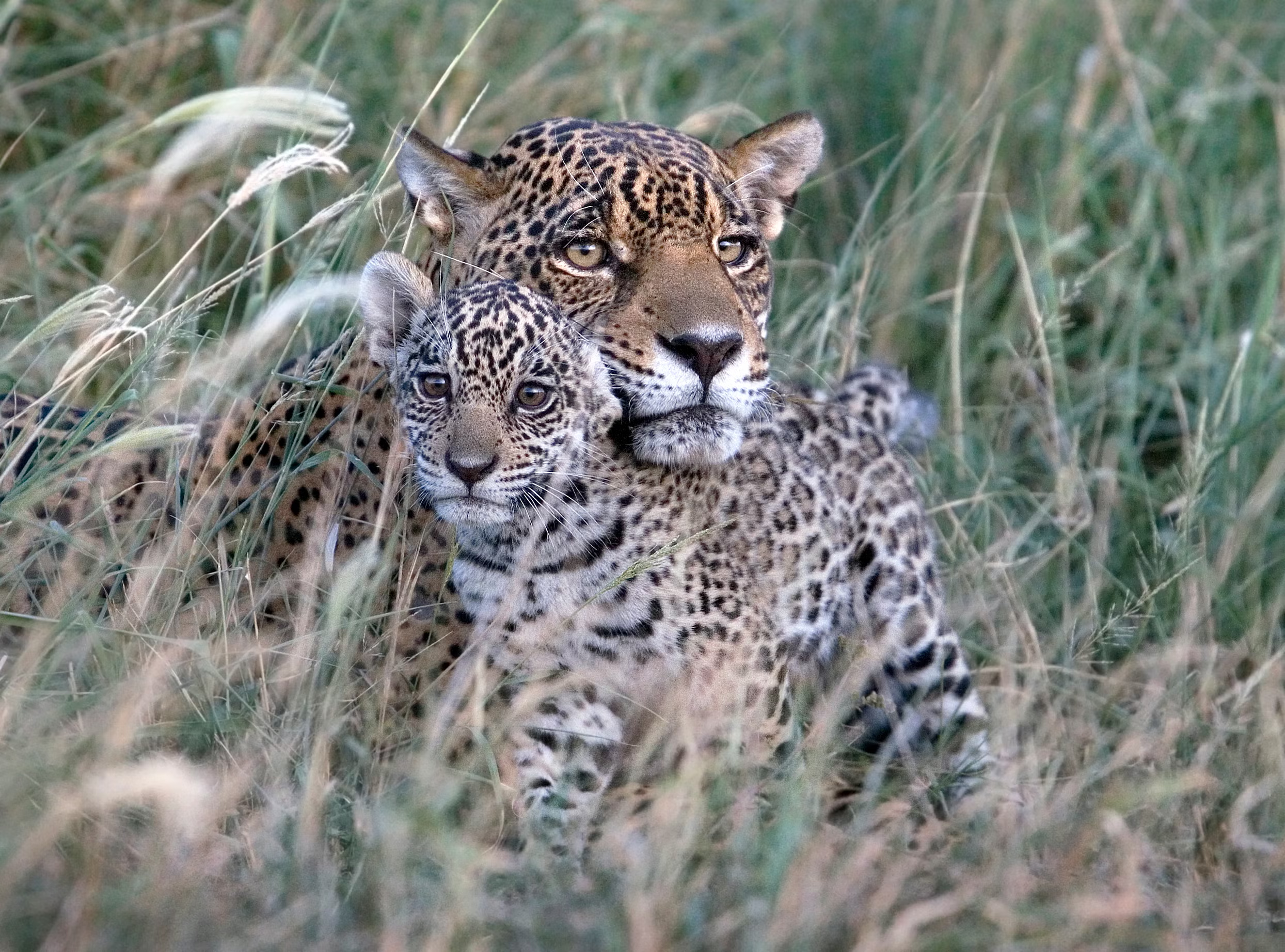
The region's centerpiece for wildlife is Kaa-Iya del Gran Chaco National Park. At 3.4 million hectares, it's Bolivia's largest protected area and the world's largest remaining tract of intact dry forest. Founded in 1995 through the initiative of the indigenous Guaraní-Isoceño people, Kaa-Iya protects over 1,000 jaguars, one of the densest populations anywhere. Here, pumas, tapirs, giant anteaters, and the rare Chacoan peccary, once thought extinct, share habitat with 350 bird species and the endangered maned wolf.
From the Journal
Field notes, cultural encounters and trail dispatches from our guides and travellers in Santa Cruz de la Sierra.
Surveys estimate over 1,000 jaguars in the Gran Chaco Jaguar Conservation Unit, the largest known population anywhere on the planet. Five wild cat species share a single park larger than Belgium. Camera traps record them stalking tapirs at dawn, drinking at waterholes in the midday blaze, and dragging caiman carcasses through reed margins at dusk. This is the kingdom of the jaguar, and almost nobody knows it exists.

Is it safe to travel to Bolivia in 2026? An honest look at the current protests, crime and scams, altitude sickness, and health risks, plus the sensible precautions that handle nearly all of it.
We are pleased to announce that EcoVoyager has partnered with Asociación Armonía, Bolivia’s leading bird conservation organization and the country’s BirdLife International partner.
A thousand kilometers of high plateau above 3,500 meters, running from Lake Titicaca in the north to the Argentine border in the south. Three distinct regions: Aymara communities and sacred islands, volcanic emptiness and vicuña herds, and the mineral lagoons and salt flats that everyone has seen in photographs. Most travelers see one. Here’s what a proper trip through all three looks like.
Where the Amazon, the Andes, and the dry Chaco collide: prehistoric giant ferns, jaguars and spectacled bears, and one of the richest bird lists on Earth. Here is how to experience Bolivia’s wildest park, and the crucial difference between its two sides.
Travel Logistics
Choose your route. Every option arrives at the same place.
Viru Viru International Airport (VVI), located 17 kilometers north of Santa Cruz, is Bolivia's main international gateway. Direct flights operate from Miami (Boliviana de Aviación), Madrid (Air Europa, BoA), and connections via Lima, São Paulo, and Buenos Aires serve most international origins.
The Jesuit Missions circuit begins 225 kilometers northeast of Santa Cruz at San Javier, reachable in about 3.5 hours on paved roads. The full six-mission loop covers approximately 500 kilometers over 2-4 days, with the eastern missions requiring unpaved road travel during dry season.
Kaa-Iya National Park lies 260 kilometers east of Santa Cruz via San José de Chiquitos. Access requires permits arranged through authorized operators, 4x4 vehicles, and experienced guides. The journey passes through Chiquitano dry forest with wildlife sighting opportunities en route.
Viru Viru International Airport (VVI), located 17 kilometers north of Santa Cruz, is Bolivia's main international gateway. Direct flights operate from Miami (Boliviana de Aviación), Madrid (Air Europa, BoA), and connections via Lima, São…
The Jesuit Missions circuit begins 225 kilometers northeast of Santa Cruz at San Javier, reachable in about 3.5 hours on paved roads. The full six-mission loop covers approximately 500 kilometers over 2-4 days, with…
Kaa-Iya National Park lies 260 kilometers east of Santa Cruz via San José de Chiquitos. Access requires permits arranged through authorized operators, 4x4 vehicles, and experienced guides. The journey passes through Chiquitano dry forest…
Why Travel with Us
Santa Cruz serves as Bolivia's international gateway, with Viru Viru Airport handling flights from Miami, Madrid, and major South American cities. EcoVoyager coordinates all logistics, from airport transfers to 4x4 expeditions into Kaa-Iya's jaguar territory, multi-day Jesuit mission circuits, and cloud forest treks in Amboró.
Locations
Bolivia
At the Elbow of the Andes, where mountains bend toward Peru, lies a biological miracle. Amboró National Park is the only place on Earth where three ecosystems collide: the Amazon Basin, Andean foothills, and…

Bolivia
Rising from Bolivia's altiplano at over 4,200 meters lies one of Earth's most surreal landscapes, a realm where crimson lakes mirror volcanic peaks and flamingos paint the shores pink against terrain that inspired comparisons…

Bolivia
Larger than Belgium and home to more than a thousand jaguars, Kaa-Iya del Gran Chaco is Bolivia's biggest national park and the largest single protected area in the entire Gran Chaco. Its 34,411 square…

Bolivia
Perched between 3,250 and 4,100 meters above sea level, La Paz defies gravity and expectations as the world's highest administrative capital. This breathtaking city cascades down a dramatic canyon beneath the snow-capped guardian peak…

Bolivia
At 3,812 meters, Lake Titicaca stretches across the Andean altiplano like a shimmering inland sea, the world's highest navigable lake and South America's largest, covering 8,372 square kilometers with depths reaching 284 meters. Inca…

Bolivia
Recognized by the Wildlife Conservation Society as the world's most biodiverse national park, Madidi spans nearly 19,000 square kilometers from Andean glaciers to lowland Amazon rainforest. This wilderness sanctuary harbors 14% of the planet's…

Bolivia
Carved into sheer cliffs during the 1930s Chaco War, North Yungas Road, El Camino de la Muerte, once claimed 200 to 300 lives annually on a route barely 3.2 meters wide with drops exceeding…

Bolivia
In 1545, an indigenous herder named Diego Huallpa discovered silver on a mountain the Inca had long considered sacred. Within decades, Potosí had grown to 160,000 inhabitants, rivaling London and Paris in size. Over…

Bolivia
At 3,656 meters on the Bolivian Altiplano lies the world's largest salt flat, a 10,582-square-kilometer expanse of crystalline white that transforms into Earth's most perfect natural mirror during the rainy season. Born from prehistoric…

Bolivia
Around 300 CE, the Chané people of the Mojocoyas culture began sculpting a 220-meter sandstone monolith with pumas, serpents, and celestial channels in the eastern Andean foothills, creating what UNESCO would later recognize as…

Bolivia
Founded in 1538 as Ciudad de la Plata by Spanish colonists profiting from nearby Potosí's silver mines, Sucre grew into the political heart of what would become Bolivia. On August 6, 1825, representatives signed…