Three Days Inside Kaa Iya: Bolivia's Largest and Least-Visited National Park
Jaguar Tracking with Resident Park Rangers
Amboro National Park: 800 Bird Species at the Meeting of Andes and Amazon
El Fuerte: UNESCO World Heritage Site and Easternmost Point of the Inca Empire
Seven UNESCO World Heritage Jesuit Mission Churches of the Chiquitania
High-Altitude Wine Tasting at Winery 1750 Above Samaipata
Bolivia Tour Overview
Bolivia's Wild East: Jaguars, Cloud Forest and Lost Missions
An 11-day expedition through Amboro National Park, the Gran Chaco, and the UNESCO Jesuit Missions of the Chiquitania
Duration
11 Days
Price
$4,200
Difficulty
Moderate
Best Time
May – October
This 11-day expedition covers three landscapes in eastern Bolivia that almost no international tour operator visits. Amboro National Park sits at the meeting point of the Andes and the Amazon, home to 800 recorded bird species, giant tree fern forests, and the UNESCO World Heritage site of El Fuerte. Kaa Iya National Park, Bolivia’s largest protected area at 3.4 million hectares, is one of the last intact Gran Chaco dry forests on the continent, patrolled with resident rangers in search of jaguar, ocelot, and tapir. The circuit closes with four days through the Chiquitania, where seven UNESCO World Heritage Jesuit mission churches from the 17th and 18th centuries stand in remote tropical towns where the original music and craft traditions remain alive. Maximum 10 guests.
Bolivia's Wild East: Jaguars, Cloud Forest and Lost Missions
Fill out the form below and we'll send you detailed information about this tour, including itinerary, pricing, and availability. Our travel specialists will get back to you within 24 hours.
Bolivia's Wild East: Jaguars, Cloud Forest and Lost Missions
Your Bolivia Tour Itinerary
Route Overview11 Days · Bolivia
1
Day 1
Santa Cruz to Amboro Park
The drive southwest from Santa Cruz takes three hours on roads winding through red rock formations before arriving at Refugio Los Volcanes on the southern edge of Amboro National Park. The refuge sits at the ecological meeting point of the Andes, the Amazon, and the Chaco, producing exceptional biodiversity and 800 recorded bird species. A short trail from the refuge reaches a vantage point over the park. Macaws are common in the late afternoon. Three natural waterfalls on the Elvira River, one forming a natural swimming pool, are accessible on foot from the lodge.
Meals: L / D
2
Day 2
Amboro Park to Samaipata
The morning follows the Mairana Valley south to La Yunga, a small hamlet on the park's southern edge. A trail from the village enters cloud forest where giant tree ferns grow to several meters, their dark trunks hosting wild orchids. This is one of the few accessible stands of tree ferns in Bolivia and the forest carries a distinctly prehistoric character. The afternoon drive continues to Samaipata, a quiet mountain village at 1,750 meters known for its mild climate. Wine tasting at Winery 1750, a small high-altitude estate on the hills above the village, rounds out the evening.
Meals: L / D
3
Day 3
Samaipata to Santa Cruz
The morning is spent at El Fuerte, a UNESCO World Heritage Site ten kilometers from Samaipata. This carved sandstone outcrop marks the easternmost point of the Inca Empire and holds the largest carved rock in the world, used as an astronomical observatory and ceremonial site by both Chane shamans and Inca priests. After the visit, a short stop at a hummingbird refuge hosting over 15 species breaks the return drive to Santa Cruz. The Cosmopolitano Hotel Boutique occupies a 9-room colonial building in the historic center, built around two open patios with natural ventilation throughout.
Meals: L
4
Day 4
Santa Cruz to Kaa Iya National Park
A four-hour drive southeast reaches San Jose de Chiquitos for lunch and a visit to the mission church before the final 70 kilometers of off-road track into Kaa Iya National Park. Bolivia's largest protected area at 3.4 million hectares, Kaa Iya was founded in 1995 through the initiative of three indigenous peoples: the Isosena-Guarani, the Chiquitana, and the Ayoreo, whose name for the park in Guarani means master of the forest. Temperatures regularly exceed 40 degrees Celsius. The park holds 108 mammal species including jaguar, ocelot, puma, and jaguarundi. Overnight at the park rangers' refuge. Conditions are basic with fans but no air conditioning.
Meals: L / D
5
Day 5
Kaa Iya National Park
The day begins before dawn. Early morning is the most productive time in the Gran Chaco, when birds and large mammals move before the heat builds. A guided patrol on foot with park rangers covers the trail network around the refuge. Trap cameras placed on regular jaguar routes are collected and reviewed in the afternoon at the refuge. The Gran Chaco here is dry tropical forest with good visibility into the undergrowth, structurally different from the Amazon. Peccaries, tapir, anteater, and a high diversity of reptiles and birds are present throughout. A second evening patrol takes advantage of falling temperatures and fading light.
Meals: B / L / D
6
Day 6
Kaa Iya National Park to Santa Cruz
An early vehicle patrol covers the park trails with a sensor camera mounted on the 4x4, the most effective method for photographing animals in the heat of the open Chaco. The group returns to camp for breakfast before the seven-hour drive back to Santa Cruz, stopping for lunch at San Jose de Chiquitos. After three days of extreme heat and basic conditions, the Cosmopolitano Hotel Boutique's two-patio colonial building in the historic center provides a sharp change of pace. The evening is free.
Meals: B / L
7
Day 7
Santa Cruz to Concepcion
The route northeast follows the Jesuit Mission circuit through the lowland departments of Santa Cruz and Beni. The first stop is San Javier, whose church was founded in 1691 as the first Jesuit mission in the Chiquitania. The mission also housed the region's first music school, producing violins, harps, and harpsichords whose traditions survive in the biennial International Festival of Baroque Music. After lunch the route continues to the Piedras de Paquio, an unusual geological formation of naturally balanced rocks, before arriving at Concepcion. The baroque church here, considered one of the finest in the Chiquitania, is best seen at sunset when low light reveals the carved columns and mestizo baroque detailing.
Meals: L / D
8
Day 8
Concepcion to San Ignacio
The morning begins at the Missions Museum in Concepcion, housed in the birthplace of General Hugo Banzer. The museum holds original musical scores composed and performed in the missions , a dimension of the Chiquitania that most visitors miss entirely. Every two years between April and May, the International Festival of American Baroque Music travels from church to church across the region. After lunch the drive continues east to San Ignacio de Velasco, one of the most significant missions. The town sits closer to the Brazilian border than to La Paz, and its culture reflects that frontier position in its music, food, and the particular warmth of its people.
Meals: L / D
9
Day 9
San Ignacio to San Jose de Chiquitos
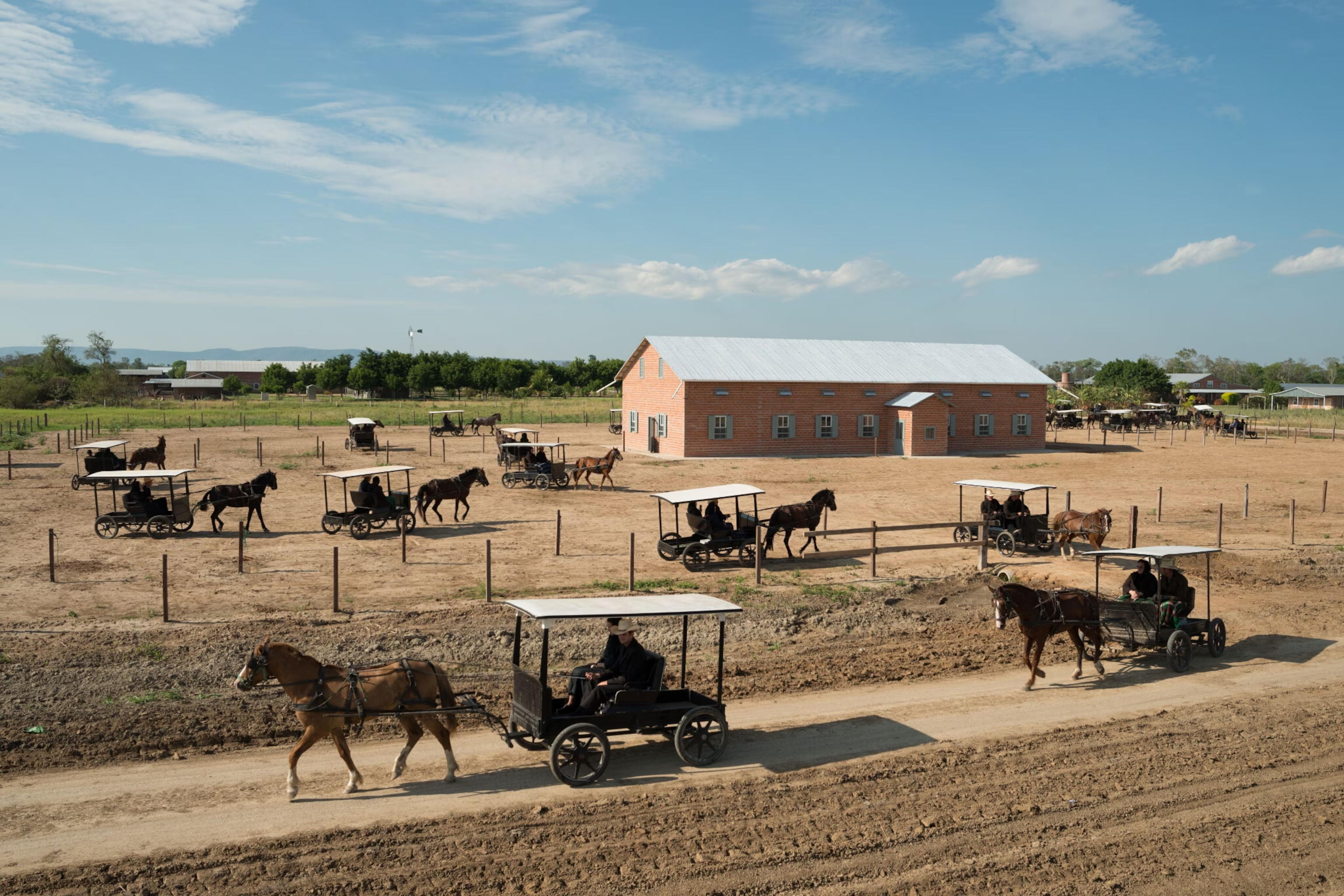
An early start covers San Miguel and San Rafael missions before continuing to Santa Ana, a village of barely 300 inhabitants where the Jesuit legacy is present in daily life rather than in tourist infrastructure. The afternoon crosses into Mennonite country, where a distinct religious community maintains 16th-century German and Dutch traditions in near-total separation from surrounding Bolivian society, avoiding cultural assimilation and preserving a language and way of life unchanged for generations. The day ends at San Jose de Chiquitos, whose mission complex is unique in the circuit for its stone and lime facade , built without large timber because the surrounding Chaco had none.
Meals: L / D
10
Day 10
San Jose de Chiquitos to Santa Cruz
The morning is spent at the Jesuit mission complex of San Jose de Chiquitos, one of the oldest standing monuments in eastern Bolivia and a UNESCO World Heritage Site. Unlike the other missions in the Chiquitania circuit, it was built entirely from stone and lime rather than wood, a practical response to the absence of large trees in the surrounding Chaco. The construction is unique in South America. The return drive west crosses the Rio Grande before rejoining the Santa Cruz highway, arriving in the late afternoon for a final night at the Cosmopolitano Hotel in the historic center.
Meals: B / L
11
Day 11
Departure
A private transfer from the Cosmopolitano Hotel to Viru Viru International Airport. The drive takes approximately 35 to 40 minutes from the historic center depending on traffic.
Meals: B
Ecovoyager Experiences
Possible Wildlife Encounters
Species you may spot along this route.
Jaguar
Panthera onca
The largest cat in the Americas; Kaa-Iya holds one of the densest populations recorded anywhere.
Giant Anteater
Myrmecophaga tridactyla
An unmistakable long-snouted, bushy-tailed anteater that walks the open country tearing into termite mounds.
Puma
Puma concolor
A large tawny cat, the wide-ranging second predator of the Chaco after the jaguar.
Lowland Tapir
Tapirus terrestris
The largest land mammal of the region, a stocky, long-snouted browser, mostly active at night.
Maned Wolf
Chrysocyon brachyurus
A tall, long-legged reddish canid of open country, neither fox nor wolf, active mainly at night.
Spectacled Bear
Tremarctos ornatus
South America's only bear, locally the jucumari, marked with pale rings around the eyes.
Ocelot
Leopardus pardalis
A beautifully marked medium-sized cat, largely nocturnal, hunting the forest floor.
Chacoan Peccary
Catagonus wagneri
The largest peccary, a Gran Chaco endemic once known only from fossils until found alive in the 1970s.
Giant Armadillo
Priodontes maximus
The largest living armadillo, a powerful nocturnal digger, rarely seen anywhere in its range.
Military Macaw
Ara militaris
A large green macaw with a red forehead, usually seen flying in pairs over the foothill forest.
Horned Curassow
Pauxi unicornis
A large, endangered forest bird with a curious blue horn on its forehead, almost mythical among birders.
Greater Rhea
Rhea americana
South America's largest bird, a flightless runner of open country, often in loose groups.
Toco Toucan
Ramphastos toco
The largest toucan, unmistakable for its huge orange bill, seen perched or in bounding flight.
Black Howler Monkey
Alouatta caraya
A large monkey whose dawn and dusk roaring carries across the dry forest; males are black, females buff.
Brown Capuchin Monkey
Sapajus cay
A stocky, clever monkey with a dark cap, common in both the Amboro forest and the Chaco gallery woodland.
White-lipped Peccary
Tayassu pecari
A larger peccary that travels in big, mobile herds, the most formidable of the wild pigs.
Bolivia Tour Details
What's Included
Everything included in the tour, and what to budget separately.
What's Included
All accommodation: 10 nights based on double occupancy (Refugio Los Volcanes x1, El Pueblito Resort Samaipata x1, Cosmopolitano Hotel Boutique Santa Cruz x3, Kaa Iya park rangers refuge x2, Gran Hotel Concepcion x1, Apart Hotel San Ignacio x1, Hotel Villa Chiquitana x1)
All meals as indicated in the itinerary
Airport arrival and departure transfers
Private transport with driver for all overland legs throughout the 11-day expedition
English-speaking guide for the full 11-day expedition
Local guides as indicated in the itinerary, including park rangers at Kaa Iya and local mission guides in the Chiquitania
All entrance fees as indicated in the itinerary (El Fuerte UNESCO site, Kaa Iya National Park, Jesuit mission churches)
Trap camera review sessions with park rangers at Kaa Iya (Days 4-6)
Wine tasting at Winery 1750 above Samaipata (Day 2)
Hummingbird refuge visit near Samaipata (Day 3)
Assistance 24/7 during your stay
Not Included
International airfare (return)
Travel insurance (required: must cover wildlife tracking and remote locations)
Meals not mentioned in the itinerary (approximately $8 per person for a local lunch, $12 for an international restaurant lunch, $20 per person for dinner)
Drinks (alcoholic and non-alcoholic beyond those included)
Gratuities for guides, drivers, and park rangers (recommended)
Personal expenses and personal laundry
Bank charges and currency exchange fees
Visa fees (if applicable)
Single room supplement ($420)
Medical evacuation costs
Bolivia Tour Details
Tour Pricing & Departures
Transparent pricing, comprehensive inclusions, and exactly what to expect.
Prefer your own dates and itinerary? Our private expeditions offer full flexibility with the same expert guides, exclusive access, and conservation partnerships, tailored entirely around your group.
Starting From
$4,200
From, based on group of 6
Single Supplement$550
Deposit$1,050
CurrencyUSD
Private Group Rates
Group Size
Per Person
Notes
2 travelers
$6,150
Per personDouble occupancy
4 travelers
$4,650
Per personGroup rate
6 travelers
$4,200
Per personGroup rate
8 travelers
$4,150
Per personGroup rate
10 travelers
$4,100
Per personBest value
*
Deposit & Payment: A 25% deposit secures your place (credit card accepted). 50% balance due 90 days before departure. Final balance due 60 days prior. ACH bank transfer available at reduced fees. Bookings within 60 days require full payment.
†
Cancellation: 90+ days: full refund minus $500 admin fee. 60-89 days: 50% refund. Under 60 days: no refund. Comprehensive travel insurance covering emergency evacuation is required for all participants.
Ready to secure your place on this expedition? Spaces are limited to ensure an intimate experience.
"Watching the northern lights from that coastal overlook was one of those moments you carry with you. EcoVoyager's team knew exactly where to take us and when."
Chile
"They made my trip to Chile super smooth. I had nothing to worry about, they connected me with local guides and took me to some super cool places."
Madagascar
"My kids are still talking about the lemurs months later. EcoVoyager handled every detail so we could actually be present together."
Mongolia
"Absolutely loved our Mongolia trip in July 2025! Ecovoyager put together the best itinerary possible that combined adventure and comfort. We would 100% recommend Ecovoyager to our friends and family!"
Guyana
"The Rupununi was fabulous. Even if there weren't any animals, it would've been a great experience. The only negative was leaving."
Cuba
"The trip was thoughtfully curated for a REAL Cuban cultural experience, juxtaposing between the island's insolvency and the faux luxuries propped up by foreign investment."
Bolivia
"The salt flats at sunrise were even more stunning than I'd imagined. Our guide positioned us perfectly for the reflections."
Kyrgyzstan
"EcoVoyager put my mind at ease with expert guidance on how to stay safe and enjoy the vibes. If I were to plan another solo trip to an unfamiliar country, I'd trust EcoVoyager to help me through it all."
Japan
"I had a wonderful time. Organization was superb and our experiences were maximized due to great planning and enthusiasm."
Kyrgyzstan
"Staying with nomadic families, riding through valleys with no other tourists in sight. This is the kind of travel I didn't know I was missing."
Explore more expeditions in Bolivia, led by local experts and built for the curious traveller.
Related Tour
BOLIVIA
Bolivian Amazon Rainforest Expedition
An 11-day expedition from La Paz through Madidi National Park to the Moseten communities of Pilon Lajas: shoeshine guides, suspended jungle camps above Mashi Lagoon, and three nights with the people who have protected this Amazon for generations
Complete your booking request below and we'll be in touch within 24 hours
Thank you! Your booking request has been received. We'll be in touch within 24 hours to confirm your adventure.
Oops! There was an issue submitting your request. Please try again or contact us directly.
Support
Frequently Asked Questions
Everything you need to know before your journey. Can't find what you're looking for? Get in touch and we'll help.
Booking, Dates & Group Size
How departures, pricing, and group size work on this expedition.
It runs in the dry season, May to October, the best window for the Gran Chaco: wildlife concentrates near the remaining water, tracks show clearly on the dry trails, and the park roads stay passable. There are set small-group departures in 2026 on August 2, August 23, and September 19, and private or custom dates can be arranged.
Departures are capped at ten guests. The expedition camp inside Kaa-Iya, the ranger capacity, and the vehicles all limit numbers, and a small group means better wildlife odds and less disturbance in a place that sees very few visitors.
A deposit of 25% of the per person rate secures your place, with the balance due before departure. You can pay by whichever method suits you, whether card, bank transfer, or wire.
Yes. Alongside the scheduled departures, the whole expedition can be arranged privately for your own party on dates that suit you.
Jaguar Tracking & Wildlife
What to expect on the Kaa-Iya drives and across the route.
Kaa-Iya is one of the best places in the world to try, with a camera-trap study estimating over a thousand jaguars in the park. You spend three days with the resident rangers running dawn, dusk, and night drives and checking trap cameras, which gives you a real chance that exists almost nowhere else. Even so, jaguars are secretive and a sighting is never guaranteed; tracks, fresh scrapes, and camera-trap images are part of the experience.
Across the Chaco drives expect monkeys, brocket deer, peccaries, rheas, and crab-eating foxes, with big mammals like tapir, puma, ocelot, and giant anteater realistic on the dawn, dusk, and night outings. Giant armadillo and maned wolf are genuine long shots. Amboro adds one of the richest bird lists on the planet.
Largely, yes. Amboro sits where the Andes, the Amazon, and the Chaco meet, with more than 800 recorded bird species, among them the military macaw and the rare horned curassow. Mammals are present but hard to see in the dense forest, so the Amboro days lean toward birds, the giant tree ferns, and El Fuerte.
Yes. The open Chaco and the camera-trap work suit wildlife photography, and the ranger-led drives are timed for the active hours. Bring a telephoto lens and be ready for low light at dawn and dusk.
Health, Climate & Fitness
Heat, fitness, and what to prepare for in the east.
It rates as moderate. Expect early starts and late finishes for the wildlife drives, walking on Chaco and forest trails in the heat, and basic camp conditions inside Kaa-Iya. Nothing is technical, but you should be comfortable with long days and simple comforts.
No. This route stays in the eastern lowlands around Santa Cruz, so altitude is not a factor, which sets it apart from Bolivia’s highland trips. The wine tasting above Samaipata is the only mild elevation, at around 1,750 meters.
The Chaco is hot and sunny through the May to October dry season, which is also the best time for wildlife. Occasional southerly cold fronts, known as surazos, can drop the temperature sharply for a day or two, so pack strong sun protection along with a warm layer.
Yellow fever vaccination is recommended for the Santa Cruz lowlands. Malaria risk is lower in the dry Chaco than in the Amazon, but confirm current advice with a travel clinic before you go. Comprehensive travel insurance with medical evacuation cover is mandatory, given how remote Kaa-Iya is.
Accommodation & Conditions
Where you sleep, from eco-lodge to expedition camp.
It ranges from an eco-lodge in the Amboro foothills and comfortable hotels in Samaipata and the mission towns to expedition-style camping with the rangers inside Kaa-Iya. The lodges and town hotels are locally owned and comfortable; the Kaa-Iya camp is deliberately basic, which is simply the cost of reaching this wilderness.
You camp with the resident rangers deep in the park, with tents, simple shared facilities, and meals prepared in camp. There are no lodges inside Kaa-Iya, so this is the only way to spend real time in the park, and the remoteness is the point.
Santa Cruz and the mission towns have coverage. Kaa-Iya is off-grid with no signal or Wi-Fi for the days you spend there, so treat the Chaco as a genuine disconnection and let people know your schedule in advance.
The final stretch is cultural and gentler than the wildlife camping. You travel the circuit of the seven UNESCO mission churches of the Chiquitania by road, staying in the mission towns of Concepcion, San Ignacio de Velasco, and San Jose de Chiquitos, a change of pace to close the expedition.
Scroll to Top
We use cookies to enhance your adventure planning experience. By continuing to explore our site, you agree to our use of cookies.
EcoVoyager Privacy Policy.