"Watching the northern lights from that coastal overlook was one of those moments you carry with you. EcoVoyager's team knew exactly where to take us and when."
Bolivia
The Bolivian Amazon Basin Birding Expedition
Foothill cloud forest, the condor cliffs, dry valleys and the Beni savanna
The Bolivian Amazon Basin Birding Expedition
Foothill cloud forest, the condor cliffs, dry valleys and the Beni savanna
Seventeen days across the great habitat gradient of central Bolivia, from the Chiquitano dry forest around Santa Cruz up into the foothill cloud forest of Amboro and down to the flooded savannas of the Beni. The birding runs the full range of eastern-slope habitats and their near-endemics, anchored by two headline experiences: the Andean Condors that ride the thermals at the Codo de los Andes, and the conservation reserves of Asociacion Armonia, where both of Bolivia’s endemic macaws hold on. Expect roughly 350 to 450 species across cloud forest, dry valleys and palm savanna, with maned wolf and giant anteater among the mammals at Barba Azul. The route stays at low to moderate elevation throughout, so altitude is never a factor.
Request More Information
The Bolivian Amazon Basin Birding Expedition
Fill out the form below and we'll send you detailed information about this tour, including itinerary, pricing, and availability. Our travel specialists will get back to you within 24 hours.
The Bolivian Amazon Basin Birding Expedition
Your Bolivia Tour Itinerary
Arrive Santa Cruz
Santa Cruz and the Chiquitano Lowlands
Santa Cruz to Refugio Los Volcanes (Amboro)
Los Volcanes, Full Day
Los Volcanes, Second Full Day
Los Volcanes to Samaipata, with a Vineyard Afternoon
Codo de los Andes Condor Day
Quirusillas and the Boliviano-Tucumano Forest
Samaipata to the Red-fronted Macaw Reserve
Red-fronted Macaw Reserve, Cliffs and Photography
Red-fronted Macaw Reserve, Community and Dry Forest
Reserve to Cochabamba
Cochabamba to Barba Azul
Barba Azul, Full Savanna Day
Barba Azul, Varied Wildlife Day
Barba Azul to Santa Cruz and Farewell
Final Morning and International Departure
Ecovoyager Experiences
Possible Wildlife Encounters
Species you may spot along this route.
Blue-throated Macaw
Critically endangered Bolivian endemic macaw with turquoise throat and bright yellow underparts.
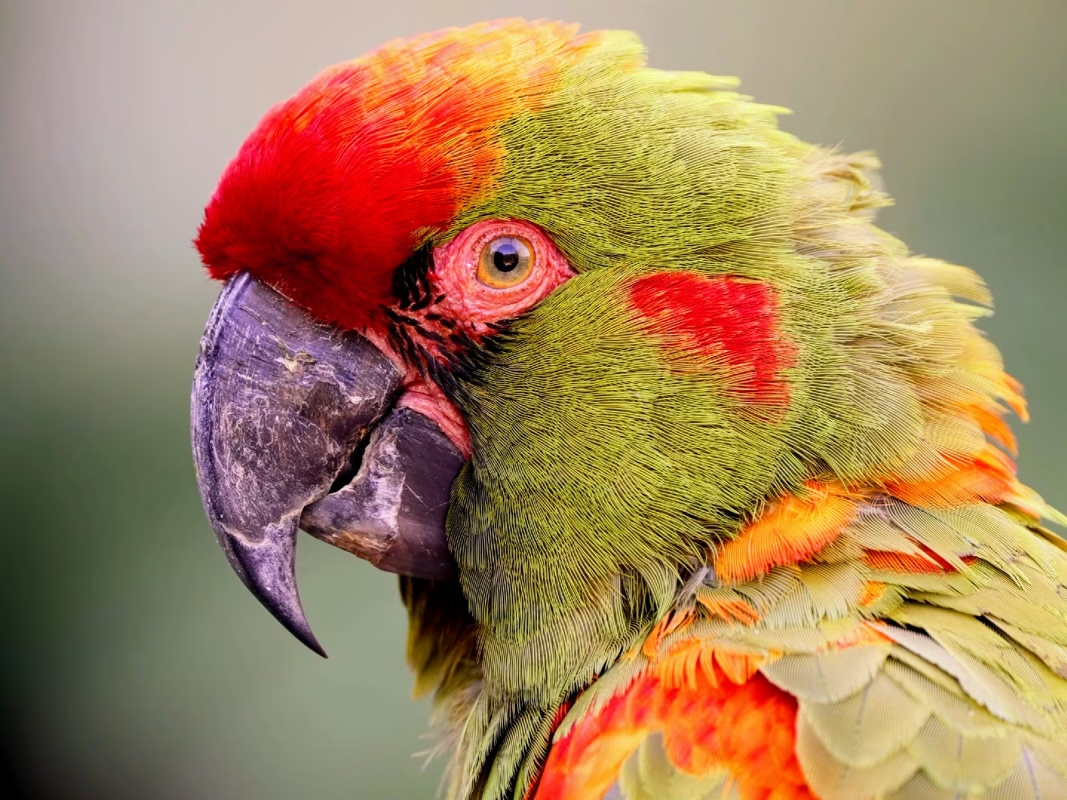
Red-fronted Macaw
Critically endangered Bolivian endemic macaw of the Inter-Andean Dry Valleys, smaller than the other macaws.
Bolivian Blackbird
Sooty-brown Bolivian endemic blackbird of arid cliff country, often in small noisy flocks.
Cliff Parakeet
Bolivian endemic parakeet, split from the Monk Parakeet, nesting in rocky cliff crevices.
Andean Condor
The largest flying bird in the Western Hemisphere, wings spanning up to three metres, soaring along Andean ridges.
Peregrine Falcon
The fastest animal on Earth, diving at over 300 km/h, slate-grey above with a black helmet.
Cock-tailed Tyrant
Small black-and-white savanna tyrant, the male carrying absurdly long tail feathers held vertical in display.
Sharp-tailed Tyrant
Tiny cryptic savanna tyrant with a long spike-like tail, one of the most difficult Beni specialties.
Black-masked Finch
Near-threatened grassland finch with a black mask, white throat, and warm buff underparts.
Greater Rhea
Large flightless ratite of South American grasslands, browsing the open savanna in small groups.
Orinoco Goose
Striking upland goose with a white head, chestnut neck, and iridescent green-black wings.
Buff-breasted Sandpiper
Near-threatened long-distance Nearctic migrant shorebird, wintering in South American grasslands.
Jabiru
The tallest flying bird in South America, with a massive upturned black bill and an inflatable red neck ring.
Cocoi Heron
Large grey South American heron with a black crown, the Neotropical counterpart of the Grey Heron.
Horned Screamer
Large primitive waterfowl with a long wiry forehead spike and unmistakable loud trumpeting calls.
Southern Screamer
Large grey-and-white screamer of southern South American wetlands, with a black neck ring and loud raucous calls.
Plumbeous Ibis
Large slate-grey ibis with a white forehead patch, crown tuft, and deep resonant call, working wet grasslands.
Hoatzin
Strange prehistoric-looking bird with a shaggy crest and blue face, placed in its own avian order.
Maguari Stork
Large white-and-black stork of South American wetlands, with a red facial skin and distinctive broken-winged flight display.
Maned Wolf
Tall red-gold canid of South American savannas with disproportionately long black legs, standing almost 90cm at the shoulder.
Giant Anteater
Large shaggy anteater with a tubular snout and bushy tail, plodding across the savanna in search of termite mounds.
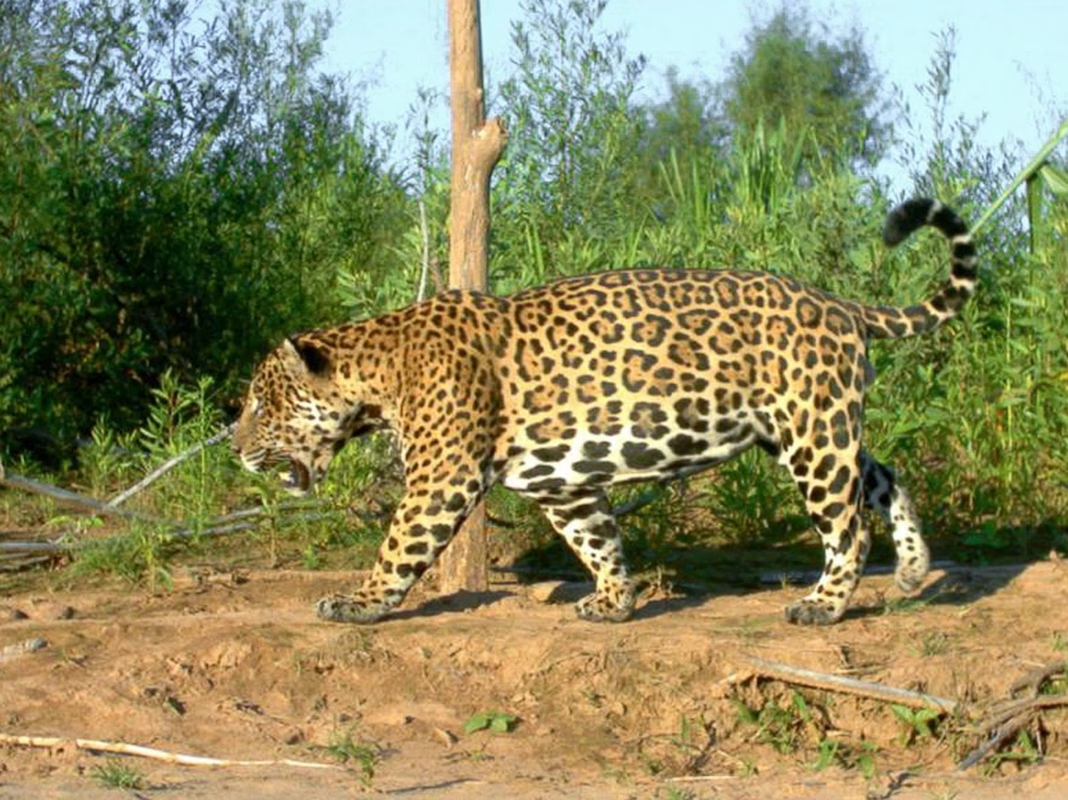
Jaguar
The largest cat of the Americas, heavily built with a distinctive rosette coat pattern, apex predator of the Neotropical lowlands.
Ocelot
Medium-sized spotted cat of the Neotropics, nocturnal and solitary, regularly detected on Barba Azul camera traps.
Gray Brocket Deer
Small reddish-brown forest deer with simple spike antlers, typically encountered singly along forest trails.
Black Howler Monkey
Dimorphic howler monkey, the adult male glossy black, the female buff-coloured, producing deep resonant territorial calls at dawn.
Bolivia Tour Details
What's Included
Everything included in the tour, and what to budget separately.
What's Included
- All accommodation: 16 nights based on double occupancy
- All meals from welcome dinner Day 1 through breakfast Day 17 as indicated in the itinerary
- Airport arrival and departure transfers in Santa Cruz
- Domestic flight Cochabamba to Trinidad and the chartered round-trip flight Trinidad to Barba Azul
- Private 4x4 ground transportation throughout, including the canyon access to Refugio Los Volcanes
- Expert English-Spanish bilingual specialist bird guide for the entire 17-day expedition
- Specialist local guide and transport for the Codo de los Andes condor trek
- Refugio Los Volcanes reserve access and guided trails on the edge of Amboro National Park
- Paraba Frente Roja reserve access, hides, and local community guides
- Barba Azul reserve access, ranger, boat trip on the Omi River, and savanna activities
- Observation hide access and photography sessions at both Armonia reserves
- Winemaker-led tour and tasting at Uvairenda (Vinos 1750) in Samaipata
- All national park, reserve, and community fees
- Welcome dinner in Santa Cruz and farewell dinner of eastern-lowland cuisine
- Bottled drinking water throughout
- 5% conservation surcharge donated to Asociacion Armonia
Not Included
- International airfare to and from Santa Cruz (Viru Viru International, VVI)
- Travel insurance (required, must include medical evacuation)
- Yellow fever vaccination (required for the Beni lowlands)
- Malaria prophylaxis where recommended
- Bolivia visa or reciprocity fee where applicable
- Personal expenses, laundry, and souvenirs
- Gratuities for guides, drivers, and lodge staff
- Alcoholic beverages beyond welcome and farewell drinks and the Uvairenda tasting
- Optional premium wine pairings
- Single supplement (see rates)
- Any additional excursions or extensions not listed
- Weather-related rerouting costs, particularly Barba Azul charter delays
Bolivia Tour Details
Tour Pricing
Transparent rates with no hidden costs.
Group Rates
| Group Size | Per Person | Notes |
|---|---|---|
| Solo traveler | $14,200 | Per person, single occupancy |
| 2 travelers | $13,300 | Per person, double occupancy |
| 3 travelers | $10,400 | Per person, double occupancy |
| 4-6 travelers | $8,400 | Per person, double occupancyBest value |
| 7 travelers | $7,900 | Per person, double occupancy |
| 8 travelers | $7,650 | Per person, double occupancy |
Ready to secure your place on this expedition? Spaces are limited to ensure an intimate experience.
Book This TourEcovoyager Adventures
Book Your Adventure
Complete your booking request and our travel specialists will be in touch within 24 hours to confirm your journey.
Traveler Stories
What Our Adventurers Say
"They made my trip to Chile super smooth. I had nothing to worry about, they connected me with local guides and took me to some super cool places."
"My kids are still talking about the lemurs months later. EcoVoyager handled every detail so we could actually be present together."
"Absolutely loved our Mongolia trip in July 2025! Ecovoyager put together the best itinerary possible that combined adventure and comfort. We would 100% recommend Ecovoyager to our friends and family!"
"The Rupununi was fabulous. Even if there weren't any animals, it would've been a great experience. The only negative was leaving."
"The trip was thoughtfully curated for a REAL Cuban cultural experience, juxtaposing between the island's insolvency and the faux luxuries propped up by foreign investment."
"The salt flats at sunrise were even more stunning than I'd imagined. Our guide positioned us perfectly for the reflections."
"EcoVoyager put my mind at ease with expert guidance on how to stay safe and enjoy the vibes. If I were to plan another solo trip to an unfamiliar country, I'd trust EcoVoyager to help me through it all."
"I had a wonderful time. Organization was superb and our experiences were maximized due to great planning and enthusiasm."
"Staying with nomadic families, riding through valleys with no other tourists in sight. This is the kind of travel I didn't know I was missing."
Related Experiences
More Adventures in Bolivia
Explore more expeditions in Bolivia, led by local experts and built for the curious traveller.
Related Tour
BOLIVIA
Sacred Lake Titicaca
An 8-day expedition across the highest navigable lake in the world, from Tiwanaku and the islands of the Sun and Moon to the Aymara eastern shore
Related Tour
BOLIVIA
Bolivian Amazon Rainforest Expedition
An 11-day expedition from La Paz through Madidi National Park to the Moseten communities of Pilon Lajas: shoeshine guides, suspended jungle camps above Mashi Lagoon, and three nights with the people who have protected this Amazon for generations
Related Tour
BOLIVIA
The Great Bolivian Traverse: Amazon to Altiplano
A 25-day expedition from the Amazon basin to the Salar de Uyuni, Lake Titicaca, and the remote Apolobamba range
Related Tour
BOLIVIA
Bolivia's Wild Altiplano
A 10-day expedition across Bolivia's volcanic southwest, both great salt flats, and the territory of the Uru-Chipaya, the Andes' oldest people
Related Tour
BOLIVIA
The Uyuni Ancient Salt Route
A 12-day expedition from the blood-red lagoons of Sur Lipez to the world's largest salt flat, on foot with the last llama caravans of the Altiplano
Related Tour
BOLIVIA
Bolivia's Wild East: Jaguars, Cloud Forest and Lost Missions
An 11-day expedition through Amboro National Park, the Gran Chaco, and the UNESCO Jesuit Missions of the Chiquitania
Destination
Explore the Places You'll Visit
Each stop on this journey through Bolivia, and the country that ties them together.
Book Your Adventure
Complete your booking request below and we'll be in touch within 24 hours
Support
Frequently Asked Questions
Everything you need to know before your journey. Can't find what you're looking for? Get in touch and we'll help.
Booking, Dates & Group Size
How departures, pricing, and group size work on this expedition.
The dry season, roughly May to October, is the birding window, with the savanna firm underfoot and the condor and macaw activity at their best. October is ideal. The wet season closes many of the unpaved roads, so we do not run the trip then. Exact dates are set with you when you book.
We run it as a small-group expedition with a maximum of eight guests, four to six recommended for the best pace at the hides and on the trails. Private departures for couples, families, or photography groups can be arranged on request.
A deposit of $2,100 per person secures your place, with the balance due before departure. We confirm the full payment schedule when you book, and you can pay by whichever method suits you, whether card, bank transfer, or wire.
The hides, the trails, and the Barba Azul charter all work best with a small group, and the conservation reserves limit numbers by design. A smaller group also means better looks at skulking forest birds and a lighter footprint at sensitive sites.
Birds, Wildlife & Photography
What you can expect to see, and how the birding is run.
A typical count is 350 to 450 species across the cloud forest, dry valleys, and savanna, including several Bolivian endemics and near-endemics. The exact total depends on the season, the weather, and how much time the group gives to general birding alongside the headline targets.
Red-fronted Macaw at its breeding cliffs and Blue-throated Macaw at Barba Azul are both very reliable at the reserves that protect them. The Andean Condors at the Codo de los Andes are exceptional in dry-season conditions, though, as with any wild bird, never guaranteed.
The Recurvebill is the trickiest target of the trip, a bamboo specialist that can be hard to find when the bamboo is not seeding. We build two full days at Refugio Los Volcanes specifically to give the best possible chance at it and the other foothill near-endemics.
Yes. The hides at both Armonia reserves are built for photography, and the condor site offers close flight passes in good light. The pace is unhurried by design, with time at each site rather than a single night and a dash to the next.
Health, Fitness & Altitude
How demanding the trip is, and what to prepare.
Most days are moderate, with forest trails, a river boat trip, and dawn and dusk sessions. The exception is the Codo de los Andes condor day, which begins before dawn and involves a steep, exposed ridge hike of several kilometres and rewards a reasonable level of fitness. It is the one strenuous day on the trip.
No. The trip runs entirely at low to moderate elevation. Santa Cruz sits at around 400 metres, Barba Azul is close to sea level, and the foothills and dry valleys reach only moderate heights, mild enough that altitude is not a concern for most travellers. If you have a heart or respiratory condition, it is always worth discussing your plans with your doctor before booking.
Yellow fever vaccination is required for the Beni lowlands, and malaria prophylaxis is recommended for the lowland portions. Confirm current requirements with a travel clinic well before departure.
Yes. Comprehensive travel insurance including medical evacuation is required, given the remote reserves and the charter flight. We can suggest providers if helpful.
On the Ground: Lodges & Conditions
Where you stay and what conditions to expect.
It ranges from boutique hotels in Santa Cruz and Cochabamba to a village-style lodge in Samaipata, a rustic ecolodge in the Amboro canyon, a community-run lodge with shared bathrooms at the Red-fronted Macaw reserve, and private river cabins at Barba Azul. All are locally owned and chosen for character and for their place in the conservation programme.
Santa Cruz, Samaipata, and Cochabamba have reliable connectivity. The reserves are off-grid by design: there is no Wi-Fi at Frente Roja or Barba Azul and mobile signal is minimal to none. Treat the reserve days as a genuine disconnection.
The dry-season window brings warm days and cooler nights, with little rain. The Beni lowlands and Santa Cruz are hot and humid, the foothills and dry valleys are warm by day and cool after dark, and the cloud forest can be misty. Pack layers for the range.
Very. It is reached by a chartered light aircraft from Trinidad over the flooded savanna, with no road access in the wet season and few visitors each year. There is no internet or phone, power is solar, and the reward is one of the wildest and least-visited reserves in the Neotropics.