


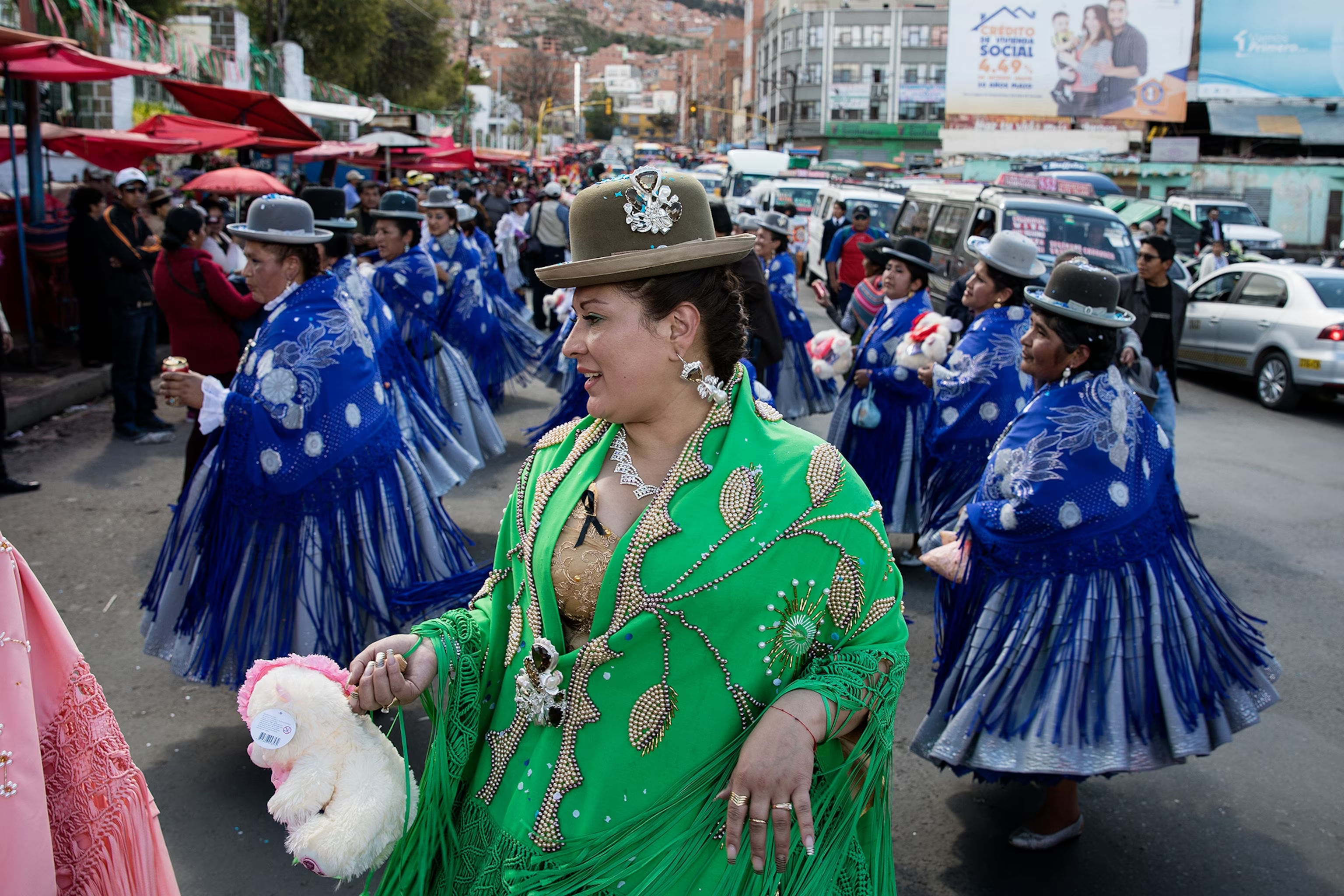
La Paz
The World's Highest Capital


Ecovoyager Experiences
La Paz Tours
Handcrafted expeditions into the remote corners of La Paz, led by local experts, designed for the curious traveller.
 Featured
LA PAZ
Bolivia's Wild Altiplano
A 10-day expedition across Bolivia's volcanic southwest, both great salt flats, and the territory of the Uru-Chipaya, the Andes' oldest people
 Featured
LA PAZ
The Uyuni Ancient Salt Route
A 12-day expedition from the blood-red lagoons of Sur Lipez to the world's largest salt flat, on foot with the last llama caravans of the Altiplano
 Featured
LA PAZ
Bolivia Endemic Macaw Birding Expedition
Two critically endangered macaws and 300 other species across canyon and savanna Bolivia
 Featured
LA PAZ
Into the Yungas: The El Choro Trek
A four-day pre-Inca traverse from the high Andes at 4,859 meters down through five ecosystems to the cloud forest of the Yungas, finishing at UMA Experience above Coroico


Experience La Paz, Your Way
Skip the standard itineraries. We design journeys around your interests, timeline, and curiosity with exclusive access you won't find on any platform.


Things to Do in La Paz
Starting points for your perfect trip
Death Road Descent
Conquer the legendary Yungas Road, once dubbed the world's most dangerous, on a 64-kilometer mountain-bike descent. You drop some 3,500 meters from the high pass at La Cumbre down through cloud forest to the subtropical Yungas.
Tiwanaku Archaeological Journey
Walk through the ruins of a civilization that rose centuries before the Incas at this UNESCO World Heritage Site. Stand before the carved Gateway of the Sun, study the rows of mysterious stone faces set into the walls of the Semi-Subterranean Temple.
Lake Titicaca & Isla del Sol
Journey to the world's highest navigable lake and to Isla del Sol, where Inca mythology places the birth of the sun. Hike the island's ancient stone pathways past some eighty archaeological sites, and explore the maze-like Chincana ruins.

Aerial City Discovery
Soar above La Paz on Mi Teleférico, the world's longest urban cable car network, around 33 kilometers of line strung across the sky. Glide between the indigenous heights of El Alto and the colonial center below.
Valle de la Luna Half-Day
Just south of the city in Mallasa, a hillside of soft clay has eroded into a maze of pale spires and slot canyons that looks more lunar than earthly, though despite the name it is not truly a valley.
Witches' Market and the Colonial Center
Climb the steep lanes above the San Francisco church to the Mercado de las Brujas, where Aymara vendors and yatiri healers sell herbs, amulets, and offerings for Pachamama.
El Alto Markets and Cholita Wrestling
Ride the cable car up to El Alto for the Feria 16 de Julio, one of South America's largest street markets, which sprawls for blocks every Thursday and Sunday.
A Taste of Paceño Cooking
Eat your way through the high city, from morning salteñas and a cup of api con pastel to anticucho skewers grilled on the evening streets and the stalls of the Mercado Lanza.
Design Your Custom Trip
Tell us about your dream adventure. Our travel specialists respond within 24 hours with a personalised itinerary.
The World's Highest Capital
A Closer Look at La Paz

Ancient Foundations, Modern Marvels
Long before the Spanish captain Alonso de Mendoza founded Nuestra Señora de La Paz on October 20, 1548, this dramatic Andean valley lay within reach of one of the most sophisticated civilizations of the ancient Americas. Just 72 kilometers away stand the ruins of Tiwanaku, the spiritual and political center of a pre-Columbian culture that flourished between 500 and 900 CE, reaching its zenith as one of the largest cities of its time, with population estimates ranging from around 10,000 to as many as 70,000. This civilization mastered high-altitude agriculture, raised megalithic architecture that still puzzles engineers today, and tracked the movements of the heavens with remarkable precision.
The Aymara people, descendants of the Tiwanaku world, called this valley Chuquiago Marka, meaning gold farm, for the precious metal found in its rivers. When Mendoza established the Spanish settlement to mark the end of Peru’s civil wars, he chose the site for its strategic position between the silver mines of Potosí and the Pacific coast. Originally founded at nearby Laja, the settlement was quickly moved into the more sheltered canyon of the Choqueyapu River, where it grew into the extraordinary vertical metropolis seen today, bridging ancient indigenous tradition with colonial grandeur and modern innovation.
The World's Highest Capital
At 3,631 meters above sea level, La Paz holds the Guinness World Record as the highest administrative capital city on Earth, an environment where newcomers find themselves catching their breath on the gentlest slope. The city sprawls across elevations from 3,250 to 4,100 meters, cascading down the canyon walls of the Choqueyapu River like a vast amphitheater carved into the Andes. The topography creates distinct microclimates and social zones, with wealthier districts traditionally in the lower, warmer south and the largely indigenous majority living in the heights, where neighboring El Alto, at about 4,150 meters, ranks among the world’s highest major cities.
The thin air holds only about 68 percent of the oxygen found at sea level, a fact that has shaped everything from local physiology to architecture. Aymara people have adapted over countless generations with greater lung capacity and higher red blood cell counts, while colonial buildings rely on thick walls and small windows to hold their heat. The snow-capped peak of Illimani, at 6,438 meters Bolivia’s second-highest mountain after Sajama, towers over the city like a guardian, a constant reminder that this is one of the most extreme urban environments on Earth, where a great metropolis thrives in air that would leave most lowland visitors gasping.
Cable Cars Conquering Gravity
In 2014, La Paz achieved what no other city had attempted: building a network of aerial cable cars as the backbone of an entire urban transit system. Mi Teleférico, meaning my cable car, transformed life in the world’s highest metropolitan area by linking La Paz with El Alto along color-coded lines that now run for around 33 kilometers. The system carries hundreds of thousands of passengers a day, turning commutes that once meant an hour in traffic into a quiet ten-minute glide above the rooftops.
The network is far more than transit infrastructure. It became a symbol of indigenous mobility and of a city that leapfrogged conventional solutions for something genuinely new. Built by the Austrian firm Doppelmayr at a cost of more than 700 million dollars, it runs roughly 1,500 gondolas that leave the stations every twelve seconds, each with wifi and sweeping views over the Altiplano. The cars have become the everyday link between El Alto, largely indigenous and working class, and central La Paz, while giving visitors an unmatched aerial view of the vertical city. Every station carries both a Spanish and an Aymara name, a nod to the heritage of the majority population woven into a thoroughly modern system.
From the Journal
Stories from La Paz
Field notes, cultural encounters, and trail dispatches from our guides and travellers in La Paz.
 Destinations
Bolivia Protests and Travel in 2026
Bolivia is in its worst crisis in decades, and protests and road blockades are disrupting travel across the highlands. An honest, up-to-date look at what is happening, which areas are affected, and how to plan a trip to Bolivia right now.
Read Full StoryMore from the Journal
 Destinations
DESTINATIONS
Is it Safe to Travel to Bolivia?
Is it safe to travel to Bolivia in 2026? An honest look at the current protests, crime and scams, altitude sickness, and health risks, plus the sensible precautions that handle nearly all of it.
Read Story Destinations
DESTINATIONS
El Choro Trek: Three Days from the Andes to the Amazon
El Choro drops 3,000 meters from La Paz's doorstep to the cloud forests of the Yungas in three days, crossing five ecological zones on a road that has been in continuous use for over a thousand years. Here is everything you need to know before you go.
Read StoryExplore More
Other Bolivia Destinations
Explore more destinations across Bolivia.
Barba Azul Nature Reserve
In the heart of Bolivia's Beni savanna, the Barba Azul Nature Reserve protects 12,200 hectares of seasonally flooded grassland, palm...
ExploreTarija Wine Country
In the far south of Bolivia, near the Argentine border, the city of Tarija and the surrounding valleys form the...
ExploreNoel Kempff Mercado
Spread across 1,523,446 hectares of remote northeastern Bolivia along the Brazilian border, Noel Kempff Mercado is one of South America's...
ExploreKaa-Iya National Park
Larger than Belgium and home to one of the largest jaguar populations in South America, Kaa-Iya del Gran Chaco is...
ExploreEduardo Avaroa Andean Fauna National Reserve
On Bolivia's altiplano above 4,200 meters, in the country's far southwestern corner where it meets Chile and Argentina, lies one...
ExploreSanta Cruz de la Sierra
In Bolivia's tropical lowlands, where the Andes tumble into the Amazon, Santa Cruz opens doors to landscapes found nowhere else...
ExploreAmboro National Park
At the Elbow of the Andes, where the mountains bend westward toward Peru, Amboró National Park sits at one of...
ExploreSamaipata
Around 300 CE, peoples of the Mojocoyas culture, later associated with the Chané, began sculpting a 220-meter sandstone monolith with...
ExploreSucre
Founded in 1538 as Ciudad de la Plata by Spanish colonists profiting from nearby Potosí's silver mines, Sucre grew into...
ExplorePotosí
In 1545, an indigenous prospector named Diego Huallpa found silver on a mountain the Inca had long held sacred. Within...
ExploreMadidi National Park
Identified by Wildlife Conservation Society researchers as probably the most biodiverse protected area on Earth, Madidi spans nearly 19,000 square...
ExploreNorth Yungas Road
Carved into sheer cliffs in the 1930s, the North Yungas Road, El Camino de la Muerte, is estimated to have...
ExploreLake Titicaca
At 3,812 meters, Lake Titicaca stretches across the Andean altiplano like a shimmering inland sea, the highest navigable lake in...
ExploreSalar de Uyuni
At 3,656 meters on the Bolivian Altiplano lies the world's largest salt flat, a 10,582-square-kilometer expanse of crystalline white that...
Explore